Azad Kashmir Paralyzed: Mass JKAAC Protests, Closed Markets, and Women-Led Rially
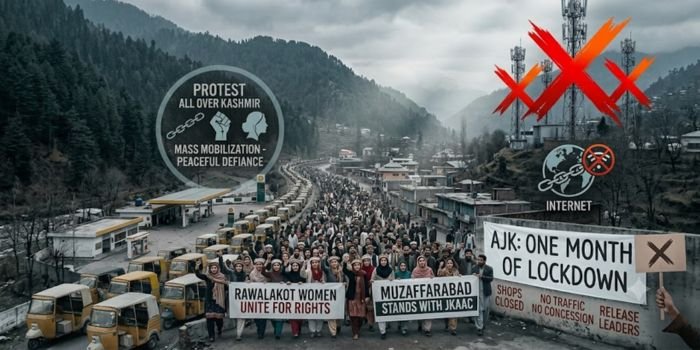
MUZAFFARABAD / RAWALA KOT: A wave of immense public mobilization has swept across Azad Jammu and Kashmir (AJK), as towns and cities ground to a near-total standstill following fresh calls for mass demonstrations. Defying stringent anti-terror designations, restrictions on public assembly, and a crippling month-long internet blackout, tens of thousands of citizens took to the streets to voice absolute solidarity with the proscribed Jammu Kashmir Joint Awami Action Committee (JKJAAC).
From the capital city of Muzaffarabad to the highlands of Poonch division, the message from the public was clear: structural reforms, constitutional rights, and the release of their leadership cannot be suppressed by state force.
A Regional Standstill: Shutter-Down and Wheel-Jam Strike
The call for renewed strikes received overwhelming structural backing from local transport unions, central trader alliances, and ordinary citizens.
- Closed Markets: Main commercial hubs, wholesale bazaars, and local neighborhood retail stalls remained tightly shut throughout the day. Glass storefronts and shuttered entrances lined the major avenues, reflecting deep economic sacrifice in pursuit of the movement’s demands.
- Paralyzed Traffic: Major intra-city transit paths and inter-district highways saw little to no commercial movement. Public buses, regional wagons, and local transport networks stayed completely off the grid. The ongoing state-enforced petrol pump closures further compounded the transport freeze, leaving only a scattering of private vehicles and pedestrians navigating the deserted asphalt.
Rawalakot’s Historic Mobilization: Women Lead the Frontlines
Rawalakot which has functioned as a central pulse point for the civil rights movement witnessed some of the largest and most socially diverse gatherings. In a historic turn of events, a massive contingent of women emerged as prominent public leaders of today’s rallies.
- Breaking Conventions: Breaking traditional regional conventions, hundreds of local women, housewives, and students marched shoulder-to-shoulder through the main public squares.
- The Message of Restraint: Holding placards demanding the immediate release of detained organizers like Shaukat Nawaz Mir, the female-led rallies emphasized peace, discipline, and unwavering resilience. Speakers at the women’s assemblies noted that families are bearing the heaviest brunt of the educational standstill and dry grocery lines, rendering active resistance a necessity for survival.
Muzaffarabad Gridlock: Standoff Near the Airport
In the regional capital, the focal point of today’s friction materialized near the Muzaffarabad Airport zone.
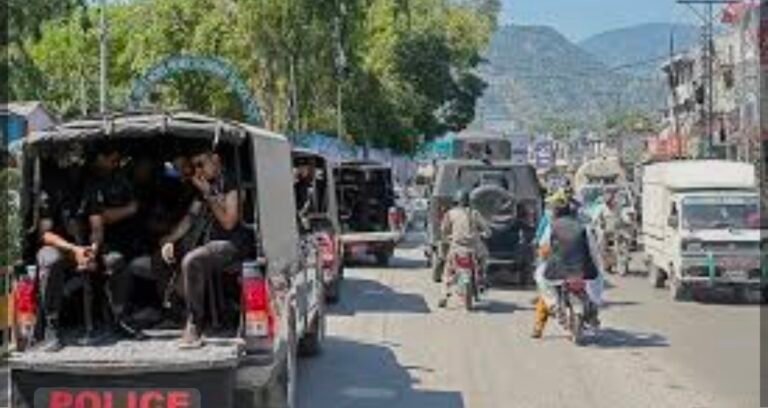
- Choke Points: Heavy contingents of armed law enforcement personnel and paramilitary units had established security pickets and containment barriers to prevent protestors from advancing toward central legislative assembly buildings.
- Peaceful Defiance: Thousands of demonstrators marching from outlying rural valleys converged near the airport perimeter, sitting down in peaceful defiance when met with state blockades. The resulting standoff completely choked off the northern transit veins of the capital, with protestors chanting slogans for administrative accountability, resource fairness, and the immediate restoration of the regional digital grid.
The Underlying Stumbling Block: Constitutional & Civic Fractures
While the immediate spark for today’s territory-wide shutter-down remains the mass arrest of civil leaders, the operational gridlock is tied directly to the JKJAAC’s 38-point charter of demands.
- The Refugee Seat Conflict: A deep political impasse remains over the 12 legislative assembly seats reserved for Jammu & Kashmir refugees living across Pakistan. The JAAC fiercely maintains that these seats are routinely manipulated by federal political parties to construct artificial regional governments, diluting local democratic representation.
- Subsidy Standoff: Despite state declarations that multiple points within the charter including wheat and electricity subsidies have been formally agreed upon, local organizers claim execution remains absent on the ground while their basic communication infrastructure continues to be treated as a weapon of war.
With solidarity rallies gaining ground and mainstream political alliances attempting to cross regional boundaries to join the sit-ins, the administration faces immense pressure. The complete public compliance with today’s strike proves that despite proscriptions and digital blackouts, the grassroots movement retains an iron grip on the region’s conscience.
About Author

Latest News!
 News07/31/2026Kashmir Solidarity Gathering: Mushtaq Ahmad Khan Leads Peace Rally at Islamabad’s F-10 Markaz
 News07/29/2026Stand for Azad Kashmir: Islami Jamiat-e-Talaba Stages Massive Protest Outside Islamabad Press Club
 Blog07/23/2026The Indian Legend Regarding the Discovery of Tea: Myth & History
 News07/18/2026AJK Polls: Bilawal Slams ‘Collective Punishment’ of Kashmiris, Vows to Bridge Islamabad-Muzaffarabad Divide