Peaceful Struggle Patience, Strategy, and Public Awareness Are the Path to Lasting Change
History demonstrates that enduring and meaningful change is achieved not through passion alone, but through patience, strategic thinking, organisation, and an informed, disciplined struggle. Emotions may inspire people in the short term, but movements reach their objectives through perseverance, unity, and responsible leadership.
The ongoing people’s rights movement in Pakistan-administered Jammu and Kashmir has entered a critical phase. It has witnessed the tragic loss of lives and immense human suffering, while also fostering a growing awareness among the people of their rights and collective strength. At this stage, the most important question is not how people feel, but what strategy is most likely to achieve lasting success.
In my view, peaceful sit-ins and sustained non-violent civic resistance remain the most effective course of action under the current circumstances. Emotional decisions may create temporary momentum, but they can also lead to consequences that weaken both the movement and the communities it seeks to represent. Young people are the movement’s greatest strength and its future. Protecting them, mentoring them, and enabling them to become informed and responsible participants in peaceful civic action is a collective responsibility.
When a movement loses one of its brightest young members, that individual is remembered with honour and their sacrifice becomes part of its history. Yet their direct contribution inevitably ends. By contrast, if that same person spends their lifetime mentoring ten capable, disciplined, and informed individuals, those ten may go on to educate and inspire hundreds or even thousands more. In this way, the vision of one individual can become the strength of an entire generation. This is the foundation upon which resilient and sustainable movements are built.
For that reason, young people should be encouraged not only to participate in peaceful demonstrations but also to develop leadership skills, organisational ability, dialogue, tolerance, research, and a commitment to public service. A generation capable of bringing positive change is not created overnight; it is shaped over many years through education, experience, and sustained civic engagement.
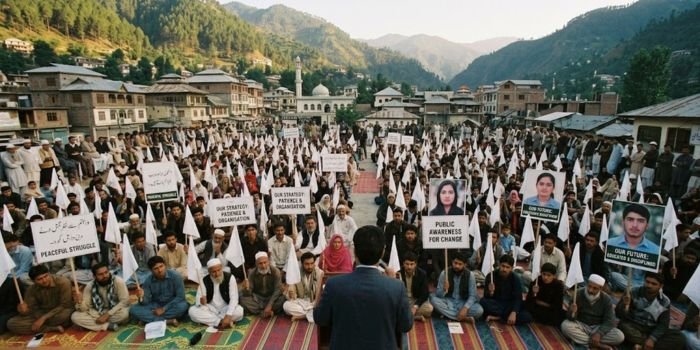
If the leadership of the Action Committee considers it appropriate, major protest camps could continue while peaceful sit-ins are expanded to cities, towns, villages, and neighbourhoods. Such an approach would strengthen community engagement, increase public awareness, and help sustain the movement over time. White flags, symbolising peace, discipline, and non-violence, could further reinforce the message that this struggle is dedicated to securing people’s rights and building a better future.
Every sit-in should become more than a place of protest. It should evolve into a public forum where people discuss constitutional rights, education, economic justice, community organisation, youth development, and public service. In doing so, peaceful gatherings can become lasting centres of civic education rather than temporary demonstrations.
We should also ask ourselves an important question: if millions of people were to sacrifice their lives in a single day, would that alone achieve the objectives of a movement? History suggests otherwise. Sacrifice gives a movement moral strength, but lasting success depends equally on those who remain alive to organise, educate, lead, and continue the struggle with wisdom and determination.
This movement, in my view, is not about hatred, revenge, or violence. It is about seeking a better future, justice, human dignity, and the protection of fundamental rights. Its greatest strength lies in moral credibility, public unity, peaceful civic resistance, and unwavering commitment to its principles.
Today, more than ever, we must choose strategy over impulse, unity over division, and patience over haste. If we succeed in nurturing an informed, organised, and responsible generation, it will not only advance the rights of deprived and marginalised people in the State of Jammu and Kashmir but may also stand as a voice for human dignity and justice wherever oppressed communities around the world seek peaceful change.
History has repeatedly shown that successful movements are built upon character, sacrifice, knowledge, organisation, and strategic vision. A peaceful struggle sustained with patience, discipline, and purpose is the path that leads societies towards a just, stable, and dignified future.
About Author

-
Khawaja Kabir Ahmed is a British/Belgian Kashmiri journalist who has been associated with the field of journalism since his educational days.
He holds a degree in journalism from the UK, is the Director News/Director Public Affairs and Anchorperson of the web TV channel Jammu Kashmir TV.
He writes on various topics in print journalism, focuses on the state of Jammu and Kashmir and is a promoter of fundamental human rights.
Latest News!
 Opinion09/21/2026Yasin Malik’s Case: A New Legal Turn and a Question for the Global Conscience
 Opinion09/15/2026After Balochistan, Pakistan-Administered Jammu Kashmir?
- Opinion09/14/2026Sanctions on Israel: A Major and Positive Step —But Why Not the Same for India and Pakistan?
 Opinion08/20/2026Changing U.S. Policy on Jammu and Kashmir And the Kashmiri People Caught Between Two Nuclear Powers