What Is the State? The People, the Territory and Sovereignty — or a Powerful Institution?
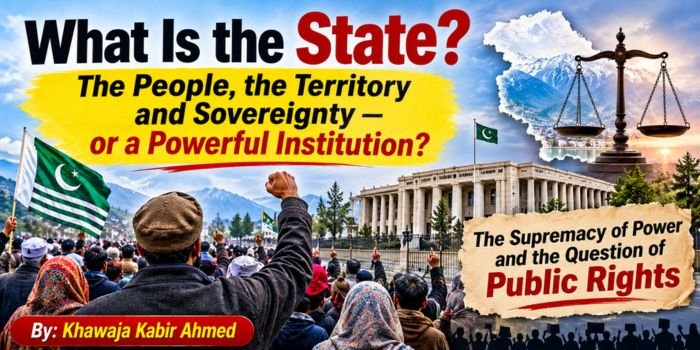
The Supremacy of Power in the Name of the State and the Question of Public Rights
By: Khawaja Kabir Ahmed
Throughout the political history of the world, the concept of the state has always held fundamental importance. A state is not the name of an individual, a family, a political party, a government, an army or any other powerful institution. Rather, it is a broader political, geographical, constitutional and legal entity founded upon territory, a permanent population, government and sovereignty. Nevertheless, in the political discourse of our region, a concept appears to be taking root in which the distinction between the state and a powerful institution is deliberately or unintentionally being erased. People are taught to stand with the state, yet when defining the state, instead of referring to its people, territory, constitution, law, political freedoms, sovereignty and collective rights, obedience to a powerful institution is presented as the standard of loyalty to the state.
The question is: Is this really what the state means? Can the power of an institution and its orders be regarded as the complete embodiment of the state? And does a citizen who questions the actions of that institution automatically become an opponent of the state?
To understand the fundamental definition of a state, it is first necessary to understand its four essential elements. The first is a defined geographical territory: the land upon which the state exists. The second is a permanent population: the people who inhabit that territory and whose collective existence forms the human foundation of the state. The third is government, which manages the administrative, political and legal affairs of the state. The fourth, and perhaps most important, is sovereignty, or supreme authority, which means that the state possesses the ultimate authority and capacity to make decisions concerning its internal and external affairs. In political science and international law, these four elements are recognised as the fundamental components of a state.
Nowhere in this definition does it state that the army is the state, that the police are the state, that intelligence agencies are the state, or that the orders of a single powerful institution constitute the state itself. The army, police, judiciary, parliament, administration and other public institutions are different components of the state structure. Each has its own defined jurisdiction, responsibilities and legal status. The primary responsibility of the military is the defence of the state; the police are responsible for maintaining public order and enforcing the law; the judiciary administers justice; parliament makes laws; and the government manages the affairs of the state. None of these institutions, individually, constitutes the entire state.
It is equally important to understand the distinction between the state and the government. The state is a permanent political and legal entity, whereas the government is the administrative and political system responsible for running it. Governments change through elections, constitutional changes or other political developments, but the state continues to exist. Similarly, the Urdu terms Riyasat and Mumlikat are generally used with the same meaning of a state. However, in the history of the Indian subcontinent, Riyasat (Princely State) was also a specific historical term used for territories governed by local rulers during the colonial era.
Another important consideration is that the administrative or military control of a territory by another country does not, in itself, erase that territory’s distinct historical or political identity. Likewise, declaring a territory a province or designating it as an administrative unit does not automatically settle questions concerning its historical, constitutional or legal status. Such questions require an examination of the relevant legal documents, constitutional arrangements, historical background and the political status of the people concerned.
This raises the question: If the concept of the state is so clear, why is a powerful institution presented as the state itself? The answer lies in the deliberate blurring of the distinction between the state and power. In political science, state power and the state are two separate concepts. The state is a broad political and legal entity, whereas state power refers to the authority exercised through various institutions within that state. When a powerful institution acquires extraordinary influence over political, administrative and decision-making processes, a tendency can emerge to present its power as the power of the state and its decisions as decisions of the state.
This is where a political narrative emerges in which loyalty to the state becomes synonymous with agreement with the policies of a particular institution. Questioning that institution’s decisions is portrayed as an attack on the state, disagreeing with its policies is presented as hostility towards the state, and demands for public rights are labelled anti-state activities. Consequently, the fundamental distinctions between the state, government, power and institutions become increasingly blurred.
In the political context of Pakistan, the role of the military establishment is a significant subject in this debate. Throughout Pakistan’s political history, the role of the military has not remained confined to defence matters. Its influence over political, administrative and decision-making affairs during different periods has been the subject of continuous debate. Even during periods of civilian democratic government, questions have repeatedly been raised about the political role of the military establishment, the autonomy of elected governments, parliamentary supremacy and military influence over national policies.
In April 2026, an academic paper by political scientist Aqil Shah, published in the Journal of Democracy under the title Pakistan’s New Military Tutelage, examined Pakistan’s political system as one in which, despite the existence of elected civilian governments, military leadership retains decisive influence over important political and security matters. Similarly, research published by the Carnegie Endowment in May 2026 examined the growing political and institutional dominance of military leadership in Pakistan, the weakness of civilian government and military influence over the decision-making process. This is not merely an allegation made by a political opponent; it is part of an international academic debate concerning Pakistan’s political and democratic system.
However, one fundamental question remains: Is it correct to identify the military establishment as the state? Can the military, instead of being the protector of the state, become its owner? Can the head of an institution or its orders be regarded as the collective will of an entire country? And is the only responsibility of the people to accept the decisions of a powerful institution under all circumstances, even when those decisions affect their fundamental rights, political freedoms, economic interests and democratic authority?
Protecting the state and protecting the power or policies of a particular institution are two entirely different matters. Protecting the state means protecting the lives, property, freedoms and rights of its people, as well as its territory, constitution, law and collective political existence. Treating an institution as being above its legally defined jurisdiction is not a requirement of the concept of the state. Institutions are not the owners of the state; they are bodies entrusted with responsibilities within the state, to be discharged in accordance with the law and the public interest.
In this context, the tendency to portray demands for public rights as opposition to the state also deserves serious consideration. In a democratic society, dissent, protest, criticism and questioning are fundamental elements of political life. Criticising a government’s policy does not mean being hostile towards the government. Questioning the actions of the military, police, judiciary or any other institution does not mean being an enemy of the entire state. Demanding ownership rights over one’s resources, political representation, basic facilities, justice and the right to self-governance does not, in itself, constitute rebellion against the state.
It must, however, also be made clear that violence, unlawful actions or violations of the fundamental rights of other citizens by any institution or individual cannot simply be described as freedom of expression or political disagreement. The distinction between peaceful protest and violence must always be maintained. If any individual or group within a movement engages in unlawful conduct, responsibility can be attributed to the individuals concerned on the basis of evidence. However, this cannot justify declaring an entire movement or all its supporters criminals. Similarly, the occurrence of violent incidents during a protest does not grant law enforcement agencies the authority to use unnecessary or disproportionate force.
The problem becomes even more serious when a powerful institution or group acquires the authority to decide who is patriotic, who is loyal to the state and who is anti-state. In such circumstances, the concept of the state begins to shrink from a shared public and constitutional entity into the narrative of a particular institution. People are told to stand with the state, yet when they speak about their rights, they are placed among those labelled opponents of the state. It is as though the definition of the state is one thing for the public and something entirely different for powerful institutions.
The state is not the personal property of any individual, family, government, political party or powerful institution. In a democratic system, the people are the source of political authority, while state institutions perform their duties under the constitution, the law and the public interest. According to this principle, institutions exist to serve the people; the people do not exist to serve institutions. Respect for institutions must be linked to their constitutional responsibilities, adherence to the law and protection of citizens’ fundamental rights, not to any supposed exemption from criticism and accountability.
When this entire issue is examined in the context of Pakistan-administered Jammu and Kashmir, its significance becomes even greater. Here too, it is essential to understand the distinction between the state, the government and powerful institutions. The historical, geographical and political identity of the State of Jammu and Kashmir remains a distinct reality. Questions concerning its people, territory, resources, political rights and future cannot be restricted to the perspective of a single administrative or powerful institution.
In Pakistan-administered Jammu and Kashmir, the public rights movement of recent years has highlighted a range of fundamental issues. These include the provision of affordable electricity at rates reflecting its actual generation cost, reduced flour prices, healthcare and educational facilities, interest-free loans for young people, reductions in official and government privileges, the elimination of corruption, political representation, powers for local government, the restoration of student unions, public control over resources and the right to self-governance.
The Jammu Kashmir Joint Awami Action Committee has brought these issues forward as collective public demands. This movement is not merely an activity of a single political party or electoral group. It has developed through the participation of different sections of society, including traders, students, lawyers, transport workers and ordinary citizens. Its demands must be examined in the context of their legal, constitutional, economic and human rights implications.
However, when public demands are met not through political negotiations, constitutional dialogue and administrative reforms, but through the use of force, arrests, restrictions and allegations of anti-state activities, the fundamental problem becomes even more complicated. It is possible to disagree with the demands of a public movement and to criticise its strategy. However, disagreements must be addressed through reason, law and political dialogue.
The events of 2026 in Pakistan-administered Jammu and Kashmir have transformed this debate into an extremely serious human rights issue. On 9 June 2026, Amnesty International expressed grave concern in its report over the designation of the Jammu Kashmir Joint Awami Action Committee as a proscribed organisation under anti-terrorism legislation, the suspension of internet and mobile services, mass arrests and the use of lethal force against protesters. The organisation described the action as raising serious concerns regarding the rights to freedom of association and peaceful assembly and called for independent investigations into the deaths.
On 17 July 2026, Jeremy Laurence, spokesperson for the Office of the United Nations High Commissioner for Human Rights, issued a statement in Geneva concerning the situation in Pakistan-administered Jammu and Kashmir. He stated that reports indicated that dozens of people, mostly protesters and some law enforcement personnel, had been killed since June. The UN High Commissioner for Human Rights called for prompt, comprehensive and impartial investigations into all deaths. He also expressed concern over the ban imposed on the Jammu Kashmir Joint Awami Action Committee, the arrests of its leaders, internet shutdowns and restrictions on the freedoms of peaceful assembly and expression.
On 21 August 2026, the International Bar Association’s Human Rights Institute expressed concern over the alleged use of disproportionate force against protesters, arrests, difficulties faced by journalists and human rights defenders, restrictions on freedom of movement and the shutdown of communication networks. The institute called for independent and impartial investigations into all deaths and allegations of unlawful use of force, respect for due process and the provision of an environment in which journalists could work freely.
Similarly, in a statement issued on 29 August 2026, the fact-finding mission of the Human Rights Commission of Pakistan stated that the causes of recent tensions in the region included a lack of trust in institutions, widespread restrictions on freedom of expression and communication, and the disproportionate use of force in the state response. The Commission also noted that different parties had presented conflicting accounts concerning the scale of violence, the methods of protest adopted by the Jammu Kashmir Joint Awami Action Committee and the role of security forces. Nevertheless, it observed that there was broad agreement that fundamental disputes should be resolved through political dialogue rather than force. The Commission called for independent investigations into all alleged deaths and injuries since June 2026 and for accountability to be established.
Taken together, these statements indicate that the situation in Pakistan-administered Jammu and Kashmir is no longer merely an administrative disagreement between a government and a protesting group. It now involves fundamental questions concerning human rights, civil liberties, the use of state power, political representation and public trust.
During this period, different figures have also emerged concerning the number of deaths. The Human Rights Situation Report No. 5, issued by the Jammu Kashmir Human Rights Observatory on 4 October 2026, contains a list of 90 individuals identified by name who reportedly died between 5 June and 22 September 2026. The report also made clear that the causes, circumstances and responsible parties in all these deaths cannot be assumed to be identical. Therefore, independent investigations into each incident are essential. Meanwhile, claims have also emerged that the overall death toll in the region has exceeded 100 and may have reached approximately 150. International investigative access and transparent investigations are indispensable for the complete and impartial verification of these figures.
Here, a particularly important question arises: If the state is the collective political and legal existence of its people, territory, constitutional and legal system, how can demands for public rights be described as opposition to the state? If a citizen demands affordable electricity, reasonably priced flour, quality education, better healthcare facilities, employment, control over local resources and political representation, does that make them an enemy of the state? If a citizen questions the actions of an institution, is it right to accuse them of disloyalty to the state?
There is a fundamental difference between criticising the policies of an institution and being hostile towards the state. Demanding public rights can, rather than weakening the state, serve as a means of making the state system accountable to the people. Demanding that state institutions answer for their actions in accordance with the law is neither unusual nor unlawful; it is a fundamental requirement of an organised and constitutional society.
Conversely, if people are made to believe that their only responsibility is to obey orders, not to ask questions; not to speak about their rights; not to demand control over their own resources; and that disagreeing with the decisions of a powerful institution amounts to hostility towards the state, how can a relationship of trust between the state and its people ever be established?
It must also be understood that the exercise of state power is subject to legal and constitutional limitations. The authority of any state institution to use force is not unlimited. Law enforcement agencies must exercise force in accordance with the principles of legality, necessity, proportionality and non-discrimination. Protecting the lives of citizens engaged in peaceful protest is a responsibility of the state. If any official or protester violates the law, responsibility must be established through evidence, independent investigations and judicial proceedings. Collective punishment, unlawful detention, enforced disappearance or the use of unnecessary force can never be a substitute for the state’s responsibilities.
Another fundamental question must also be raised: What exactly does protecting the state mean? Does it mean protecting only borders, government buildings and the power of institutions, or does it also include protecting the lives, dignity, freedoms, livelihoods, political rights, access to justice and fundamental human rights of the people? If people’s lives are not safe, their rights are not recognised, their voices are not heard and their elected representatives cannot make decisions independently, how can the collective concept of the state be considered complete?
The fundamental purpose of the state is to protect its citizens, guarantee their rights, uphold the rule of law and work for the collective good. The power of state institutions becomes meaningful and worthy of respect only when they perform their duties in accordance with the constitution and the law. Respect for an institution should not be based merely on its name or power, but on its lawful role, responsibilities, transparency and treatment of the public.
These same principles must also apply in Pakistan-administered Jammu and Kashmir. The rights of its people, their political identity, control over their resources and the question of their right to self-governance must be considered not from the perspective of a single powerful institution, but in the context of the collective interests of the people, their historical and political status and their fundamental rights. Rather than placing the people in opposition to the state, there is a need to restore trust between the people and the state. This requires dialogue, transparency, the rule of law and independent investigations instead of the use of force, accusations and restrictions.
Ultimately, one fundamental truth must be understood: the state is a permanent political and legal entity, whereas governments, institutional leaders, policies and centres of power change over time. The state is not the personal property of a powerful institution, nor can the orders of any institution become the complete definition of the state. Institutions are part of the state; the state is not their property. The people are the foundation of the state, not machines whose only function is to obey orders. The government administers the state; it does not own it. And loyalty to the state does not mean unconditional support for every decision made by an institution. It means respect for the constitution, the law, public rights, the territory and the collective interests of the people.
The state is formed by its people, operates through its institutions and is sustained under the constitution and the law. The power of an institution cannot become the definition of the state. Protecting the state cannot be separated from protecting the rights of its people.
If the people are recognised as part of the state, then their voices are also the voice of the state. Their questions are the collective questions of the state, and their rights are also the responsibility of the state. Before branding those who demand public rights as opponents of the state, we must first consider one fundamental question:
Whom does the state ultimately exist to serve — the people, or those who seek to rule over them?
About Author

-
Khawaja Kabir Ahmed is a British/Belgian Kashmiri journalist who has been associated with the field of journalism since his educational days.
He holds a degree in journalism from the UK, is the Director News/Director Public Affairs and Anchorperson of the web TV channel Jammu Kashmir TV.
He writes on various topics in print journalism, focuses on the state of Jammu and Kashmir and is a promoter of fundamental human rights.
Latest News!
 Opinion11/23/2026What Is the State? The People, the Territory and Sovereignty — or a Powerful Institution?
 Opinion11/21/2026Bloodshed in Pakistan-Administered Jammu and Kashmir: Civilians and Allegedly Its Own Personnel Killed — Why Fear Independent International Investigations?
 Opinion11/18/2026Three and a Half Years of a People’s Movement, Questions Raised a Year Ago, and a People Paying the Price for Their Sacrifices
 Opinion11/10/2026From the War Balloons of 1849 to Armed Drones of 2026 — The Evolution of Military Technology, the Iran–Israel War, and a New Chapter of Drone Attacks Against Unarmed Civilians in the Pakistani-Administered State of Jammu and Kashmir