From the War Balloons of 1849 to Armed Drones of 2026 — The Evolution of Military Technology, the Iran–Israel War, and a New Chapter of Drone Attacks Against Unarmed Civilians in the Pakistani-Administered State of Jammu and Kashmir
Throughout human history, the nature of warfare has continuously evolved. Swords, spears, bows and arrows were once the principal weapons of war. They were followed by gunpowder, artillery, firearms, tanks, fighter aircraft, missiles and nuclear weapons. Advances in science and technology have transformed warfare from the battlefield on the ground to the skies, from the skies to outer space, and now towards automated and remotely operated systems that no longer require a human presence at the point of attack. An operator sitting thousands of miles away can observe, identify and target an object or individual in another country or territory. One of the most significant and rapidly developing weapons of this modern military technology is the drone, which has fundamentally transformed the nature, strategy and understanding of human protection in twenty-first-century warfare.
A drone is no longer merely a flying camera or a surveillance device. It has become an advanced military weapon used for surveillance, intelligence gathering, identifying military targets, overwhelming air defence systems, supporting missile strikes and carrying out direct destructive attacks. Perhaps its most alarming characteristic is that military personnel operating it do not necessarily have to be present on the battlefield or put their own lives at risk. An individual sitting in a secure room can participate in decisions concerning the life and death of people thousands of miles away, simply by looking at a screen.
However, the history of this technology did not begin with the 2026 war involving Iran, Israel and the United States. Its origins go back almost two centuries.
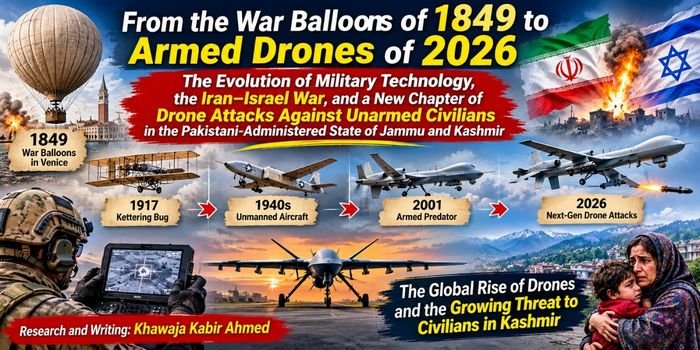
One of the earliest examples in the history of drones dates back to 1849, when Austrian forces attempted to use unmanned balloons carrying explosive material during the siege of Venice in Italy. These were not modern drones in the contemporary sense, but they represented an early experiment in using an unmanned aerial platform to deliver explosives against an enemy.
During the First World War, serious efforts began to develop unmanned aircraft as weapons. In 1917, American engineer Charles F. Kettering, working with the support of the United States Army, developed an unmanned aircraft known as the Kettering Bug, or Kettering Aerial Torpedo. Its purpose was to carry explosives and attack enemy positions. It was an experimental weapon capable of following a predetermined flight path over a specified distance. However, technical difficulties and the end of the war meant that it was never deployed in actual combat.
The United States Navy also worked on the development of unmanned aerial torpedoes. On 6 March 1918, an unmanned aerial torpedo developed by Curtiss successfully completed an automated flight along a predetermined course. This was an important milestone in the history of modern unmanned aerial systems.
Thus, the fundamental military concept behind drone technology was, from the very beginning, to develop an aerial weapon capable of conducting operations against an enemy without a human pilot on board.
During the Second World War, the United States, Germany and other countries made considerable progress in developing and using unmanned aircraft. The United States produced aircraft such as the Radioplane OQ-2 on a large scale, primarily for training air defence personnel and target practice. Germany’s V-1 was an automatically guided flying cruise missile, frequently mentioned in discussions of the modern military history of drones, although technically it should be distinguished from conventional remotely controlled drones.
After the war, during the Cold War, the United States and the Soviet Union continued advancing unmanned aircraft technology. During this period, drones increasingly came to be used for intelligence gathering, photographing enemy military installations, assessing the capabilities of air defence systems and monitoring sensitive areas.
During the Vietnam War, American forces used unmanned aircraft such as the Ryan Firebee for reconnaissance and surveillance. This represented an important development, as drones were no longer merely experimental weapons; they had become an established means of gathering military intelligence.
The 1973 Arab–Israeli War gave drones a new level of military significance. Israel used unmanned aircraft to deceive enemy air defence systems, activate their radar installations and create opportunities for its fighter aircraft to carry out attacks.
Under this strategy, drones were presented as aerial targets to force the enemy to activate and expend its air defence missiles. This helped Israeli forces identify the locations and capabilities of enemy defence systems. Following these experiences, Israel further developed its domestic drone industry and produced systems such as the Scout reconnaissance drone and the Mastiff.
During the 1982 Lebanon War, Israel deployed drones extensively against Syria’s air defence systems. These drones played an important role in activating enemy radar, conducting aerial surveillance, monitoring the movements of military aircraft and planning attacks.
This was the stage at which drones began to emerge as a regular and effective component of modern aerial warfare.
At the beginning of the twenty-first century, the United States decided to arm the Predator drone. Previously, it had primarily been used for reconnaissance and surveillance. On 16 February 2001, the United States Air Force successfully test-fired a Hellfire missile from a Predator drone. Subsequently, in October 2001, it fired a missile during an operational combat mission in Afghanistan.
This marked a decisive turning point in the development of modern armed drone warfare.
A pilot no longer needed to enter enemy territory. A drone could be launched from a distant military base, remain airborne for several hours or longer while monitoring an area, and fire a missile after identifying its intended target.
On 3 November 2002, the US Central Intelligence Agency (CIA) used a Predator drone to target a vehicle in Yemen. Six people were killed in the attack, including al-Qaeda leader Qaed Salim Sinan al-Harethi. The incident triggered an international debate over targeted killings by drones outside conventional battlefields and the legality of such operations.
After 2010, drone technology advanced further. New types of drones began to emerge, carrying explosives to their targets and destroying themselves upon impact. These are known as One-Way Attack Drones or Loitering Munitions.
Iran’s Shahed-136 is a prominent example. It is a relatively low-cost, long-range attack drone that can be deployed against enemy military installations, energy infrastructure and other strategic targets. In addition, small First-Person View (FPV) drones became part of modern warfare. These are controlled by operators who view live camera footage transmitted directly from the drone. Such small drones began to be used against military vehicles, tanks, trenches and other targets.
This technology is no longer confined to major military powers. Countries with relatively limited resources and armed groups can now acquire the capability to conduct attacks using drones that previously would have required expensive fighter aircraft and substantial military resources.
The 2020 war between Azerbaijan and Armenia over Nagorno-Karabakh brought the importance of modern drone warfare to international attention. Azerbaijan deployed various unmanned aircraft, including the Turkish-made Bayraktar TB2. These drones played an important role in identifying and attacking enemy military vehicles, artillery, defence systems and other military targets. The conflict demonstrated to military establishments around the world that modern drones could fundamentally alter the balance of power on the battlefield.
The war between Russia and Ukraine, which began in February 2022, took drone technology to another level. Both countries deployed different types of drones for surveillance, artillery targeting, identifying military objectives, long-range attacks and direct destructive operations. Russia used Geran drones, based on designs similar to Iran’s Shahed drones, to target Ukrainian cities and critical infrastructure. Ukraine also deployed domestically developed small FPV drones and long-range unmanned aircraft in its military operations.
The large-scale production and deployment of drones during this war transformed the speed and nature of modern warfare. A drone is no longer merely an instrument supporting a major military offensive. In some circumstances, it can influence military movements, logistics, defence and offensive strategies across an entire front line.
During the night of 13–14 April 2024, Iran launched hundreds of drones and missiles towards Israel. The attack involved different types of unmanned aircraft, including Shahed drones, as well as cruise and ballistic missiles. Israel, the United States and their allies deployed air defence systems to intercept the incoming attacks. This event was historically significant because Iran launched such a large-scale drone and missile assault directly from its own territory towards Israel for the first time.
The world witnessed that drones were no longer weapons limited to targeting individual objectives; they could also play a significant role in large-scale aerial military operations.
On 28 February 2026, the United States and Israel launched large-scale airstrikes against Iran. In response, Iran carried out missile and drone attacks against Israel, American military bases and other targets across the region. The confrontation continued for several weeks. A ceasefire was announced on 8 April, but tensions, attacks and allegations of ceasefire violations between the parties did not come to an end. In June, a memorandum of understanding between the United States and Iran also emerged. However, following its collapse in August, reports of renewed limited attacks and military escalation surfaced.
The use of drones during this war attracted international attention because Iran employed relatively inexpensive Shahed drones to place pressure on expensive air defence systems. On the other side, the United States also deployed low-cost LUCAS attack drones in operational missions. Their concept was influenced by Iranian Shahed-type drones. This represented an unusual historical development. Even the United States, one of the world’s most powerful military forces, was now incorporating relatively inexpensive attack drones into its military strategy.
On 6 November 2026, claims also emerged from Iran that it had shot down an American MQ-1 unmanned military aircraft. However, no immediate confirmation of this claim was issued by American officials. The incident is indicative of the fact that drones are no longer merely supporting aerial equipment; they have become a permanent and significant front in modern warfare. The confrontation involving Iran, Israel and the United States has attracted extraordinary international media attention to drone warfare. However, it is important to understand that the history of drone attacks stretches back several decades before this conflict. The war has simply brought the global significance and destructive potential of this technology into sharper focus.
In various wars around the world, drones have been used to target military objectives, defence installations and the military capabilities of opposing forces. However, when the same technology is allegedly deployed against civilians who are not participating in any war, have no affiliation with any armed group and are engaged in peaceful protests for their fundamental rights, the matter assumes an entirely different legal and humanitarian dimension.
Even on a battlefield, the use of drones is not unconditionally lawful. International Humanitarian Law requires a distinction between civilians and combatants, proportionality in the use of force and all feasible precautions to protect civilian populations. Deliberately targeting civilians and carrying out indiscriminate attacks are prohibited.
A clarification document issued by the International Committee of the Red Cross (ICRC) on 10 December 2025 also makes clear that armed drones are not inherently prohibited weapons. However, their use is subject to the same legal restrictions that apply to attacks carried out by fighter aircraft or helicopters. This is why the fundamental legal question surrounding drone technology does not concern its existence, but rather its use, the selection of targets, the circumstances of an attack and its consequences for human life.
Against the background of this entire history, it is now necessary to turn to the Pakistani-administered State of Jammu and Kashmir.
It is fundamentally important to understand that the State of Jammu and Kashmir is not Pakistan. Pakistan is a separate and internationally recognised sovereign state, whereas the State of Jammu and Kashmir is a distinct historical and disputed territory whose ultimate political future remains unresolved.
The geographical unity of the State of Jammu and Kashmir includes both territories under Pakistan’s administrative control: Azad Jammu and Kashmir and Gilgit-Baltistan. Other parts of the state remain under the control of India and China.
Paragraph 141 of the United Nations Office of the High Commissioner for Human Rights (OHCHR) report on Kashmir, dated 14 June 2018, states that Pakistan-administered Kashmir consists of two administrative regions: Azad Jammu and Kashmir and Gilgit-Baltistan. The report also explains that both regions are considered part of the disputed State of Jammu and Kashmir and have not been formally incorporated into Pakistan.
Article 257 of the Constitution of Pakistan also makes the future relationship with the State of Jammu and Kashmir conditional upon the wishes of its people.
Therefore, Pakistan’s administrative control over these territories does not extinguish the distinct historical and disputed status of the State of Jammu and Kashmir, nor does it negate the right of its people to self-determination.
United Nations Security Council Resolution 47, dated 21 April 1948, is also important in this historical context. The resolution called upon Pakistan to secure the withdrawal of non-local tribesmen and Pakistani nationals who had entered the state, to prevent further intervention and to take steps towards restoring peace and order. The resolution also referred to the right of the people of the state to express their free will and determine their political future.
For this reason, the people of the Pakistani-administered State of Jammu and Kashmir cannot simply be treated as an ordinary provincial population of Pakistan while their distinct political, historical and international legal identity is ignored.
Pakistan exercises administrative authority over these territories, but that authority also carries responsibilities. The fundamental humanitarian obligation is to protect the lives, property, dignity, basic needs and human rights of the people living there.
It is essential to understand the fundamental demands of the public rights movement currently underway in the Pakistani-administered State of Jammu and Kashmir under the leadership of the Jammu Kashmir Joint Awami Action Committee.
These demands are not calls for an attack on another country, the occupation of territory, the destruction of military installations or armed operations.
They are demands for the fundamental necessities of life.
People are demanding better hospitals equipped with modern medical facilities. They want access to facilities such as MRI (Magnetic Resonance Imaging) and CT Scans (Computed Tomography Scans), so that patients do not have to travel to other cities to receive treatment. They are demanding quality education, better schools and colleges, a uniform education system, a common curriculum and a brighter future for their children.
They want better roads, improved infrastructure, clean drinking water, employment opportunities and facilities that can make the lives of ordinary people safer and more dignified.
They want a fair local share and appropriate pricing for electricity generated from their water resources. Their position is that electricity produced from their natural resources is supplied to other regions, while they themselves are denied electricity at affordable rates that meet their needs.
They want affordable flour, cheaper food and reasonable prices for essential commodities.
They are demanding control over their resources, the right to ownership, the right to governance and genuine public participation in decisions concerning their political and economic future.
These demands are not the manifesto of an armed rebellion. They are the voice of a population seeking its rights over natural resources, basic public services and human dignity.
Men, women, elderly people, young people and students are participating in this movement. Mothers sit at protest camps holding their infants in their arms. Some women are participating in protests with babies as young as two months old. These are not scenes from a military battlefield; they reflect the collective deprivation of a society and its struggle for public rights.
It is against this background that the events of 5 November 2026 in Rawalakot have raised an extremely serious humanitarian and international legal question.
For several months, supporters of the public rights movement had been holding sit-ins at Umar Farooq Chowk, the Matial Mera Bus Terminal and other protest locations in Rawalakot. Their demand was that commitments made under the Public Rights Charter be implemented and that the government engage in serious negotiations to resolve public grievances.
On the morning of 5 November, reports emerged of an operation involving the Pakistan Rangers, the Frontier Corps and local police. According to local media reports and allegations made by the Jammu Kashmir Joint Awami Action Committee, the operation involved firing, heavy weapons, explosive materials and alleged drone attacks. On the other hand, different claims have also emerged from the police and official authorities regarding the operation, all of which require independent verification.
Reports of civilian deaths and injuries emerged following the incident. Initial reports mentioned the deaths of at least three civilians and injuries to 18 others. These figures and the full circumstances of the incident still require comprehensive official and independent verification.
Sardar Umar Nazir, a leader of the Jammu Kashmir Joint Awami Action Committee, presented fragments of explosive material reportedly recovered following the alleged drone attacks before the media. He also levelled allegations that residential buildings and protest locations had been targeted.
All these allegations are extremely serious in nature. Independent forensic investigations are essential to establish which weapons were used, where the attacks took place, which institution operated the drones and the extent of the damage caused to civilian lives and property.
The question here is not simply what type of drone was involved or which weapon was mounted on it. The fundamental question is this: if any state force used armed drones to deliberately target peaceful protesters, their homes or residential areas, what was the legal justification for such an operation?
Under international law, the protection of civilian life is of fundamental importance. If a situation meets the legal definition of an international or non-international armed conflict, the Geneva Conventions and International Humanitarian Law prohibit the deliberate targeting of civilians, indiscriminate attacks and the use of disproportionate force.
However, an important legal distinction must also be understood. A public protest or state crackdown cannot automatically be classified as an armed conflict simply because military personnel, rockets or drones have been deployed. To establish a war crime, the existence of an armed conflict and all the relevant legal elements of the alleged offence must be proven. Nevertheless, if the incident constitutes the unlawful use of state force against peaceful civilians, it can still be examined under international human rights law.
According to the United Nations Basic Principles on the Use of Force and Firearms, the use of force during peaceful assemblies should be avoided as far as possible. If an assembly is unlawful but non-violent, the use of force must be kept to the minimum necessary extent. The use of firearms is subject to particularly strict conditions and is permissible only in circumstances where it is strictly necessary to protect life.
According to General Comment No. 36 of the United Nations Human Rights Committee, the right to life is a fundamental right from which no derogation is permitted, even during armed conflicts and states of emergency.
Similarly, if evidence establishes that attacks against a civilian population were widespread or systematic and the other relevant legal elements are present, the question of crimes against humanity may also arise.
Therefore, the nature of the alleged drone attacks in Rawalakot, their targets, civilian casualties and the identification of those responsible must be established through independent investigations. Even if the situation does not meet the legal definition of an armed conflict, accountability remains essential for unlawful lethal force against civilians, violations of the right to life and other serious human rights violations.
The question of Pakistan’s responsibility also emerges with considerable urgency. The people of the Pakistani-administered State of Jammu and Kashmir are not a civilian population living in a province of Pakistan. They are inhabitants of territories belonging to a disputed state over which Pakistan exercises administrative control. Both Gilgit-Baltistan and Azad Jammu and Kashmir form part of this administrative context.
Pakistan has an administrative responsibility towards the people of these territories. They need access to essential services, medical assistance, education, infrastructure, food, electricity and the protection of their human dignity.
If a government or administration fails to provide these facilities, the people have the right to ask questions, protest, demand control over their resources and collectively raise their voices for their rights.
No government or administration has the right to treat those demanding basic necessities as enemies, rebels or combatants and deploy military force against them on that basis.
A bitter contradiction becomes apparent here. On the one hand, people are demanding schools for their children, hospitals for the sick, MRI and CT Scan facilities for medical treatment, affordable electricity for their homes and cheaper flour for their households. On the other hand, there are reports and allegations that advanced weapons, previously associated with destruction in major international wars, have allegedly been used against them. This contradiction is not merely political; it is fundamentally a humanitarian and moral question.
The operator of a drone may be sitting far away, but the consequences of that operator’s decisions are borne by human beings.
One of the most frightening aspects of modern drone warfare is that the person carrying out an attack does not need to be physically close to the target. There is a screen in front of them. On that screen, they see a location, a building, a vehicle or an individual. Then, with the press of a button, an explosion, fire and death can follow.
But on the other side of that screen are human beings. A father may be sitting at home with his children. A mother may be breastfeeding her infant. A sick person may be waiting for medical treatment. A young person may be participating in a protest sit-in for a better future.
Technological advancement cannot diminish the value of human life. Drone operators, their commanders, the relevant institutions and the officials responsible for making operational decisions cannot be placed beyond accountability.
If the allegations of armed drone attacks in Rawalakot are proven, it will also be essential to establish who operated the drones, under whose orders they were deployed, which weapons were mounted on them, what targets were selected and whether information about the presence of civilians was obtained before the attacks.
For this purpose, it is essential to preserve drone flight records, operational orders, weapons issuance records, debris recovered from the scenes, forensic reports of explosive materials, hospital records, post-mortem reports and statements from eyewitnesses.
Today, the world is witnessing the devastating consequences of drone attacks, missiles and advanced military weapons in Ukraine, Gaza, Iran, Israel and other conflict zones across the Middle East. The United Nations, human rights institutions, international media and humanitarian organisations are speaking about the protection of civilians, investigations into war crimes and accountability for those responsible.
But civilians in the Pakistani-administered State of Jammu and Kashmir are equally entitled to that protection.
Their lives are no less valuable than those of citizens in any other country. The future of their children is no less important than that of children in any other region. Their homes, hospitals, schools and human lives deserve exactly the same protection as those of people living anywhere else in the world.
The international community must understand that while the dispute over the State of Jammu and Kashmir remains unresolved, the fundamental human rights of its people cannot be suspended until a political settlement is reached.
The United Nations human rights bodies, OHCHR, the Human Rights Council, Amnesty International, Human Rights Watch, the International Committee of the Red Cross and international media organisations must take the events in Rawalakot seriously.
Pakistani authorities must be called upon to immediately stop any unlawful military operations against civilians, ensure unhindered medical treatment for all those injured, release transparent information about detained individuals, grant access to independent journalists and human rights observers, preserve all relevant evidence and permit independent international investigations.
Investigations must also establish whether drone attacks took place, what types of weapons were used, whether civilians were deliberately targeted and, if violations are established, how the personnel, commanders and officials who ordered the operations will be held accountable.
This is the time for the world to act to restrain Pakistan and ensure that civilians in Pakistani-administered Jammu and Kashmir are not left at the mercy of weapons of war!
The concept of unmanned aerial attacks, which began with military balloons in 1849, has now evolved into artificial intelligence, advanced satellite systems, automated target recognition, long-range missile-carrying drones and kamikaze aerial weapons. The world has witnessed this technology being deployed in major wars. The recent confrontation involving Iran, Israel and the United States has further highlighted its destructive potential. But what could be more alarming for humanity than the possibility that this same military technology is now being used, according to allegations, against a population that is not part of any international war, whose people are not carrying guns but demanding their rights, where men, women, elderly people and young people are sitting in protest camps for the better future of their children, where mothers are participating in demonstrations with their two-month-old infants in their arms, and where people are demanding modern hospitals, MRI and CT Scan facilities, quality education, better roads, affordable electricity, cheaper flour and control over their natural resources?
These people have not taken to the streets to attack another country. They have not come to fight an enemy on a military front. They are engaged in a peaceful struggle to improve their lives and secure their fundamental human rights.
The State of Jammu and Kashmir is not Pakistan. Pakistan exercises administrative control over parts of this disputed state, namely Azad Jammu and Kashmir and Gilgit-Baltistan, and that authority carries with it the responsibility to protect the lives, property, human dignity and basic facilities of the people living there.
However, if instead of providing these people with essential services, allegations that drones from the air, rockets from the ground and heavy military weapons are being used against them prove to be true, this would not merely be a political dispute. It would represent a serious test for the conscience of humanity, international law and the global human rights system.
The world must ask: why is an administration responsible for providing essential services to its people allegedly deploying weapons that put their lives at risk? Should those demanding hospitals be met with missiles? Should children whose families are demanding education be forced to live under the threat of drone attacks on their homes? Can unarmed civilians demanding control over their electricity, water, land and natural resources be silenced through military force?
We appeal to the United Nations, international human rights organisations, the European Union, the United Kingdom, the United States, Canada, international media and all democratic countries around the world to take immediate and effective action to protect unarmed civilians in the Pakistani-administered State of Jammu and Kashmir. Diplomatic and international pressure must be brought to bear on Pakistan to ensure that it refrains from using any form of unlawful lethal force, rockets, heavy weapons or armed drones against the peaceful public rights movement.
Independent, impartial and internationally credible investigations must be conducted into the events in Rawalakot from 5 June 2026 to the present. Evidence relating to the alleged drone attacks must be preserved, all civilian deaths must be thoroughly investigated and those responsible must be brought to justice.
Pakistan must remember that its administrative authority over these territories of the State of Jammu and Kashmir carries a responsibility to provide the people with the necessities of life. It does not give it the authority to take their lives.
The world must act to restrain Pakistan. Those demanding hospitals, education, electricity, bread, control over their resources and the right to govern themselves must be provided with the necessities of life, not death from the skies. The unarmed civilians of this region, their children and their mothers must not be left at the mercy of military drones.
To remain silent now would be tantamount to abandoning the conscience of humanity.
About Author

-
Khawaja Kabir Ahmed is a British/Belgian Kashmiri journalist who has been associated with the field of journalism since his educational days.
He holds a degree in journalism from the UK, is the Director News/Director Public Affairs and Anchorperson of the web TV channel Jammu Kashmir TV.
He writes on various topics in print journalism, focuses on the state of Jammu and Kashmir and is a promoter of fundamental human rights.
Latest News!
- Opinion11/10/2026From the War Balloons of 1849 to Armed Drones of 2026 — The Evolution of Military Technology, the Iran–Israel War, and a New Chapter of Drone Attacks Against Unarmed Civilians in the Pakistani-Administered State of Jammu and Kashmir
 Opinion11/07/2026From Rawalakot to the Entire State of Jammu and Kashmir — The Struggle for Public Rights, Geographical Unity and the Expanding Reach of the Movement!
 Opinion10/31/2026From the Assembly to the Ministries: Who Will Answer for the People’s Lives and Future?
 Opinion10/23/2026The People’s Rights Movement, Overseas Kashmiris and Visits by Political Figures: A Serious Wake-Up Call!