From Rawalakot to the Entire State of Jammu and Kashmir — The Struggle for Public Rights, Geographical Unity and the Expanding Reach of the Movement!
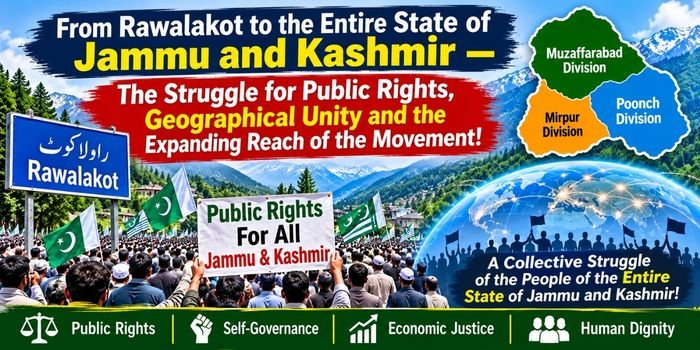
The attempt to portray Rawalakot or the Poonch Division as isolated within the Public Rights Movement is, in fact, a government and institutional narrative. Its purpose is to confine a state-wide public movement to a particular city or division and, as has happened in the past, once again create regional divisions among a united people. Some individuals, through a lack of understanding, are advancing this very narrative and treating it as reality in their writings and statements. They need to step outside the confines of this propaganda, observe the situation on the ground and understand the facts.
First and foremost, it is essential to understand the fundamental reality that the public gathering in Rawalakot is not a sit-in intended to remain confined to Rawalakot or Poonch alone. It is, in fact, a staging point for the public march towards Muzaffarabad, which was scheduled to depart for Muzaffarabad on 9 June. However, before that, on 5 June, members of the Core Committee of the Jammu Kashmir Joint Awami Action Committee were targeted by Pakistani forces. One Core Committee member, Umar Nazir Kashmiri, was injured, while his companion, Shazib Habib, was martyred. Following this incident and the circumstances that emerged afterwards, the march was halted and the Joint Awami Action Committee continued its encampment in Rawalakot. During this period, the chests of more than one hundred movement activists were riddled with bullets as Pakistani forces used weapons of war against them. This encampment continues until the next phase of the march, which could move towards Muzaffarabad at any time.
Therefore, describing the gathering in Rawalakot merely as a local sit-in, or viewing it as confined to the Poonch Division, amounts to ignoring fundamental facts. The reality is that people from the Mirpur and Poonch divisions have been present there from the very beginning, while the Muzaffarabad Division has also maintained a continuous representation. The participation of people from all three divisions demonstrates that this struggle is a collective struggle of the people of the entire state entity.
A look at the geography of the state makes it even clearer that Rawalakot is not situated on an island, nor is the Poonch Division disconnected from the rest of the state. The three divisions of the state entity under Pakistan’s administration — Muzaffarabad, Poonch and Mirpur — along with all their districts, are connected by the same common question of public rights. And Poonch is currently the centre of this movement.
Athmuqam, Sharda, Kel and Taobat in the Neelum Valley; Chakothi and Leepa in the Jhelum Valley; the border areas of Muzaffarabad; Forward Kahuta in Haveli; Hajira, Abbaspur and Tatrinote in Poonch; Pallandri and Tarar Khel in Sudhnoti; Dhirkot and other areas of Bagh; Mirpur and Dadyal; Nakyal, Khoi Ratta and Charhoi in Kotli; and Samahni and Barnala in Bhimber are all part of the geography and collective identity of the State of Jammu and Kashmir under Pakistan’s administration. The problems, rights and future of the people living in these areas are interconnected. The problems, sacrifices and rights of the people living there are just as important as those of the people of Rawalakot, Muzaffarabad or Mirpur.
(A fundamental point needs to be understood here: the border areas of this state entity are not the outermost limits of the entire State of Jammu and Kashmir; rather, they are important parts of its geographical unity. Since it is necessary to examine those areas of the State of Jammu and Kashmir that are now under different administrative controls in order to understand its complete geographical unity, it is important to consider the following. The Indian-administered parts of the State comprise Jammu and Kashmir and Ladakh. The southern region of Jammu and Kashmir adjoins the Indian state of Punjab, particularly Gurdaspur District, and Himachal Pradesh, where areas such as Kathua, Lakhanpur, Hiranagar, Ghagwal, Basohli and Billawar are located. In addition, the eastern and north-eastern region of the historic State of Jammu and Kashmir, Ladakh, adjoins Himachal Pradesh, China’s administered regions of Xinjiang and Tibet, while its western side adjoins areas under Pakistan’s administration.
Similarly, Gilgit-Baltistan is an important part of the northern geography of the State of Jammu and Kashmir. To its north and north-west lies Afghanistan’s Wakhan Corridor; to the north-east and east lies China’s Xinjiang region; to the south and south-east lie the Indian-administered areas of Ladakh; to the west lies Khyber Pakhtunkhwa; and to the south-west lies the State of Jammu and Kashmir under Pakistan’s administration. Geographical locations such as Khunjerab, Shimshal, Kilik, Mintaka and Wakhan highlight the international geographical significance of this region. All these areas are important for understanding the wider geographical context of the historic State of Jammu and Kashmir. Therefore, rather than viewing any one part of the state in isolation, it is necessary to consider its complete historical and geographical context.)
Now, let us return to the Public Rights Movement currently underway in Jammu and Kashmir under Pakistan’s administration.
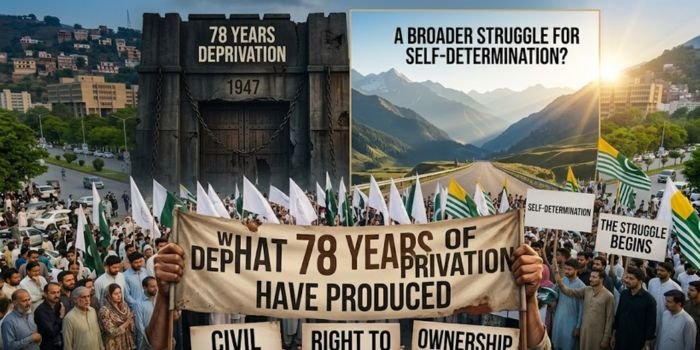
This movement is not fighting for regional supremacy, the monopoly of any district, or the dominance of any particular geographical identity. It is a collective struggle for the right to ownership, the right to self-governance, economic justice, human dignity and public rights. Its demands concern the people of every area of this state entity, whether they live in the difficult valleys of Neelum, the mountains of Leepa, the border areas of Hajira and Abbaspur, Bagh and Sudhnoti, Mirpur and Dadyal, Kotli and Nakyal, or Bhimber and Samahni.
The attempt to portray this movement as confined to Poonch is, in reality, an attempt to diminish its state-wide public character. Some individuals are advancing this narrative through a lack of understanding, but they must realise that repeating propaganda again and again does not turn it into reality.
Those who still believe that this movement has become confined to Poonch or Rawalakot alone should observe the situation around them. They should listen to the voices emerging from their surroundings and also take notice of the voices being raised from different parts of the world. This movement is no longer confined to the territory of the State of Jammu and Kashmir under Pakistan’s administration; it has now reached every corner of the world.
People from the State of Jammu and Kashmir living in Britain, Europe, the United States, Canada, the Middle East and other parts of the world are expressing their affiliation with and solidarity for this movement. Regardless of which part of the state, division, district, city or village they belong to, they stand in support of this struggle for public rights. Geographical distances have not prevented them from remaining connected with this movement. Alongside the people present in Rawalakot, those raising their voices in different countries around the world are also part of this same struggle.
Therefore, everyone should understand and communicate this reality to others: people from every area, every region, every district, every city and every village of the State of Jammu and Kashmir under Pakistan’s administration are participating in this movement in one way or another. This is not a movement belonging to one city or division; it is a collective struggle for the fundamental rights of the people of the entire state.
Those attempting to portray Rawalakot as isolated should observe the situation on the ground rather than follow the government and institutional narrative. They should look at the gathering in Rawalakot, understand the representation of all three divisions and listen to the voices of Kashmiris spread across the world. The public, too, should verify the situation on the ground before accepting any news, claim or commentary as fact. Rather than circulating hearsay, checking the facts is the responsibility of every conscious citizen.
Rawalakot is not isolated, Poonch is not isolated, and the struggle for public rights is not isolated either. Rawalakot is the staging point of this movement and this Public Rights March, not the boundary of the movement. This is not a struggle for Poonch alone; it is a struggle for the rights of every individual in the State of Jammu and Kashmir under Pakistan’s administration, and its voice has now reached every corner of the world.
About Author

-
Khawaja Kabir Ahmed is a British/Belgian Kashmiri journalist who has been associated with the field of journalism since his educational days.
He holds a degree in journalism from the UK, is the Director News/Director Public Affairs and Anchorperson of the web TV channel Jammu Kashmir TV.
He writes on various topics in print journalism, focuses on the state of Jammu and Kashmir and is a promoter of fundamental human rights.
Latest News!
 Opinion11/07/2026From Rawalakot to the Entire State of Jammu and Kashmir — The Struggle for Public Rights, Geographical Unity and the Expanding Reach of the Movement!
 Opinion10/31/2026From the Assembly to the Ministries: Who Will Answer for the People’s Lives and Future?
 Opinion10/23/2026The People’s Rights Movement, Overseas Kashmiris and Visits by Political Figures: A Serious Wake-Up Call!
 Opinion10/21/2026From Hereditary Power to a Crisis of Leadership: The Historic Responsibility Now Rests on the Shoulders of the Younger Generation!