After Balochistan, Pakistan-Administered Jammu Kashmir?
Enforced Disappearances, Killings, the Boundaries of Human Rights, and the Silence of the International Community
Written by: Khawaja Kabir Ahmed
After Pakistan’s own province of Balochistan, reports and allegations are now emerging that enforced disappearances of Kashmiris by Pakistani forces have also reached alarming levels in Pakistan-administered Jammu Kashmir. Core members of the Jammu Kashmir Joint Awami Action Committee—including Shaukat Nawaz Mir, Advocate Amjad Ali Khan, Anjum Zaman, Sajjad Pothi, Advocate Tauseef Jaral, and Iftikhar Zaman—as well as hundreds of people supporting the Jammu Kashmir Joint Awami Action Committee, have reportedly gone missing.
Among them are people who were allegedly arrested publicly by the forces. For example, videos of the arrest of Shaukat Nawaz Mir have emerged, apparently showing him being taken into custody in the presence of police and Pakistani forces. There are also claims that eyewitnesses were present at the time of Sajjad Pothi’s arrest. Yet, despite more than three months having passed, there are continuing complaints that none of these individuals has been produced before a court.
On the other hand, the Pakistani forces and authorities are reportedly claiming that the very people whose arrests or disappearances have been reported are actually hiding themselves and are not in police custody. The question is very simple: if state forces or institutions arrested them, where are they now? And if they were not arrested, what explanation do the forces and authorities have for the videos and other evidence relating to their arrests?
This is not merely a political dispute. It is fundamentally a question of law, justice and human rights. If a person has been arrested by state institutions, the state has a legal responsibility to disclose their whereabouts and produce them before a court within the framework of law. Keeping families and the public without information for months raises extremely serious questions about due process and fundamental human rights.
The fears of families in Pakistan-administered Jammu Kashmir cannot therefore simply be dismissed as political allegations. Their concerns must be addressed through transparent, independent and credible investigations.
There are also claims that during the past three months, more than one hundred young people have been deliberately targeted and killed by Pakistani forces. If this figure is accurate, it represents an extraordinarily serious situation and requires immediate, independent and transparent investigation. Every alleged killing must be investigated to establish what happened, who was responsible, what weapons were used, and whether any orders or institutional involvement were involved.
The situation in Rawalakot and Poonch raises another serious concern. There have been complaints that Pakistani forces have occupied or established positions on private property, with local residents alleging that positions and heavy weapons have been deployed there.
Heavy weapons are normally associated with war or armed confrontation between opposing forces. This raises a fundamental question: why are peaceful public-rights activists being treated as if they were a party to a war on their own land?
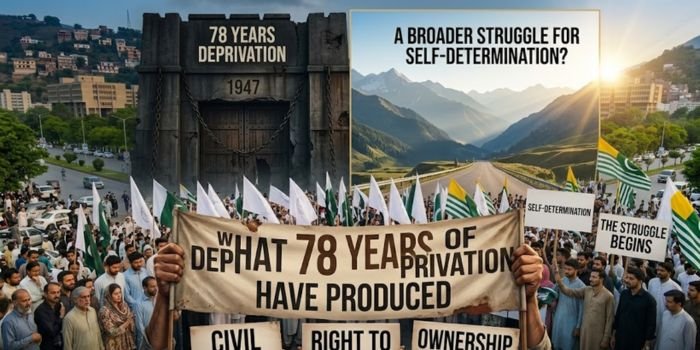
The Jammu Kashmir Joint Awami Action Committee is a peaceful public-rights movement. Its demands include the right of ownership, the right to governance and self-rule, better governance, public control over public resources, and the fulfilment of legitimate economic, political and social rights.
If the movement is peaceful, why should its demands be answered with guns, arrests, alleged disappearances and force?
If these people have been arrested, why are they not being presented before courts?
If the authorities insist that they have not been arrested and are merely hiding themselves, then where are they, and what explanation is being offered for the videos and other evidence surrounding their alleged arrests?
If more than one hundred young people have been killed, where are the independent investigations?
And if the state has clear answers to these questions, why are those answers not being presented openly before the people of Jammu Kashmir and the international community?
There is also an important distinction between Balochistan and Pakistan-administered Jammu Kashmir. Balochistan is internationally recognised as a province of Pakistan and its internal affairs are therefore generally treated as matters within Pakistan’s sovereign jurisdiction. Jammu Kashmir, however, has a long-standing and internationally recognised disputed status. Its final status remains unresolved, and both India and Pakistan are parties to the dispute, while the people of Jammu Kashmir themselves are the principal party whose political future and rights are directly at stake.
This distinction makes the human-rights situation in Pakistan-administered Jammu Kashmir an issue that cannot simply be treated as an ordinary internal administrative matter.
The international community, the United Nations and global human-rights organisations therefore need to ask a straightforward question:
Has the international community ever given Pakistan the authority—or the responsibility—to kill, arrest, forcibly disappear or deprive people of their fundamental rights in the part of Jammu Kashmir under Pakistan’s administration?
The answer is no.
Administrative control or state authority cannot provide a justification for violations of fundamental human rights. The lives, freedom, dignity and right to justice of Kashmiris are no less important than those of people anywhere else in the world.
For this reason, the following practical steps are urgently required.
A United Nations special human-rights mission should be permitted to visit Pakistan-administered Jammu Kashmir and independently meet affected families, lawyers, journalists, human-rights workers and eyewitnesses.
A complete and independently verified list of alleged enforced disappearances should be prepared, including each person’s name, age, profession, date and location of arrest or last sighting, eyewitness accounts and the institution allegedly involved.
Anyone for whom credible evidence of arrest exists should immediately be produced before a court, provided with legal representation, and released if there is no lawful basis for continued detention.
All alleged killings and targeted killings must be independently and transparently investigated, including the identity of the perpetrators, weapons used, orders issued and any institutional or individual responsibility.
International forensic and human-rights experts should be given access to preserve evidence and independently examine medical and forensic records relating to alleged killings.
The alleged occupation and use of private civilian property by Pakistani forces must end. Military positions and fortifications established on private property should be removed, and affected owners should receive appropriate legal and financial remedies.
Journalists, lawyers, human-rights workers and affected families must be protected so that they can document and report alleged violations without harassment, intimidation or arrest.
The United Nations and international human-rights organisations should ask both Pakistan and India to clarify their human-rights responsibilities in the areas of Jammu Kashmir under their respective administration. The disputed status of Jammu Kashmir can never be used as a justification for violating human rights.
An international mechanism should be established to provide legal, psychological and financial support to families of missing persons.
Individuals found responsible for unlawful arrests, enforced disappearances, torture or extrajudicial killings must face individual legal accountability, regardless of their official position or institutional affiliation.
Regular international public reports should document arrests, disappearances, deaths, court appearances and human-rights cases in Pakistan-administered Jammu Kashmir.
If state institutions refuse access to international human-rights missions, that refusal itself should be formally documented and reported internationally.
Most importantly, the voices of the people living in both Pakistan-administered and India-administered Jammu Kashmir must be heard directly. Decisions about their future should not be made exclusively in Islamabad, New Delhi or any other capital. Kashmiris, genuine elected representatives, public-rights movements, lawyers, journalists, civil-society representatives and affected families must be given an equal and meaningful international platform.
These demands are not calls for war, violence or armed confrontation. They are demands for accountability, justice and human dignity.
Human life must remain more important than state power.
The law must remain above the gun.
The international community cannot continue to respond to alleged enforced disappearances, arrests, killings and human-rights violations merely with expressions of concern, regret or formal statements. The United Nations, global human-rights organisations, Amnesty International and other credible institutions must explain what practical action they are prepared to take when credible allegations of disappearances, unlawful arrests, killings and violations of fundamental rights are placed before them.
If the world remains silent, history will eventually ask where the international community was while families searched for their missing loved ones and young people were allegedly killed.
Silence is never always neutrality. In some circumstances, silence itself becomes a question—and eventually, it can become a form of complicity.
The final question remains:
Are human rights truly for everyone, or do human rights also have political borders?
About Author

-
Khawaja Kabir Ahmed is a British/Belgian Kashmiri journalist who has been associated with the field of journalism since his educational days.
He holds a degree in journalism from the UK, is the Director News/Director Public Affairs and Anchorperson of the web TV channel Jammu Kashmir TV.
He writes on various topics in print journalism, focuses on the state of Jammu and Kashmir and is a promoter of fundamental human rights.
Latest News!
 Opinion09/15/2026After Balochistan, Pakistan-Administered Jammu Kashmir?
- Opinion09/14/2026Sanctions on Israel: A Major and Positive Step —But Why Not the Same for India and Pakistan?
 Opinion08/20/2026Changing U.S. Policy on Jammu and Kashmir And the Kashmiri People Caught Between Two Nuclear Powers
 Opinion08/15/2026A Dangerous Game for Pakistan:If Jammu and Kashmir’s State Identity Is Attacked, How Far Will the Backlash Go?