Yasin Malik’s Case: A New Legal Turn and a Question for the Global Conscience
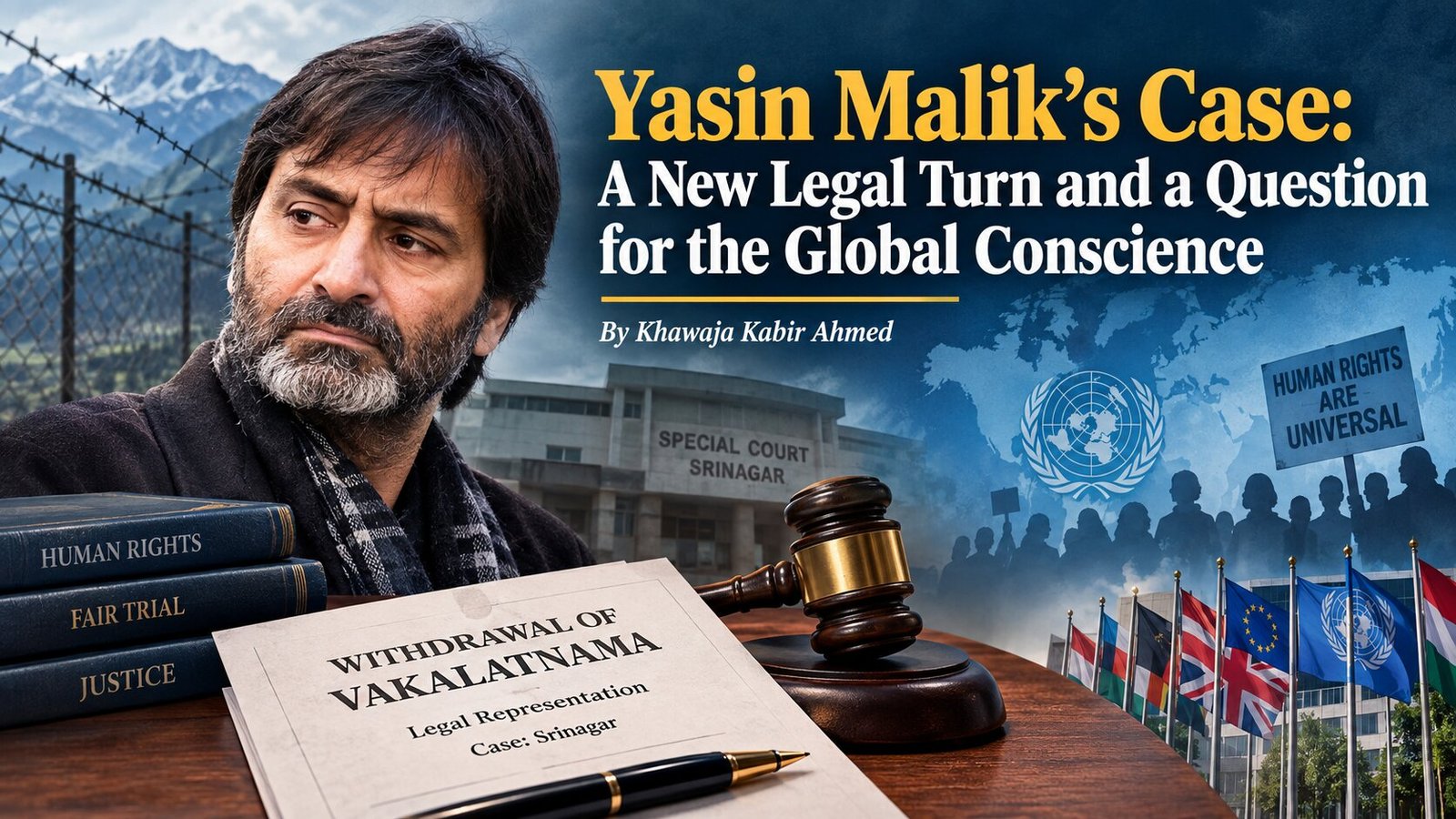
The case against Yasin Malik, currently before a special court in Srinagar, entered a new and unusual legal phase on 19 September 2026.
His lawyer, Advocate Abu Adil Pandit, formally approached the court seeking permission to withdraw his vakalatnama — the authorisation to represent Yasin Malik — in this particular case and to cease representing him in these proceedings.One fundamental point, however, needs to be made clear before this development is interpreted: a lawyer’s request to withdraw from a case is not itself a judicial decision. It is now for the court to determine whether the lawyer will be permitted to withdraw.
The application followed instructions from Yasin Malik and a 25-page written submission filed before the court. In that submission, Malik denied any involvement in the killing of Sarla Bhat and rejected the allegations against him. At the same time, he stated that he would no longer pursue the case.
This distinction is legally and politically important and should not be overlooked.A decision not to pursue a case does not, by itself, amount to an admission of guilt.In his written submission, Yasin Malik has expressly stated that his decision should not be interpreted as an admission of guilt, an acceptance of the prosecution’s allegations, or an admission of the facts alleged against him. He has rejected the allegations and described them as a “bundle of lies.”
Therefore, at this stage, it would be inaccurate to portray his decision as an admission of the crime. Such a characterization would not reflect the position he has set out in his own written submission.
There is another important point.Advocate Abu Adil Pandit’s present application should not automatically be interpreted as a withdrawal from all of Yasin Malik’s legal cases. Based on the information currently available, the application concerns this particular case pending in Srinagar. Representation in other cases, including matters pending before the TADA court in Jammu, is understood to continue.
The central question now is: why has Yasin Malik decided not to pursue this case any further?Is this a legal strategy? Is it an expression of a political position? Is it a new form of resistance? Is he taking this course because of his longstanding objections to the Indian judicial system? Or is there another legal reason behind the decision?These questions cannot responsibly be answered through speculation.
A definitive explanation can emerge only from the full text of Yasin Malik’s written submission, the judicial record and the proceedings that follow.
But another question has now become increasingly important:If Yasin Malik has decided not to pursue the case further, should the international community simply remain a silent spectator?The issue is no longer limited to the case of one individual. It also raises broader questions concerning human rights, due process and the fundamental legal protections owed to people caught up in political conflicts.
People may agree or disagree with Yasin Malik’s political ideology. They may support or oppose his political activities. But fundamental human rights should not depend upon whether a person’s political beliefs are popular, unpopular or controversial.
For that reason, the UK Government, European governments, the European Union, relevant United Nations human rights bodies, Amnesty International, Human Rights Watch and other international human rights organisations can reasonably be urged to examine Yasin Malik’s case and his wider legal situation.
Such an appeal should not seek to influence the court or demand any particular judicial outcome.The demand should instead be for a transparent and fair judicial process consistent with international human rights standards.Yasin Malik should have effective legal representation and a meaningful opportunity to defend himself. The evidence and legal proceedings against him should be subject to impartial scrutiny. His dignity, health and fundamental human rights should be protected while he remains in custody.
And if serious questions arise regarding the fairness of the proceedings or possible human rights violations connected with his detention, the relevant international bodies should independently examine those concerns.It is also important to remember a basic principle of international human rights: a person does not lose fundamental legal protections because of his political beliefs or affiliations.
Yasin Malik is one of the most prominent figures associated with a particular political position advocating an independent Kashmir. His political views can be challenged, and his strategies can be debated.But from a democratic and human-rights perspective, the fundamental question remains:
Does a political prisoner or accused person have the same fair-trial guarantees that international human rights principles recognise for every human being?That question is addressed not only to India but also to the international community.
If human rights are genuinely universal, they must apply equally to friend and adversary, state officials and political activists opposed to the state, and majorities and minorities alike.
The killing of Sarla Bhat is a serious matter, and the victims and their families are entitled to justice.But justice also requires that the person accused be subjected to legal proceedings that are transparent, fair and based on credible evidence and established legal principles.These two principles are not contradictory.
Justice for the victim’s family is essential, and a fair trial for the accused is equally essential.That is why reducing the present situation surrounding Yasin Malik simply to the question — “Why is he not fighting the case?” — is not enough.The wider questions are equally important.
Why has he taken this position?What exactly does his 25-page written submission say?Why has his lawyer sought permission to withdraw from this particular case?And how will the court respond to that application?Beyond all these questions, a larger issue now stands before the international community:
Will international human rights organisations raise their concerns only after a final judgment has been delivered, or will they engage before that stage to seek guarantees of a fair judicial process and the protection of fundamental human rights?A new legal turn has taken place in Yasin Malik’s case.
His lawyer has asked the court for permission to withdraw.Yasin Malik has maintained his decision not to pursue the case further.
But he has denied admitting guilt.And the court has yet to make a decision on the lawyer’s application.The attention, therefore, should not be focused solely on the court in Srinagar. It should also be directed towards international human rights organisations and democratic governments.Because justice is not merely about delivering a verdict.Justice also means ensuring that the fundamental rights of every human being remain protected until that verdict is delivered.
About Author

-
Khawaja Kabir Ahmed is a British/Belgian Kashmiri journalist who has been associated with the field of journalism since his educational days.
He holds a degree in journalism from the UK, is the Director News/Director Public Affairs and Anchorperson of the web TV channel Jammu Kashmir TV.
He writes on various topics in print journalism, focuses on the state of Jammu and Kashmir and is a promoter of fundamental human rights.
Latest News!
 Opinion09/21/2026Yasin Malik’s Case: A New Legal Turn and a Question for the Global Conscience
 Opinion09/15/2026After Balochistan, Pakistan-Administered Jammu Kashmir?
- Opinion09/14/2026Sanctions on Israel: A Major and Positive Step —But Why Not the Same for India and Pakistan?
 Opinion08/20/2026Changing U.S. Policy on Jammu and Kashmir And the Kashmiri People Caught Between Two Nuclear Powers