Azad Kashmir Crisis: 1 Month of Internet Blockout, School Closures & Fuel Shortage
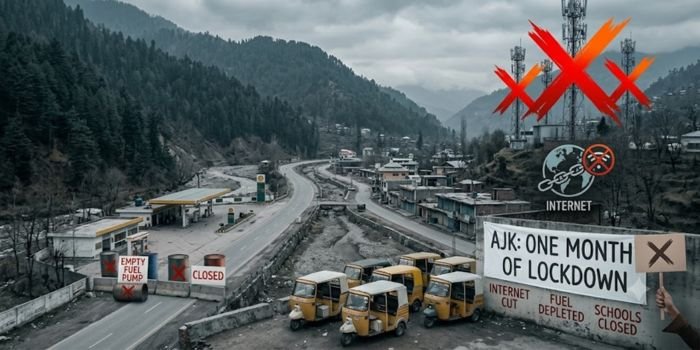
MUZAFFARABAD: What began as an escalatory face-off between state authorities and civil society has spiralled into a profound humanitarian and economic crisis. For nearly a full month, Azad Jammu and Kashmir (AJK) has been subjected to a punishing digital and physical lockdown. Following a fierce state-wide crackdown on the grassroots movement led by the Jammu Kashmir Joint Awami Action Committee (JKJAAC), local authorities effectively sealed off the region, plunging its population into deep isolation.
While central trader associations and transport representatives have cautiously attempted to resume partial operations in main urban hubs like Muzaffarabad, daily survival remains virtually impossible. A complete fuel depletion, shuttered educational institutes, and a month-long internet blackout have combined to bring normal life to a grinding halt.
The Background: Banned Movements and Broken Agreements
The current unrest traces back to a deeper dispute regarding governance, political representation, and resource distribution. Tensions flared extensively when negotiations between the government and the JKJAAC broke down over structural demands, including a controversial provision reserving 12 legislative assembly seats for refugees a mechanism critics argue is weaponised by political parties to manufacture regional governments.
The JAAC had warned that if the extensive reform agreements signed with the state in October 2025 were not implemented, they would launch a massive regional strike. In anticipation of the planned June 9 protests, the regional executive moved aggressively:
- Terrorism Designation: On June 5, the regional government officially designated the JKJAAC as a “proscribed organisation” under the Azad Jammu and Kashmir Anti-Terrorism Act.
- Mass Arrests: Over 600 activists and key public leaders including senior organizer Shaukat Nawaz Mir were swept up in night raids and arbitrary detentions.
- Deadly Clashes: The ensuing confrontations between enraged protestors and heavy deployments of law enforcement personnel resulted in severe unrest, claiming the lives of at least 24 people, including 4 security officers, and leaving dozens wounded.
Educational Blackout: Schools and Futures Indefinitely Closed
With the deployment of federal paramilitary troops and the implementation of strict public assembly ordinances, the regional administration suspended academic operations across the territory to prevent student mobilization.
- Empty Classrooms: Primary schools, secondary colleges, and universities have remained closed, completely disrupting the academic calendar for hundreds of thousands of students.
- No Digital Alternatives: Unlike previous educational disruptions where students could pivot to online modules, the simultaneous closure of schools and the absolute termination of internet connectivity has left the youth completely stranded. Students have expressed immense desperation, warning that the state is actively ruining their futures by forcing an absolute educational standstill.
Dry Pumps and Empty Stalls: The Fuel and Supply Emergency
Even as the JKJAAC sit-ins moved to the fringes of Rawalakot and partial commercial activity attempted to restart, the physical economy cannot breathe without energy.
- No Petrol or Diesel: Under official state orders, petrol stations across AJK have been strictly shut down. Public transport, intra-city wagons, and daily delivery logistics are completely paralyzed.
- Economic Self-Slaughter: Auto-rickshaw operators, motorcycle taxi drivers, and daily wage earners report that even when shops try to open, there are no passengers or customers due to the total absence of fuel. For the region’s blue-collar workforce, weeks without a single rupee in earnings has turned the strike into what they describe as economic “self-slaughter”.
- Depleted Rations: Although a few grocery stalls and medical stores open for highly limited, cautious hours, local supply routes have been systematically obstructed. Families are reporting that basic household necessities including wheat flour, sugar, and life-saving medicines—have entirely run out in remote valleys and urban pockets alike.
A Month Without Connectivity: Digital & Financial Paralysis
The open-ended suspension of mobile data, satellite communication, and fixed-line broadband has completely separated the state from the outside world.
- Banking at a Standstill: Official bank notices slapped across glass doors explicitly blame the state-enforced internet outage for the widespread failure of ATM networks and baseline digital banking. People are unable to process transactions, withdraw cash reserves, or receive emergency remittances from family members working abroad.
- The Digital Refugee Flight: The tech and freelancing ecosystem has completely evaporated. Desperate students and digital professionals are forced to spend significant financial resources traveling across the regional border into neighboring towns of Khyber Pakhtunkhwa (such as Garhi Habibullah) just to find a cellular signal, submit university forms, or communicate with overseas clients.
Dialogue Over Force
Human rights groups, including Amnesty International, have strongly criticized the state’s aggressive measures, labeling the internet blackout, economic blockade, and anti-terror designations as unlawful violations of fundamental freedoms.
As AJK approaches a highly volatile regional election cycle slated for late July, local business alliances and civic bodies are unified in their plea to the state: the current approach of chokeholds, surveillance drones, and communication blockades must end. Lasting stability can only be retrieved by restoring basic services, opening the schools, refilling the fuel lines, and engaging in transparent political dialogue rather than blunt force.
About Author

Latest News!
 News07/31/2026Kashmir Solidarity Gathering: Mushtaq Ahmad Khan Leads Peace Rally at Islamabad’s F-10 Markaz
 News07/29/2026Stand for Azad Kashmir: Islami Jamiat-e-Talaba Stages Massive Protest Outside Islamabad Press Club
 Blog07/23/2026The Indian Legend Regarding the Discovery of Tea: Myth & History
 News07/18/2026AJK Polls: Bilawal Slams ‘Collective Punishment’ of Kashmiris, Vows to Bridge Islamabad-Muzaffarabad Divide