The Indian Legend Regarding the Discovery of Tea: Myth & History
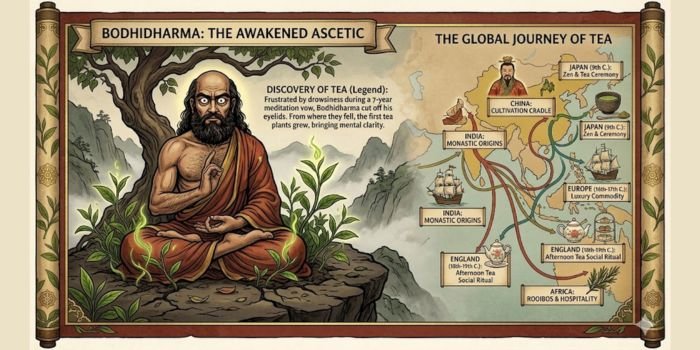
Tea is far more than a global commodity or a comforting morning ritual; it is a fluid archive of human history, spirituality, and myth. Today, millions reach for a steaming cup of green tea or a spiced blend of chai without realizing that the roots of this universal beverage are tangled deep within ancient ascetic mysteries.
While historical records point to early cultivation pipelines, the psychological origin of tea remains beautifully shrouded in spiritual folklore. Chief among these origin stories is the astonishing Indian legend regarding the discovery of tea. A macabre tale of ironclad devotion, severed eyelids, and the relentless pursuit of spiritual awakening.
The Master of Meditation: The Indian Legend of Bodhidharma
The foundational narrative of India’s connection to tea’s mystical birth centers around Bodhidharma (often referred to in historical texts as Bodhi Dharma). A legendary 5th-century Indian prince turned Buddhist monk, Bodhidharma left the luxuries of his home subcontinent behind and traveled northward across the mountains into China. He carried with him the intense, internal frameworks of Chan Buddhism which would later travel to Japan and evolve into Zen.
Seeking ultimate truth and absolute enlightenment, Bodhidharma perched himself atop a rugged hill at the historic Shaolin Monastery. There, he committed to a staggering, unwavering vow: nine consecutive years of unbroken wall-gazing meditation.
[9 Years of Continuous Meditation]
                │
                ▼
[Overwhelming Drowsiness & Fatigue]
                │
                ▼
[The Sacrifice: Severed Eyelids Cast to Earth]
                │
                ▼
[First Tea Plants Sprout From the Sacred Soil]
Years into his silent vigil, the heavy, natural toll of human exhaustion began to creep in. His eyelids grew heavy, and his focus fractured under the weight of overwhelming drowsiness. Terrified that physical weakness would break his holy vow and derail his spiritual quest, Bodhidharma was consumed by a fit of holy rage.
To ensure his eyes could never betray his spirit again, he cut off his own eyelids and cast them violently onto the monastery soil.
Where the severed eyelids met the earth, a strange, unprecedented bush began to sprout. Intrigued by this new vegetation, the monk harvested the leaves and steeped them in boiling water. Upon drinking the fragrant infusion, he discovered a profound remedy. His fatigue vanished, his mind sharpened into absolute focus, and his mental clarity was permanently restored. The sacred tea plant was born originating natively from a sacrifice made for divine alertness.
Tracking the Origin of Tea Across Different Regions
While the legend of Bodhidharma infuses tea with its iconic spiritual mystique, the physical and cultural geography of the tea leaf spans vast regional tapestries, each adapting the plant to reflect their societal values:
1. China: The Cradle of Cultivation
Thousands of years before European trade ships arrived, tea’s agricultural journey began in ancient China. Historical records confirm organized cultivation in the Yunnan province during the Shang Dynasty ($1600–1046\text{ BCE}$).
Parallel to India’s legend, Chinese lore attributes the discovery to Emperor Shen Nong in $2737\text{ BCE}$. According to tradition, wild leaves from a Camellia sinensis bush drifted on a breeze and fell into his pot of boiling water. Intrigued by the resulting aromatic infusion, the emperor drank it, launching a tea culture that eventually evolved to produce complex Green, Black, Oolong, and aged Pu-erh varieties.
2. Japan: The Zen Zenit and Chanoyu
In the 9th century, Japanese Buddhist monks traveling through China witnessed how tea sustained long hours of meditation. They brought the seeds back to Japan, seamlessly blending the beverage with the Zen philosophy pioneered by Bodhidharma.
This culminated in the creation of Chanoyu (or Chado), the highly choreographed Japanese Tea Ceremony. Rooted in four core principles Harmony, Respect, Purity, and Tranquility the ritual transforms the preparation of Matcha (vibrant, powdered green tea) into a moving meditation, reinforcing the Buddhist doctrine of mindfulness and the transience of life.
3. India: From Monastic Roots to the Culture of Chai
Centuries after Bodhidharma’s legendary trek, India transformed tea into a domestic lifestyle juggernaut. In the 19th century. The British East India Company established massive commercial plantations in Assam and Darjeeling to break the Chinese monopoly on the global market.
The local population adapted this commercial leaf into Chai a deeply comforting, spiced concoction brewed fresh with rich milk, sugar, and indigenous therapeutic spices like cardamom, ginger, cloves, and cinnamon. Today, Chaiwalas (street tea vendors) serve as the social hubs of daily Indian life, turning the beverage into an emblem of unmatched hospitality.
4. England: High Society and Afternoon Tea
Introduced to the British Isles in the 17th century by Portuguese and Dutch merchants, tea initially served as an exclusive luxury item for the wealthy aristocracy. By the 19th century, Anna, the Duchess of Bedford, popularized the concept of Afternoon Tea to bridge the long hunger gap between luncheon and dinner. Accompanied by scones, clotted cream, and delicate finger sandwiches, tea-drinking quickly transformed into a defining British social ritual.
5. Africa: Herbal Innovation and Hospitality
Africa embraced tea culture with vibrant regional innovations. South Africa became globally celebrated for harvesting Rooibos, a naturally caffeine-free, needle-like herbal tea packed with antioxidants. Meanwhile, across Northern Africa—particularly in Morocco and Egypt sweet. Refreshing maghrebi mint tea became a foundational element of social gatherings, poured from high heights into delicate glasses as an absolute symbol of friendship.
The Global Spread: Trading Along the Silk Road
The transition of tea from a localized monastic stimulant to a dominant global commodity was fueled by ancient trade networks.
[Ancient Yunnan/Assam] ──► [The Silk Road] ──► [Japan & Southeast Asia]
                                                     │
[Colonial India/Sri Lanka] ◄── [European Traders] ◄──┘
Carried by merchants along the rugged Silk Road, tea traveled across hazardous terrain to unite disparate cultures. By the 16th and 17th centuries, Western exploration saw European powers cultivating vast tea plantations across their overseas colonial territories, primarily in India and Sri Lanka. In the Americas, tea became a powerful lightning rod for political identity, status, and historical revolution.
Summary of Global Tea Traditions
| Region | Primary Tea Type | Cultural Core Principle |
| India (Legend) | Sacred Monastic Brew | Alertness, Determination, and Enlightenment |
| India (Modern) | Spiced Masala Chai | Warmth, Community, and Street Hospitality |
| China | Green, Oolong, and Pu-erh | Imperial Discovery, Balance, and Herbal Medicine |
| Japan | Finely Ground Matcha (Chanoyu) | Zen Mindfulness, Purity, and Tranquility |
| England | Robust Black Tea Blends | Elegance, Social Ritual, and Afternoon Gathering |
| Africa | Rooibos and Herbal Mint | Welcoming Friendship and Natural Wellness |
Conclusion
When we strip away the centuries of trade data, colonial shifts, and corporate branding, we find ourselves right back where the history started: a simple leaf infusing hot water with the spirit of awareness.
Whether you lean toward the natural historical reality of ancient Chinese emperors or favor the fierce.Poetic Indian legend of Bodhidharma sacrificing his sleep for divine focus, tea remains a universal symbol of human connection. It bridges wellness, art, and history inviting us to ground ourselves. Completely within the present moment, one slow, mindful sip at a time.
About Author

Latest News!
 News07/31/2026Kashmir Solidarity Gathering: Mushtaq Ahmad Khan Leads Peace Rally at Islamabad’s F-10 Markaz
 News07/29/2026Stand for Azad Kashmir: Islami Jamiat-e-Talaba Stages Massive Protest Outside Islamabad Press Club
 Blog07/23/2026The Indian Legend Regarding the Discovery of Tea: Myth & History
 News07/18/2026AJK Polls: Bilawal Slams ‘Collective Punishment’ of Kashmiris, Vows to Bridge Islamabad-Muzaffarabad Divide