From the Assembly to the Ministries: Who Will Answer for the People’s Lives and Future?
By: Khawaja Kabir Ahmed
The true measure of a state’s progress is not the grand claims made by its rulers, political speeches, official statistics or legislation passed in the corridors of power. It is the improvement brought about in the everyday lives of ordinary citizens. Healthcare, education, employment and basic public services are fundamental priorities of any civilised society. Providing these is neither a favour, charity nor political generosity; it is a fundamental responsibility of the state. However, when people in a state struggle to access medical treatment and education, children are forced to study in unsafe buildings or under open skies, patients are deprived of adequate healthcare facilities, and citizens repeatedly have to take to the streets to demand their legitimate rights, the questions should not be directed at public expectations but at the performance of those in positions of power. Those who receive salaries, privileges and official protocol at the expense of public resources must explain what they have done to improve people’s lives.
All 53 members of the Legislative Assembly of the Pakistan-administered State of Jammu and Kashmir are accountable to the people. Whether they are members of the ruling government or the opposition, former ministers or current government office-holders, no one can use their political position as a shield against accountability. Those who have held different ministerial portfolios, made administrative decisions, approved budgets and supervised government projects must all present their records of performance before the public. Members of the government must account for their decisions and the results they have delivered, while opposition members must also explain to what extent they have fulfilled their responsibility to scrutinise the government and raise public concerns. Membership of the Assembly is not a licence to evade public questions; it is a responsibility to remain answerable to the people.
An impartial assessment of the performance of individuals who held different ministerial portfolios in previous governments is essential. Those who have served in ministerial positions at various times since 2021 must be asked what changes they introduced in their departments, what measures they took to address public problems, and what facilities were delivered to the people in return for the public money spent. A former minister cannot escape responsibility by simply claiming that they no longer hold office, just as a current minister cannot use the failures of previous governments as an excuse for their own performance. Those who were part of earlier governments and are once again part of the administration must also be held accountable for their previous decisions and performance. A change of government does not eliminate public problems, nor does it erase the responsibilities of former rulers.
This accountability must not be confined to a single ministry or a handful of political figures. The performance of all departments must be brought into the public domain, including Finance, Health, Education, Public Works, Energy, Electricity and Water, Agriculture, Forests, Tourism, Local Government, Planning, Communications, Food, Industries and Commerce, and all other departments. The budgets, projects, expenditure and practical outcomes of every ministry must be presented transparently before the people. How much money was allocated? Where was it spent? How many projects were completed, and what tangible benefits did ordinary citizens receive? If a project has remained incomplete for years, who is responsible for the delay? If public institutions are failing to deliver the expected results, what action have those responsible for supervising them taken? Government meetings, official files and inauguration ceremonies must not be presented as achievements. The real measure of performance must be the actual improvement in people’s lives.
Health and education are the fundamental pillars of any state. The condition of these sectors is a clear reflection of a government’s priorities, administrative capacity and public responsibility. If hospitals lack essential medical equipment, diagnostic facilities and medicines; if patients are forced to travel to other cities for treatment; if poor families cannot afford the cost of private healthcare; and if the quality of medicines is not effectively monitored, these are not merely administrative difficulties. They raise serious questions about the performance of the healthcare system. Former health ministers must be held accountable for their performance during their respective tenures, while the current minister must answer for the present situation and the results of ongoing reforms. Hospital facilities, the availability of medical staff, procurement of medicines, quality control and access to treatment in remote areas must all be subject to transparent scrutiny. Matters directly involving human lives cannot be left to political explanations and formal statements.
The Ministry of Health must never become a means of rewarding a political party, group or individual. It is an extremely sensitive department directly concerned with human lives. Its leadership requires an understanding of the relevant sector, administrative competence and the ability to work effectively with specialists. Being a practitioner of alternative medicine or traditional healing has its own specific academic and professional standing. However, that qualification alone cannot automatically establish someone’s suitability to lead the entire administrative structure of a modern healthcare system. If a person is appointed Health Minister without the necessary understanding of public health, hospital administration, medical services and the supervision of relevant institutions, the issue goes beyond an ordinary political appointment. It becomes a matter of safeguarding human lives and protecting public resources. It is not essential for every minister to be a doctor, but an understanding of the relevant sector, the ability to make informed decisions with the guidance of qualified experts, and the administrative capacity to shoulder responsibility are indispensable. Sacrificing a ministry concerned with human lives at the altar of political expediency is unacceptable.
The education sector demands the same level of serious accountability. The future of a state depends on the education, upbringing and intellectual development of its children. If school buildings damaged by earthquakes remain awaiting reconstruction years after the disaster, if children are forced to study under temporary shelters or in the open air, if girls have to sit on stones because proper classroom furniture is unavailable, and if schools lack basic facilities, every citizen has the right to question the performance of the relevant authorities. Former education ministers must explain what steps they took during their respective tenures to rebuild schools, ensure the safety of buildings, provide teachers and improve educational standards. The current minister and departmental authorities cannot absolve themselves of responsibility either. Records of affected schools, construction projects, allocated budgets and expenditure must be made public, and a clear explanation must be provided as to why the delivery of basic educational facilities to children has been delayed.
Literacy rates and school enrolment figures have their own significance, but enrolment numbers alone cannot be presented as evidence of educational success. The real questions are whether children are studying in safe buildings, whether teachers are available, what the standard of teaching is, whether essential facilities exist, and whether children from poorer families have equal opportunities to receive quality education. If children from influential sections of society benefit from better educational opportunities in private institutions or abroad, while children from ordinary families struggle even to access basic facilities, the state’s priorities must inevitably come under scrutiny. The issue is not that some people send their children to private institutions; rather, it is the contradiction that children dependent on the public education system are denied a safe environment, quality education and equal opportunities to progress. Education is not a privilege reserved for a particular class; it is a fundamental right of every child.
This is the fundamental question confronting the entire administrative structure of the state. When institutions funded by public resources fail to meet the basic needs of the people, an assessment of their performance becomes unavoidable. The practice of distributing ministries as rewards for political loyalty, party arrangements or personal relationships has raised serious questions about the standards of governance. The position of a minister is not merely a means of enhancing political status or securing a share in power; it is a public trust and an obligation to serve the people. Every minister must possess the ability to understand the problems within their department, establish priorities, ensure the effective use of budgets, supervise institutions and accept responsibility for outcomes. If problems persist within a ministry despite the expenditure of public funds, the relevant minister must explain their performance. Where negligence or corruption is established, action in accordance with the law becomes essential.
The growing contrast between the privileges enjoyed by the ruling elite and the basic difficulties faced by ordinary people in the Pakistan-administered State of Jammu and Kashmir also demands serious attention. When access to healthcare, education and everyday necessities becomes a struggle for ordinary citizens, while salaries, privileges, official protocol and the protection of political interests remain priorities within the corridors of power, the public has every right to ask whose interests the state machinery is actually serving. Representatives elected through the votes of the people and institutions sustained by public resources exist to serve the people themselves. If ordinary citizens are denied their basic rights while the ruling class appears preoccupied with protecting its own interests, this model of governance must be called to account. Public service must be demonstrated through practical results, not political slogans.
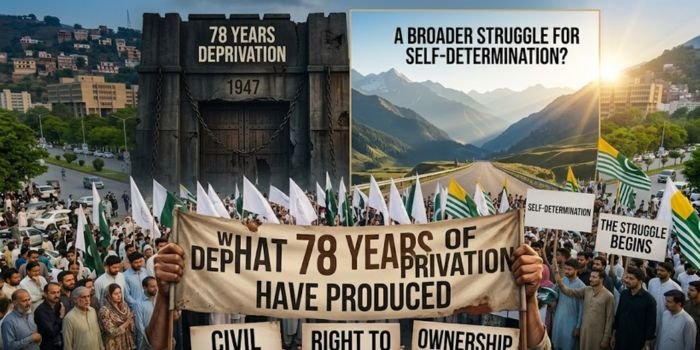
The public rights movement led by the Jammu Kashmir Joint Awami Action Committee has brought this very contradiction into sharp focus. Over more than three years, the movement has played an important role in presenting public grievances not merely as individual complaints but as questions of fundamental rights and accountable governance. Healthcare, education, electricity, basic public facilities, the people’s rights over their resources and public participation in governance are among the prominent issues raised by this movement. This struggle has made it clear that people are not obliged to accept their rights as favours from a ruler or acts of generosity by a political party. Basic public services are the rights of the people, and providing them is the responsibility of the state.
One of the movement’s significant achievements has been strengthening public awareness about the importance of questioning authority and recognising one’s rights. People are now asking why hospitals in their areas have not improved, why school buildings remain incomplete, why essential public infrastructure projects are delayed, where government resources are being spent and when elected representatives will account for their responsibilities. These questions are not a personal campaign against any particular party or individual. They represent a demand for public accountability across the entire system of governance. The movement has played an important role in challenging the long-standing atmosphere of silence and helplessness surrounding public grievances. It is no longer easy for those in power to ignore public questions or dismiss them simply as political opposition.
This growing public awareness has also spread among the younger generation, young people and students. A generation that asks questions about its future must be given answers, not silenced. People have the right to know who benefited from decisions made in their name, what results were achieved through money spent from the public treasury, and to what extent their elected representatives fulfilled their responsibilities. Public awareness cannot be subordinated to party interests or political expediency. It is precisely this awareness that forms the foundation of transparency, better governance and genuine accountability within a state.
The responsibility of the core members of the Jammu Kashmir Joint Awami Action Committee is equally important in this context. Their collective position on public issues and demands for fundamental rights is a source of strength for the movement. The purpose of this struggle is not to establish the political dominance of any individual or group, but to secure the fulfilment of public demands and build a system that delivers tangible benefits to ordinary citizens. In view of the expectations people have placed in this movement, it is essential to continuously monitor progress on its demands, compare government promises with practical measures, provide the public with reliable information and scrutinise the implementation of agreements. An announcement or promise alone does not resolve a problem; what matters is the result that brings genuine improvement to people’s lives. Public trust can only be protected through a principled position, collective unity and continuous accountability.
Overseas Kashmiris have also expressed solidarity with and support for the public rights movement taking place in the state. Their support highlights the fact that the question of the fundamental rights of the people of the state is not confined by geographical boundaries. This support must be used in the wider public interest rather than divided along community, party, regional or personal lines. Raising questions about the performance of former and current governments on the basis of reliable information, highlighting the problems faced by the people of the state and taking demands for fundamental rights to the relevant institutions are all part of this struggle. Effective representation of public concerns and holding those responsible to account are far more important than promoting any individual political personality.
The political class of the state must now accept that public awareness has grown, and the traditional claims of political representation are increasingly being judged against the standards of practical performance. The positions held by representatives elected through the people’s votes are a public trust. Those who have served in ministries must account for their decisions and performance. The current rulers must present clear measures and measurable results to address public problems, while the opposition must demonstrate through practical action that it is effectively scrutinising the government and representing public concerns. The practice of sacrificing people’s rights for party interests or concealing government failures behind political slogans can no longer be acceptable.
The people of the State of Jammu and Kashmir need hospitals where adequate treatment is available, schools where children can study in a safe environment, an administrative system in which citizens do not face humiliation and helplessness when seeking legitimate services, and a model of governance in which the use of public resources is transparently accounted for. Forcing people to protest repeatedly just to secure basic facilities cannot be described as a government’s success. Resolving public problems is a fundamental responsibility of those in positions of power, and evidence of fulfilling that responsibility must be demonstrated through practical results. Where results are absent, accountability is unavoidable.
From the halls of the Assembly to the ministerial offices, every person in a position of responsibility must present an account of their performance before the people. The failures of previous governments and their respective ministries must be examined impartially, with particular attention to accountability in the health and education sectors. The budgets and practical outcomes of all departments must be scrutinised, and where negligence or irregularities are established, action must be taken in accordance with the law. In future, the allocation of ministerial portfolios must be based on relevant qualifications, administrative competence and an understanding of the respective sectors, rather than political loyalty or personal relationships. The practice of handing ministries responsible for human lives and the future of children to politically motivated but unsuitable appointees must come to an end.
Holding office does not place anyone above scrutiny; being in power does not free anyone from accountability; and political affiliation cannot be more important than the rights of the people. The true measure of public representation is not privileges, official protocol or a prolonged stay in power, but the genuine improvement it brings to people’s lives. The public awareness generated through the platform of the Jammu Kashmir Joint Awami Action Committee has highlighted the importance of asking questions and demanding answers. This awareness will grow stronger, the performance of public representatives will continue to be scrutinised, and everyone in a position of responsibility will be required to account for their period in office. From now on, the real standard in the politics of the state must be results, not claims; performance, not position; and the judgement of public trust must be based not on speeches, but on the genuine improvement in the lives of ordinary people.
About Author

-
Khawaja Kabir Ahmed is a British/Belgian Kashmiri journalist who has been associated with the field of journalism since his educational days.
He holds a degree in journalism from the UK, is the Director News/Director Public Affairs and Anchorperson of the web TV channel Jammu Kashmir TV.
He writes on various topics in print journalism, focuses on the state of Jammu and Kashmir and is a promoter of fundamental human rights.
Latest News!
 Opinion10/31/2026From the Assembly to the Ministries: Who Will Answer for the People’s Lives and Future?
 Opinion10/23/2026The People’s Rights Movement, Overseas Kashmiris and Visits by Political Figures: A Serious Wake-Up Call!
 Opinion10/21/2026From Hereditary Power to a Crisis of Leadership: The Historic Responsibility Now Rests on the Shoulders of the Younger Generation!
 Opinion10/15/2026Can Any Uniform Grant a Licence to Kill? Can It Erase the Stain of Blood?