Bloodshed in Pakistan-Administered Jammu and Kashmir: Civilians and Allegedly Its Own Personnel Killed — Why Fear Independent International Investigations?
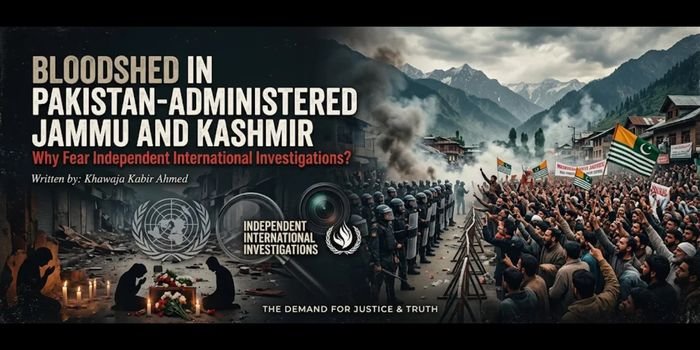
Written by: Khawaja Kabir Ahmed
Over the past three and a half years, during the ongoing public movement in Pakistan-administered Jammu and Kashmir, a series of incidents involving civilian deaths and bloodshed have come to light during major protests held at different times. From Muzaffarabad to Chamyati, Dhirkot, Kotli, Dadyal, Mirpur, Baloch and Rawalakot, incidents at various locations have shaken the entire state. Responsibility for the deaths of civilians in these incidents has repeatedly been attributed to Pakistani forces. These are not merely grievances raised by a few individuals; they are serious matters whose facts, responsibilities and underlying roles must be established.
The most disturbing aspect of these incidents is that Pakistani forces have not only faced allegations of killing ordinary civilians, but also serious allegations that, in order to evade responsibility for their operations and the resulting civilian deaths, protect their own credibility and discredit the public movement, they have allegedly targeted personnel belonging to their own institutions and members of the police force of Pakistan-administered Jammu and Kashmir. The alleged purpose is to shift the blame for these killings onto the Jammu Kashmir Joint Awami Action Committee and its peaceful public movement, thereby avoiding responsibility for what actually happened.
These are extremely serious allegations, and it is essential that the truth behind them be established. If personnel of state forces, including individuals associated with their own institutions, are also being targeted, this matter can no longer be regarded as merely a local political dispute. It becomes an extremely serious issue of human rights and the rule of law. The killing of any civilian or member of the security or police forces is unacceptable, and concealing facts or tampering with evidence in order to shift responsibility for a killing onto another party would constitute an even more serious offence.
The fundamental question here is: who will establish the truth behind all these incidents? Who opened fire? On whose orders were the operations carried out? Who was responsible for the deaths of civilians and police personnel? Were members or supporters of the Jammu Kashmir Joint Awami Action Committee actually involved in these incidents, or are these events being used for some other purpose? These questions cannot be answered through statements issued by government spokespersons, force representatives or any political party. The answers can only emerge through independent, transparent investigations conducted under international supervision.
The Jammu Kashmir Joint Awami Action Committee has maintained a clear position from the very beginning: this is a peaceful, non-partisan movement for fundamental human rights. Its demands concern the provision of fundamental rights to the people, public control over the state’s natural resources and the right of the people to govern their own affairs. Through its public gatherings and statements, the Committee has repeatedly made it clear that its struggle is for public rights. It cannot be permitted to associate the movement with violence, level unproven allegations against its members or use its name to justify any killing.
If the Pakistani forces and government are correct in their position, they should have no reason to fear independent investigations. But the question is: why is international media not being granted unrestricted access to Pakistan-administered Jammu and Kashmir? Why are impartial human rights organisations being prevented from visiting affected areas, speaking to eyewitnesses, obtaining statements from the injured and affected families, and examining the available evidence?
Even ordinary Pakistani media, let alone international media, has repeatedly faced complaints of restrictions and obstacles regarding unrestricted access to affected areas. When journalists are not permitted to reach the scenes of incidents, report independently and speak directly to victims, how can the world establish the facts? If everything was carried out in accordance with the law and established procedures, why is there a need to close the doors to independent journalists, international observers and human rights organisations?
At this stage, merely demanding access for international media is no longer sufficient. Comprehensive, independent and impartial international investigations into all deaths, including those of civilians and police personnel, that have occurred in Pakistan-administered Jammu and Kashmir over the past three and a half years are now essential. These investigations should be conducted under the supervision of the United Nations, with effective oversight and support from the international community, including the European Union and the British Government. The investigating bodies must not be subordinate to any Pakistani government institution, force, local administration, the Jammu Kashmir Joint Awami Action Committee or any other party. They must be granted full authority to access all relevant locations, obtain official records, available video evidence, post-mortem reports, medical records and eyewitness statements.
The scope of the investigations must not be limited to civilian deaths. It must also include the deaths of police personnel and other individuals who, according to allegations, were allegedly targeted by their own institutions or forces. Meanwhile, the position of the forces is that people associated with the Jammu Kashmir Joint Awami Action Committee targeted them. Therefore, every incident must be investigated separately, and all potential individuals responsible, from those who issued the orders to those who carried out the actual operations, must be identified. No institution or office-holder should be granted immunity. Nor should the Jammu Kashmir Joint Awami Action Committee be exempt from scrutiny.
If investigations establish that any force, institution, officer or personnel member, or the Jammu Kashmir Joint Awami Action Committee, unlawfully killed civilians or individuals belonging to state institutions, concealed evidence, conspired to attribute incidents to another party, or obstructed the course of justice, all those responsible must face proceedings in accordance with internationally recognised legal principles and, if found guilty, receive the strictest punishments under the law. No uniform, position, institution or government patronage should be allowed to serve as a shield for any offender.
This demand does not belong to any single organisation or a handful of individuals. It is the demand of the entire Kashmiri nation. It is the demand of the Jammu Kashmir Joint Awami Action Committee, and it is also the demand of Overseas Kashmiris from Pakistan-administered Jammu and Kashmir living in different countries around the world: that the truth behind all killings in Pakistan-administered Jammu and Kashmir must be brought before the world, those responsible must be identified, and they must be brought to justice.
The question now facing the Pakistani Government, the government of Pakistan-administered Jammu and Kashmir, and the Pakistani forces is just one: if you are truthful in your position, why refuse international investigations? Why obstruct unrestricted access for international media, the United Nations and impartial human rights organisations?
Telling the world a story of your own choosing cannot change the truth. Closing journalists’ paths, silencing the voices of victims and avoiding independent investigations cannot absolve anyone of responsibility. State power does not grant anyone the authority to kill, nor does any institution have the right to conceal its crimes.
The time for further statements, denials and allegations has passed. International investigations must now take place. Evidence must now be brought to light. Those responsible must now be identified, and justice must now be delivered.
The demand of the entire Kashmiri nation, the Jammu Kashmir Joint Awami Action Committee and Overseas Kashmiris from Pakistan-administered Jammu and Kashmir living in different countries around the world — a demand that has also taken the form of a social media campaign — is clear: international media and human rights organisations must be granted unrestricted access, and all killings in Pakistan-administered Jammu and Kashmir must be subjected to independent international investigations under the supervision of the United Nations. All those responsible must be brought to justice and, if found guilty, given the strictest punishments under the law.
About Author

-
Khawaja Kabir Ahmed is a British/Belgian Kashmiri journalist who has been associated with the field of journalism since his educational days.
He holds a degree in journalism from the UK, is the Director News/Director Public Affairs and Anchorperson of the web TV channel Jammu Kashmir TV.
He writes on various topics in print journalism, focuses on the state of Jammu and Kashmir and is a promoter of fundamental human rights.
Latest News!
 Opinion11/21/2026Bloodshed in Pakistan-Administered Jammu and Kashmir: Civilians and Allegedly Its Own Personnel Killed — Why Fear Independent International Investigations?
 Opinion11/18/2026Three and a Half Years of a People’s Movement, Questions Raised a Year Ago, and a People Paying the Price for Their Sacrifices
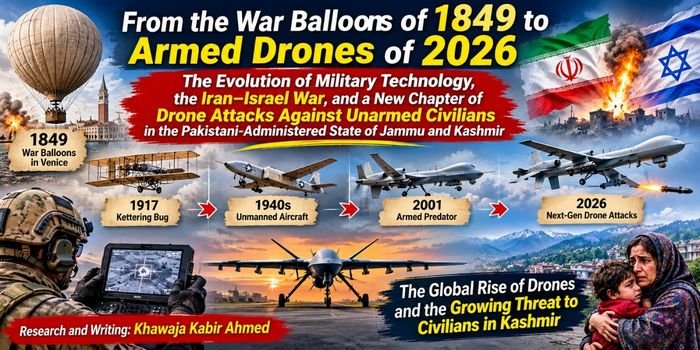 Opinion11/10/2026From the War Balloons of 1849 to Armed Drones of 2026 — The Evolution of Military Technology, the Iran–Israel War, and a New Chapter of Drone Attacks Against Unarmed Civilians in the Pakistani-Administered State of Jammu and Kashmir
 Opinion11/07/2026From Rawalakot to the Entire State of Jammu and Kashmir — The Struggle for Public Rights, Geographical Unity and the Expanding Reach of the Movement!