Pakistan’s $100 Billion Export Dream: The Missing Link Is Policy Delivery
By Rashid Nasir
PhD Scholar, Pakistan Institute of Development Economics (PIDE)
Pakistan’s ambition to rise exports to $100 billion raises the question of what has to change in the nation’s production, governance, and business support systems to make such growth possible?
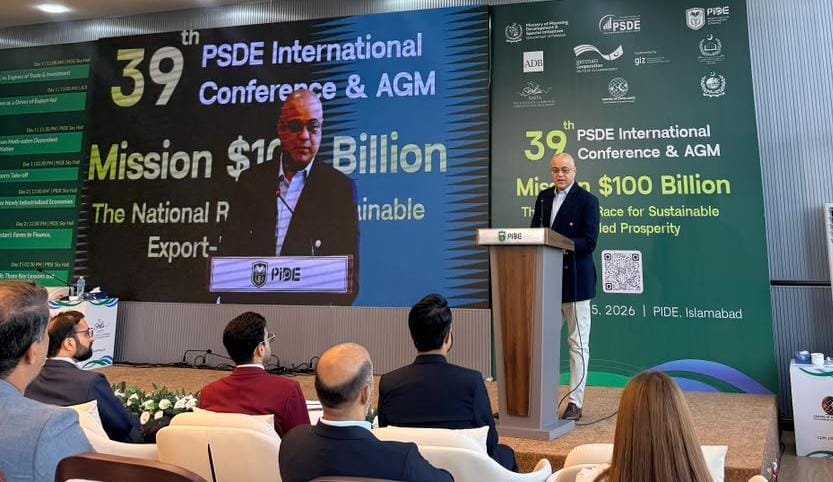
Research presented at the 39th International Conference and Annual General Meeting of the Pakistan Society of Development Economists (PSDE), which took place at PINE Islamabad on October 14–15, 2026, provided clear evidence-based answers to the key questions surrounding Pakistan’s export constraints and offered actionable policy insights. Researchers looked at agriculture, industry, government, small enterprises, digital services, labor mobility, marine development, tourism, and creative industries under the topic “Mission $100 Billion: The National Race for Sustainable Export-led Prosperity.”
As a whole, these studies suggest that Pakistan’s export problem goes beyond a mere lack of output. It is an inability to link production capability to international markets, technology, skills, financing, and reliable institutions. The policy challenge is to turn these separate ingredients into a functioning export system.
First, make agricultural policy export-oriented. Research on the citrus and mango value chains in Sargodha and Multan reveals that when farmers learn how to use digital technology, it improves export performance. This calls for a pragmatic change: create export-readiness initiatives for specific agricultural value chains that incorporate digital advisory services, climatic data, quality testing, traceability, cold storage, and certification. Export quality, lower post-harvest losses, and access to new markets should be used to gauge success rather than just how many farmers receive technology or training.
Second, replace scattered industrial incentives with a consistent competitiveness strategy. Research comparing Pakistan with Bangladesh, Vietnam, and India emphasises the significance of long-term industrial policy, financial inclusion for SMEs, and integration into global value chains. Pakistan should pinpoint industries with practical export potential and connect governmental assistance to quantifiable gains in market diversification, productivity, product quality, and technology adoption. Instead of making smaller businesses forever reliant on protection, export finance, technical support, and international certification can help them become competitive.
Third, treat governance as economic infrastructure. Research on political uncertainty, trade regulations, and federal-provincial cooperation, infrastructure alone cannot guarantee export growth. When firms deal with inconsistent regulations, redundant processes, or disjointed public agencies, roads and ports become less valuable. Export coordination units at the corridor level should be established by the government with participation from business representatives, federal and provincial departments, customs, and standards authorities. Every department should provide information on new exporters accessing foreign markets, compliance expenses, and clearance delays.
A measurable example of what reform can accomplish is provided by the Pakistan Single Window study. It estimates savings in clearance time and transaction costs of around 1.75 days and US$220 per shipment, based on over 300,000 transactions between 2020 and 2025, along with an eight-percentage point increase in the SME share of exports. These are estimations from the study, but they show why real business results should be used to assess improvements.
Fourth, make SMEs and skilled people central to export policy. Research on women-owned enterprises, foreign employment, freelancing, gemstone clusters, highlight potential that traditional export plans may miss. An integrated SME Export Readiness Program that provides working capital, digital payments, product certification, e-commerce assistance, and connections to foreign buyers should be developed in Pakistan. In the meanwhile, technical and vocational training should be developed in collaboration with employers and international markets to ensure that credentials meet the demands of higher-value jobs in manufacturing, IT, healthcare, logistics, and other fields. Training programs should be evaluated based on export contracts, employment, earnings and export contracts—not enrolment figures alone.
Fifth, expand the definition of exports. Foreign exchange earnings can be diversified through digital services, tourism, sustainable fisheries, maritime activities, and music. However, these industries require particular policies, such as reliable digital infrastructure and data security for services; coordinated destination management and environmental protection for tourism; improved processing and sustainable fishing practices for coastal industries; and professional distribution, intellectual property protection, and a proposed music export council for creative industries. Instead of just including new sectors in a policy statement, diversification must entail creating sustainable industries.
These recommendations require an implementation mechanism. A national export-performance dashboard that tracks export receipts, product diversity, domestic value addition, SME involvement, productivity, export survival, and job quality should be publish in Pakistan. Every priority sector should have an accountable organization, a schedule, and objectives that are independently assessed. Research organisations like PIDE can assist in setting baselines, testing interventions, and determining whether policies are effective, for whom, and in what circumstances.
The conference does not offer one magic solution. Its combined effect is to show the necessity of mutual reinforcement between technology, industrial strategy, skills, trade facilitation, and institutional quality. Infrastructure cannot overcome policy uncertainty, training cannot build competitive firms by itself, and a digital platform cannot make up for low productive capacity. In the end, Pakistan’s $100 billion ambition will ultimately depend on its quality economic institutions function and how consistently it makes decisions. The real race is not to announce a bigger export number. the goal is to create a framework that will allow Pakistani businesses to compete, expand, and stay in global markets.
About Author

Latest News!
 Opinion10/17/2026Pakistan’s $100 Billion Export Dream: The Missing Link Is Policy Delivery
 News07/31/2026Kashmir Solidarity Gathering: Mushtaq Ahmad Khan Leads Peace Rally at Islamabad’s F-10 Markaz
 News07/29/2026Stand for Azad Kashmir: Islami Jamiat-e-Talaba Stages Massive Protest Outside Islamabad Press Club
 Blog07/23/2026The Indian Legend Regarding the Discovery of Tea: Myth & History