August 13:What 78 Years of Deprivation Have Produced
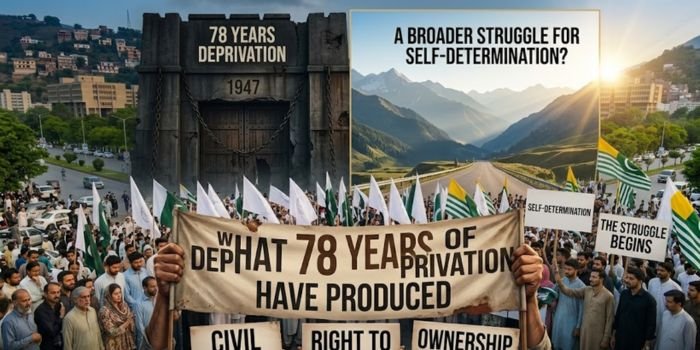
From civil rights to the right to govern and the right to ownership — can the present movement become the beginning of a broader struggle for self-determination?
Not every date is merely a date. Some dates carry questions that remain unanswered for generations. August 13 is one such date in the history of Jammu and Kashmir.
On August 13, 1948, the United Nations Commission for India and Pakistan (UNCIP) adopted a resolution concerning a ceasefire, the withdrawal of forces, and the future of Jammu and Kashmir. Earlier, on April 21, 1948, the UN Security Council adopted Resolution 47, addressing the restoration of peace and order in Jammu and Kashmir and providing for a plebiscite to determine the future of the state.
Seventy-eight years later, the fundamental question remains: when will the people of Jammu and Kashmir be able to freely express their political will about their own future?
But to understand that question, we must first examine the civil rights movement that has developed in Pakistan-administered Jammu and Kashmir over the past several years and what it may represent beyond its immediate demands.
From civil rights to political authority
To reduce this movement, led through the platform of the Jammu Kashmir Joint Awami Action Committee, to demands for electricity, flour, taxation, employment, or public services alone would be to overlook its broader political significance.
Electricity at production cost, affordable flour, employment opportunities, improved education and healthcare, fair taxation, and transparency in the use of public resources are basic rights.
But behind these demands lies a deeper question:
Who has the authority to decide how these rights are provided and how the state’s resources are used?
If electricity tariffs are determined without effective public participation; if local people have little meaningful control over their natural resources; if elected representatives have limited legislative and financial authority; and if elected institutions remain unable to exercise meaningful power, then the issue goes beyond electricity or flour.
It becomes a question of popular authority, accountable government, and democratic power.
This is why the current movement should be understood not merely as an economic protest, but as part of a wider debate about who governs, who benefits from public resources, and how citizens participate in decisions affecting their lives.
The movement’s greatest strength should remain its peaceful, organized, democratic, and popular character. It is not a struggle against any nation, religion, region, or ordinary citizen. Nor should it become a vehicle for hostility toward individuals or political parties.
History shows that popular movements achieve lasting results not through slogans alone, but through clear principles, disciplined organization, public unity, peaceful action, and the ability to turn immediate grievances into a coherent political vision.
The question of resources and ownership
Jammu and Kashmir is rich in water, hydropower potential, minerals, forests, and other natural resources. But being rich in resources is not the same as ensuring that the people who live there have an effective and fair claim over their use and the benefits generated from them.
The central questions are simple:
Where does the revenue from these resources go? Who makes the decisions? How much benefit reaches the local population? And what role do the people have in determining these matters?
If citizens have little meaningful participation in decisions concerning their land, water, minerals, and other resources, then the concepts of ownership, development, and public welfare remain incomplete.
The right to ownership, therefore, should not be understood merely as individual ownership of land or property. It also includes the broader democratic principle that people should have an effective and equitable stake in the resources of the land they inhabit and in the benefits derived from them.
Elections are not enough
Democracy is not simply the act of casting a vote.
A meaningful democracy requires that representatives elected by the people possess genuine legislative, financial, and administrative authority and remain accountable to those who elected them.
An electoral system in which people vote but major political, financial, administrative, or resource-related decisions are effectively made elsewhere can leave citizens with limited political power.
Democratic reform therefore means more than elections. It means real authority for elected institutions and real accountability to the people.
Citizens must also be free to form political parties, contest elections, vote, assemble peacefully, disagree with governments and institutions, and express political opinions without being treated as enemies of the state.
Dissent is not treason. In a democratic society, dissent is part of political life.
Justice, accountability and the need for restraint
The deaths, injuries, arrests, and reported instances of violence associated with the current movement cannot simply be ignored. Where allegations of wrongdoing exist, justice requires credible, independent, and impartial investigations, followed by accountability wherever responsibility is established.
The cases of individuals who may have been targeted solely for peaceful political or civic activity should also be reviewed through due legal process.
At the same time, the movement itself must protect its peaceful character.
Violence, armed confrontation, sectarianism, linguistic prejudice, regional hatred, and blind hostility toward institutions can divert a popular movement from its objectives and weaken its legitimacy.
A movement that remains peaceful, disciplined, democratic, inclusive, and grounded in constitutional, political, and human rights principles can attract much broader support.
This places a particular responsibility on intellectuals, journalists, lawyers, students, workers, women, young people, political activists, and civil society.
This is not the time to label one another traitors, patriots, enemies, or loyalists.
It is time to discuss seriously how the people of Jammu and Kashmir can secure their rights, political authority, dignity, and democratic future.
August 13, 1948 and the question of today
The UNCIP resolution of August 13, 1948 must be understood within the historical, political, and military circumstances of its time. It remains an important part of the international documentary history of the Jammu and Kashmir dispute.
But the historical existence of a resolution and its present political interpretation are not necessarily the same thing.
Since 1948, Jammu and Kashmir has experienced profound political, social, economic, demographic, and human changes. Generations have grown up amid division, conflict, political uncertainty, economic hardship, and competing national narratives.
It therefore cannot simply be assumed that a political framework developed in 1948 necessarily represents, in exactly the same form, the political aspirations of every Kashmiri today.
Many Kashmiris today express political aspirations that go beyond the traditional positions associated with India and Pakistan. Political views differ across the various parts of Jammu and Kashmir, but one principle should be common to all:
the people themselves must have the freedom to express their political opinion about their future.
Kashmiris should not be treated merely as supporters of one country’s position or the other’s. They should be recognized as people with their own political interests, aspirations, rights, and voice.
Acknowledging the historical and documentary status of the 1948 UN framework is therefore one matter. Treating that historical framework as the complete and final expression of the political aspirations of present and future generations is another.
This is why August 13, 1948 should be remembered not only as a document of the past, but also as a historical starting point for asking a contemporary question:
What do the people of Jammu and Kashmir themselves want in 2026?
From 1948 to 2026: a new political dialogue
The right to self-determination should not be reduced to a slogan. At its most fundamental level, it concerns the principle that people should have the opportunity to form and express their political will freely and democratically.
If the future of Jammu and Kashmir is to be addressed seriously, the political voice of its people must therefore be given central importance.
Pakistan and India have their respective positions. But the people of Jammu and Kashmir also have a fundamental stake in the question.
They cannot remain spectators in decisions concerning their own political future.
Jammu and Kashmir remains geographically, politically, and administratively divided. This division has separated families, restricted human contact, disrupted economic relationships, and affected political and cultural interaction.
Even if a comprehensive political settlement cannot be achieved immediately, meaningful steps can be taken to restore human connections, facilitate travel and trade, encourage academic and cultural exchanges, and reconnect families separated by the Line of Control.
Human beings should not remain permanently divided simply because politics has failed to resolve a dispute.
Can the present movement reach beyond one region?
A crucial question now is whether the civil rights movement in Pakistan-administered Jammu and Kashmir can find resonance among people living in other parts of the state.
The answer does not lie in imposing one political agenda on everyone.
It lies in identifying shared principles and common human interests.
People across different parts of Jammu and Kashmir may have different political views, but many face questions concerning resources, employment, education, healthcare, taxation, land, political representation, democratic participation, and governance.
These common concerns can provide the foundation for a broader democratic dialogue.
For this to happen, the movement in Pakistan-administered Jammu and Kashmir must connect its local demands to principles that can be understood and accepted by people across the entire state:
effective public participation in decisions concerning natural resources;
a fair share of the benefits generated from those resources;
genuine legislative, financial, and administrative authority for elected institutions;
freedom of political association, peaceful assembly, dissent, and expression;
restoration of human, academic, cultural, and economic connections between the different parts of Jammu and Kashmir; and
above all, recognition of the people’s right to freely express their political opinion about the future of the state.
If these principles become a shared political language, today’s civil rights movement could eventually contribute to a broader democratic movement across Jammu and Kashmir.
From ownership to governance to self-determination
This is where three ideas connect:
the right to ownership, the right to govern, and the right to self-determination.
The right to ownership means that people should have an effective and equitable stake in the resources of the land they inhabit.
The right to govern means that elected representatives should possess genuine authority and remain accountable to the people.
The right to self-determination means that the people of Jammu and Kashmir should be able to form and express their political will regarding their future freely and democratically.
These are not necessarily separate struggles. They can be understood as stages of a broader political journey:
from economic rights to popular authority, from popular authority to democratic empowerment, and from democratic empowerment to the people’s right to determine their political future.
If the current movement can transform its experience and organization into these broader principles, its influence could extend beyond one region.
But that influence must come through example, dialogue, public awareness, democratic organization, and shared interests — not through hatred, coercion, or confrontation.
A voice raised for civil rights in one part of Jammu and Kashmir can encourage people elsewhere to examine their own rights and political circumstances.
And eventually a broader question may emerge:
If people have the right to decide how their local resources are governed and how their institutions operate, why should they not also have the right to express their free political opinion about the overall future of their state?
That question can connect today’s civil rights movement with a broader, peaceful, democratic struggle for self-determination.
The road ahead
This will not be an immediate process. It will require long-term political strategy, sustained public engagement, dialogue among people from different parts of Jammu and Kashmir, an independent and responsible media, the involvement of intellectuals and civil society, and continued peaceful democratic struggle.
A local rights movement can become a movement for popular authority.
A movement for popular authority can create the political consciousness necessary for a wider democratic struggle.
And that democratic consciousness can, over time, provide a foundation for addressing the unresolved question of self-determination.
None of this requires hatred toward Pakistan, India, or any other nation. It requires no hostility toward any religion or community. Ordinary Pakistani and Indian citizens are not the enemies of the people of Jammu and Kashmir.
The central issue is political rights, human dignity, democratic authority, and the right of the people to have a meaningful voice in decisions that determine their lives and future.
From August 13, 1948 to August 13, 2026, seventy-eight years have passed.
History demonstrates that resolutions matter. International documents matter. Political agreements matter.
But the lasting resolution of a political dispute cannot be complete without meaningful participation by the people whose lives are directly affected by it.
Therefore, the question in 2026 is not only what was proposed in 1948.
The deeper question is:
What do the people of Jammu and Kashmir themselves want — and when will they be given a genuine opportunity to express it freely?
And an equally important question must be addressed to Pakistan and India:
Will the people of Jammu and Kashmir continue to be viewed merely through the competing positions of two states, or will they be recognized as an empowered political party to the question of their own future?
Time demands an answer.
If the present civil rights movement in Pakistan-administered Jammu and Kashmir is to enter a new phase, it will need wisdom more than emotion, political consciousness more than slogans, and long-term strategy more than momentary reaction.
Its greatest strength is its peaceful and democratic character.
Its future strength will depend on broader public unity, clear political principles, disciplined organization, responsible leadership, and sustained political dialogue.
The people of Jammu and Kashmir should not merely be heard.
They should have meaningful political power.
Their votes should carry real authority. Their rights over their resources should be recognized. Their political opinions should not be criminalized. Their dissent should be protected.
And in every serious discussion about the future of Jammu and Kashmir, the voice of the people themselves must hold fundamental importance.
If today’s civil rights movement can move beyond immediate economic demands and connect itself with the broader principles of ownership, democratic governance, political authority, and freedom of expression, it may become more than a regional rights movement.
It could become the beginning of a wider political consciousness — one capable of linking the struggles for rights, ownership, governance, and ultimately self-determination.
Perhaps that is the greatest lesson of the seventy-eight years between August 13, 1948 and August 13, 2026:
The journey from demanding rights to gaining authority, and from authority to freely deciding one’s political future, must ultimately be completed by the people themselves.
About Author
-
Khawaja Kabir Ahmed is a British/Belgian Kashmiri journalist who has been associated with the field of journalism since his educational days.
He holds a degree in journalism from the UK, is the Director News/Director Public Affairs and Anchorperson of the web TV channel Jammu Kashmir TV.
He writes on various topics in print journalism, focuses on the state of Jammu and Kashmir and is a promoter of fundamental human rights.
Latest News!
 Opinion09/21/2026Yasin Malik’s Case: A New Legal Turn and a Question for the Global Conscience
 Opinion09/15/2026After Balochistan, Pakistan-Administered Jammu Kashmir?
- Opinion09/14/2026Sanctions on Israel: A Major and Positive Step —But Why Not the Same for India and Pakistan?
 Opinion08/20/2026Changing U.S. Policy on Jammu and Kashmir And the Kashmiri People Caught Between Two Nuclear Powers