Op-Ed: The Ballot as a Weapon of Resistance—A Strategic Imperative for Kashmiri Leadership
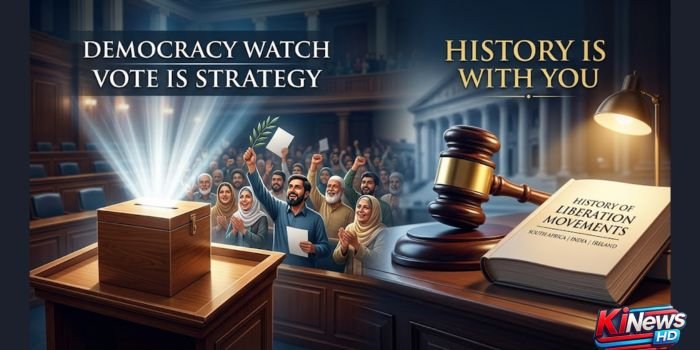
By Raja Muzaffar Director Board, South Asia Democracy Watch, USA
As a Kashmiri living in exile and serving on the Board of Directors for the South Asia Democracy Watch (SADW)—a U.S.-based organization dedicated to promoting democratic values and human rights—I have spent years observing the political gridlock gripping Jammu & Kashmir. For the past four years, our organization has consistently submitted rigorous reports and recommendations to authorities on both sides of the Line of Control (LoC). Our core message has always been clear: democratic elections are a fundamental pillar of public representation, and no political ideology or party should ever be locked out of the electoral process.
Yet, a deep-seated fracture remains within our own political ranks. Today, I want to address a crucial message directly to those Kashmiri nationalist parties and leaders who continue to rely on election boycotts. Specifically, I am speaking to those organizations advocating for complete independence who refuse to enter the electoral arena due to constitutional constraints or oath-related requirements linked to accession.
To these leaders, I say this with the utmost respect for their sacrifices: history shows us that a permanent boycott is not a show of strength; it is a tactical retreat that leaves a power vacuum for others to fill.
The Historical Blueprint: Resisting Under Colonial Rules
A dispassionate look at global history reveals a striking truth: the world’s most successful liberation and anti-colonial movements did not shy away from the ballot box. Instead, they transformed flawed, colonial electoral systems into powerful strategic platforms for peaceful mobilization.
- The Subcontinent: Both the Indian National Congress and the All-India Muslim League fiercely contested elections held under British colonial rule. They used these restricted forums to consolidate public mandates, prove their legitimacy, and ultimately build the legal and moral cases for independence.
- South Africa: Nelson Mandela’s African National Congress (ANC) strategically leveraged democratic participation to systematically dismantle the apartheid regime from both inside and outside the system.
- Global Precedents: From Kwame Nkrumah’s Convention People’s Party (CPP) in Ghana and Julius Nyerere’s TANU in Tanzania to Sinn Féin in Ireland—all of these movements engaged in elections under colonial or hostile administrations.
None of these movements viewed taking an oath or participating in a rigged framework as a surrender of their ultimate goal. Instead, they recognized that elections are a unique mechanism to organize public opinion, secure internal legitimacy, and command international attention.
Legitimacy in the Eyes of the International Community
This historical lesson holds immense weight for the contemporary political leadership across both Indian-administered and Pakistan-administered Jammu & Kashmir.
The harsh reality of modern geopolitics is that the international community, global bodies, and foreign governments operate on the currency of democratic credentials. While protests, grassroots resistance, and individual sacrifices are undeniable pillars of a movement, they rarely grant a seat at the global diplomatic table.
An elected representative standing on the floor of an assembly or parliament carries an institutional weight that a dissident in exile or on the streets cannot easily replicate. When an elected voice speaks on behalf of millions, the world is forced to listen.
By keeping the option of electoral participation open, Kashmir’s peaceful struggle for self-determination can transition from a localized dispute into a legally credible, internationally recognized political mandate.
A Call for Strategic Maturity
My personal advice to our leadership is rooted in historical precedent and political pragmatism: Do not fear the ballot box. Entering the democratic fray is neither a sign of weakness nor an act of surrender. It is a mature, time-tested, and highly sophisticated political strategy. The massive public support currently enjoyed by platforms like the Awami Action Committee (AAC) and allied pro-freedom organizations is our greatest political asset. However, as long as this support remains unchanneled into formal democratic representation, it cannot yield legislative results.
Transforming this immense street power into electoral mandates will not disappoint the Kashmiri people; rather, it will protect them from being governed by proxy regimes and give the broader movement undeniable political weight.
The Path Forward
History teaches us that the struggles that ultimately succeeded were those that stayed organically connected to their people, adapted their tactics to the changing global landscape, and weaponized democratic systems with patience and political wisdom.
For the long-term welfare, dignity, and legitimate rights of the Kashmiri people, I appeal to all political stakeholders to reconsider the philosophy of absolute boycotts. A peaceful, public, and constitutional path does not dilute a cause it makes it sustainable, organized, and structurally unstoppable.
Let us move forward with hope, strategic wisdom, and a commitment to public mandate. History is watching, and it is on the side of those who adapt.
About Author

Latest News!
 News07/31/2026Kashmir Solidarity Gathering: Mushtaq Ahmad Khan Leads Peace Rally at Islamabad’s F-10 Markaz
 News07/29/2026Stand for Azad Kashmir: Islami Jamiat-e-Talaba Stages Massive Protest Outside Islamabad Press Club
 Blog07/23/2026The Indian Legend Regarding the Discovery of Tea: Myth & History
 News07/18/2026AJK Polls: Bilawal Slams ‘Collective Punishment’ of Kashmiris, Vows to Bridge Islamabad-Muzaffarabad Divide