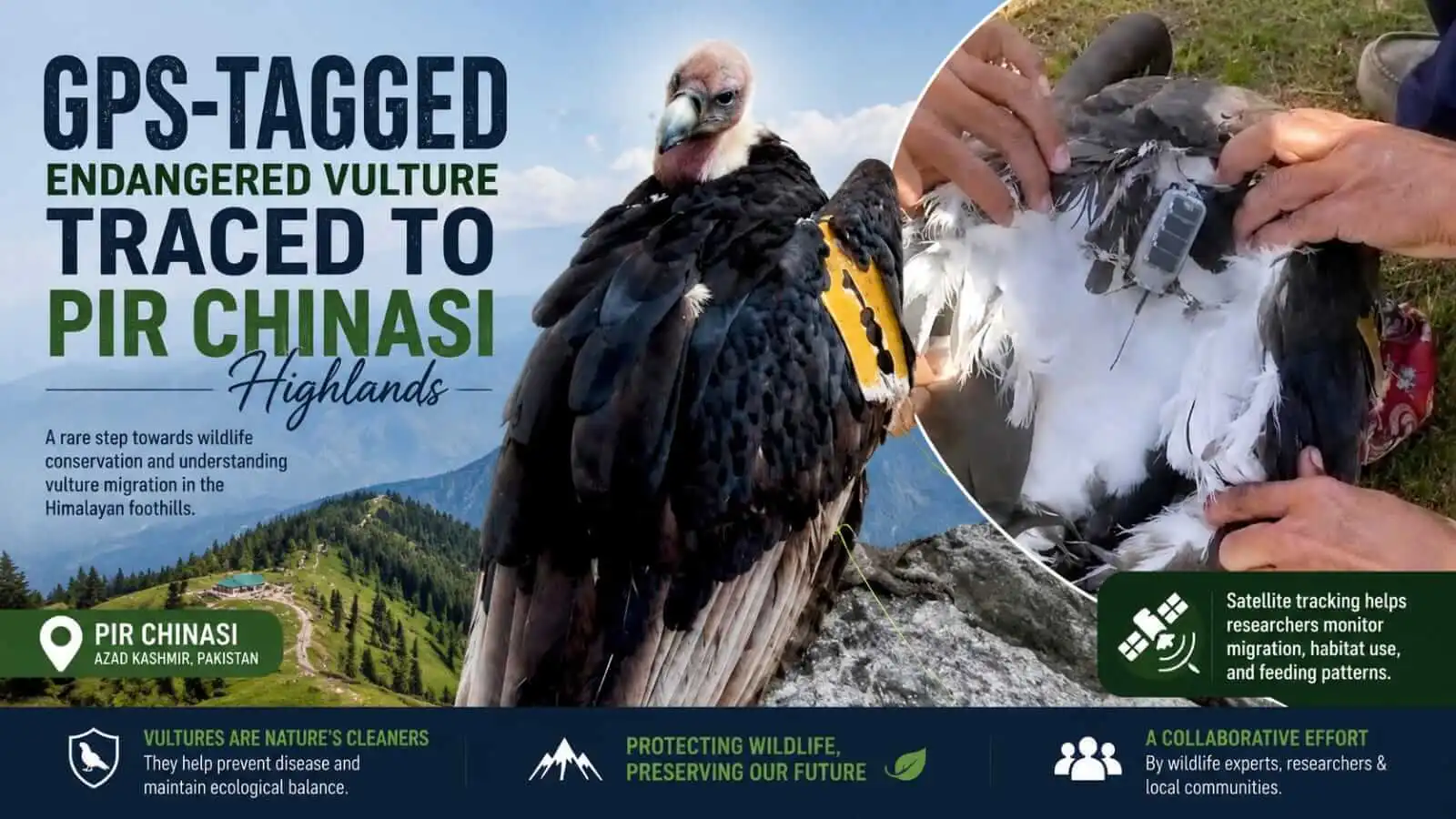
GPS-tagged endangered vulture traced to Pir Chinasi highlands
By Tariq Naqash
Wildlife authorities in Azad Jammu and Kashmir (AJK) said on Tuesday that a critically endangered vulture fitted with sophisticated satellite-tracking equipment, captured in the 9,500-foot-high Pir Chinasi area, would soon be released back into the wild.
A video clip recorded on Monday by Muzaffarabad resident Xain Raja and widely circulated on social media showed a group of locals carefully examining the large bird of prey after safely capturing it with a net when it landed in the highland, apparently weakened by hunger and exhaustion.
The dark-coloured scavenger, identified as a White-rumped Vulture (Gyps bengalensis) by the distinct white patch on its lower back, was found to be carrying a solar-powered GPS transmitter and a yellow wing tag bearing the code “F49”.
The White-rumped Vulture is listed as “Critically Endangered” by the International Union for Conservation of Nature (IUCN).
Wildlife officials said the harness and electronic device attached to the bird were standard tools used in international migratory research and conservation programmes. They added that the bird appeared healthy and calm when it was examined.
Dr Shaista Ali, monitoring officer at the AJK Wildlife Department, said the vulture was believed to have flown more than 1,000 kilometres across the Himalayan region from Nepal, which runs one of the world’s most successful vulture conservation programmes.
She said Nepal’s initiatives included the Jatayu Restaurant project and the release of GPS-tagged vultures from the Kasara Breeding Centre. Researchers there routinely use yellow wing tags and solar-powered GPS Platform Transmitter Terminals (PTTs) similar to those attached to the bird found in Pir Chinasi.
“The presence of ‘F49’ in Muzaffarabad is a significant data point for international researchers,” Dr Ali said. “It confirms that these vultures are traversing the Himalayan corridor linking Nepal, India and Pakistan.”
She noted that the White-rumped Vulture population had suffered a catastrophic decline of nearly 99 per cent during the 1990s due to diclofenac poisoning caused by the veterinary drug widely administered to livestock.
According to Dr Ali, Nepal’s tagging programme aimed to monitor whether rehabilitated vultures could survive and restore their historic migratory patterns in the wild.
“The fact that this vulture reached the heights of Pir Chinasi suggests that the species is attempting to reclaim its historical migratory routes,” she said.
Jazba Shafi, a range officer in the Wildlife Department, said the bird had temporarily been taken into custody at an army installation in Pir Chinasi to verify that the tracking equipment was not being used for espionage purposes.
“They are feeding the bird properly and have assured us that it will be handed over to the Wildlife Department within a day so it can be released back into the wild,” he said.
Dr Ali said the department was also coordinating with international conservation agencies to ensure that the bird’s tracking data was properly documented before its release.
“The presence of this vulture in Pir Chinasi reminds us that our region is a vital link in a global ecological chain,” she said. “When we protect our forests and mountains, we are not just conserving local wildlife but supporting a biological network that spans continents.”
About Author

Latest News!
 News07/31/2026Kashmir Solidarity Gathering: Mushtaq Ahmad Khan Leads Peace Rally at Islamabad’s F-10 Markaz
 News07/29/2026Stand for Azad Kashmir: Islami Jamiat-e-Talaba Stages Massive Protest Outside Islamabad Press Club
 Blog07/23/2026The Indian Legend Regarding the Discovery of Tea: Myth & History
 News07/18/2026AJK Polls: Bilawal Slams ‘Collective Punishment’ of Kashmiris, Vows to Bridge Islamabad-Muzaffarabad Divide