Azad Kashmir’s Awakening: Elections, Reform and a Diaspora Caught Between Two Political Storms
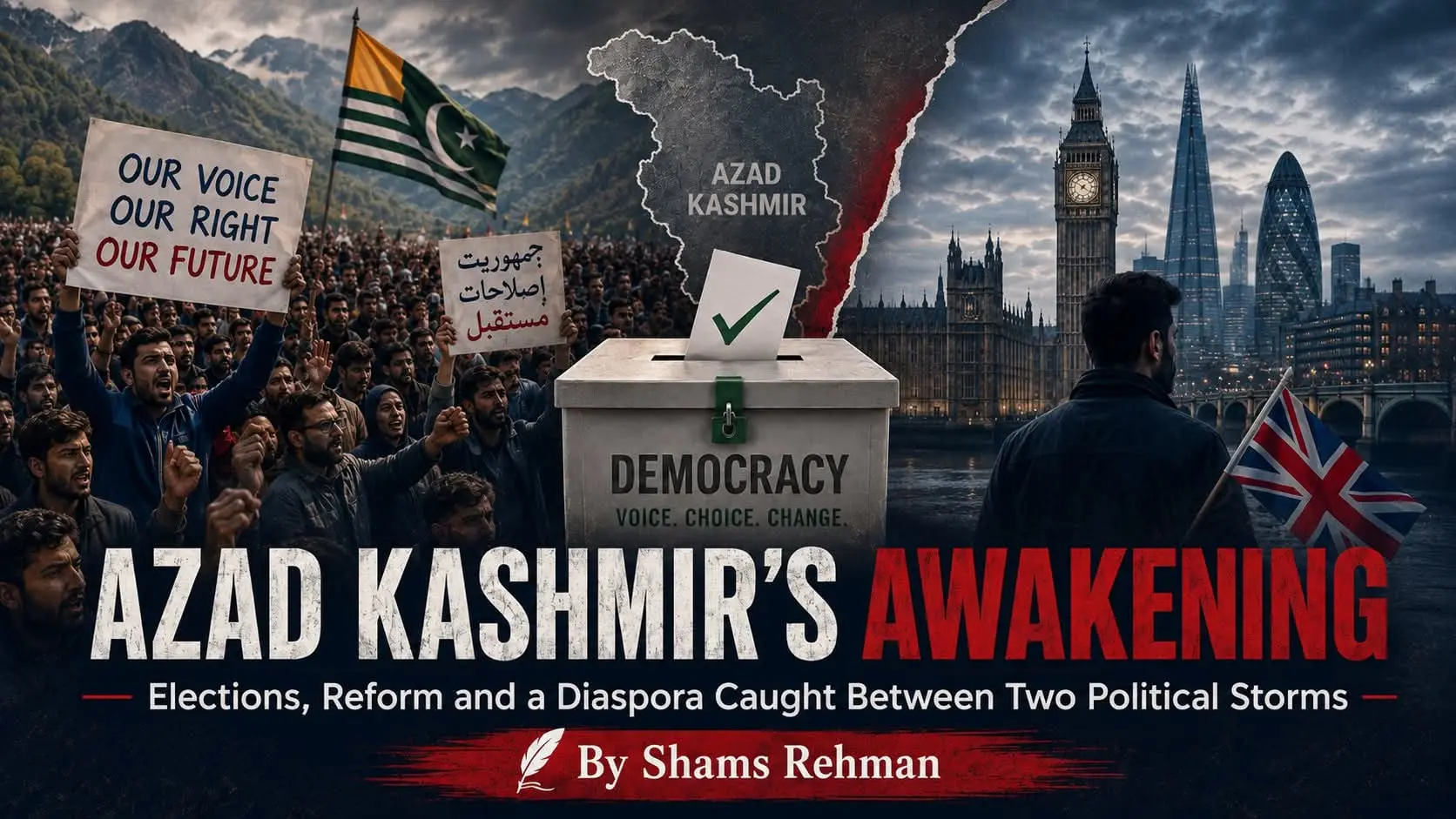
By Shams Rehman
Drafted and developed by the author, with ChatGPT used for language enhancement, editorial refinement and thumbnail generation.
Azad Jammu and Kashmir is passing through one of its most important political moments in recent history.
What began as public anger over electricity bills, flour prices, taxes and elite privileges has now become a much bigger question:
who really speaks for the people, who controls public resources, and whether the coming elections can still command public trust.
At the centre of this moment is the Jammu Kashmir Joint Awami Action Committee (JAAC). It is not a traditional political party. It is a people’s platform that has brought together traders, transporters, lawyers, students, civil society activists, local committees and ordinary citizens who are tired of broken promises, weak governance and recycled politics.
The movement has changed the political language of Azad Kashmir. Electricity bills, flour subsidies and development funds are no longer just administrative issues. They have become symbols of a deeper democratic crisis.
The coming elections are therefore not ordinary elections. They are becoming a test of legitimacy.
The Action Committee has made it clear that elections without meaningful reforms, and without implementation of the 04 October 2025 agreement, will not restore public confidence. Instead, such elections may deepen the mistrust that already exists between the people and the ruling structure.
The committee has also announced that it will not contest elections as an organisation, nor will it allow anyone to use its name for electoral advantage. This is understandable. A people’s movement should not be reduced to another election machine.
But this position also creates a difficult question.
If the Action Committee remains completely outside the electoral process, will the field once again be left open to the same traditional, dynastic and patronage-based politicians who have dominated Azad Kashmir for decades?
And if candidates who support the people’s charter, public accountability and democratic reforms enter the election field, should they automatically be treated as opponents of the movement?
This is where the movement needs political wisdom as well as moral courage.
A possible way forward may be this: the Action Committee should remain independent and should not become a political party, but it should not treat every rights-based candidate as an enemy either. Those who publicly commit to the people’s demands, transparency, local accountability and implementation of the agreement can become a voice of the movement inside the Assembly.
Because street power is important, but street power alone cannot permanently replace institutions.
This is perhaps the most important change taking place in Azad Kashmir. The politics of blind loyalty, biradari pressure and family influence is being challenged by the politics of public accountability.
This debate is already visible on the ground. In places such as Bsaari Bazaar and Keri Kot Galla Bazaar, local young people have reportedly begun challenging routine electioneering. They are asking simple but powerful questions:
Where did development funds go?
Why is our area still backward?
Why do politicians appear only at election time?
Why should we vote without accountability?
Their message is clear: no vote without transparency, no support without accountability.
This is perhaps the most important change taking place in Azad Kashmir. The politics of blind loyalty, biradari pressure and family influence is being challenged by the politics of public accountability.
However, this new public assertiveness is also making the privileged classes of Azad Kashmir increasingly restless. In particular, the dynastic and hereditary political clans that have long treated constituencies as inherited spaces of influence are now finding it difficult to accept direct questioning from ordinary people. When they go out for election campaigns, they are no longer being received only with garlands, slogans and traditional hospitality. In many places, they are being asked about development funds, broken promises, corruption, public services and years of political neglect.
This demand for accountability is unsettling for those who are used to politics without scrutiny. Their discomfort is visible in the way some of them react to public questioning — with irritation, defensiveness and, at times, open intolerance. But this is precisely what a maturing democratic culture looks like. A constituency is not a family estate, and voters are not subjects. If politicians want votes, they must now be prepared to answer questions.
But the legitimacy crisis is not limited to local corruption. One of the most sensitive issues is the 12 Assembly seats reserved for refugees from Indian-administered Jammu and Kashmir who settled in Pakistan after 1947 and later displacements.
Historically, these seats were justified because the Kashmir dispute remains unresolved and displaced communities from Jammu and the Kashmir Valley are part of the wider political body of the former princely state.
But today the democratic question is unavoidable.
Many of these refugee families have lived in Pakistan for generations and enjoy full citizenship rights there. Yet through these reserved constituencies, they also help determine the government of Azad Kashmir — a government under which they do not live in the same everyday sense as residents of Muzaffarabad, Mirpur, Kotli, Poonch, Bagh, Neelum or Bhimber.
This issue must be handled with great care. It should never be turned into hostility towards refugees. Their suffering and displacement are real. They are part of the wider tragedy of Jammu and Kashmir.
But democratic reform also requires fairness. The identity and dignity of refugees can be respected while still asking whether non-resident constituencies should continue to shape the government that rules over people living inside Azad Kashmir.
This is why the coming elections are not simply about which party wins. They are about whether the system itself can still claim public legitimacy.
There is also a wider danger. If the Action Committee calls people to march, negotiate and then return home with another promise, the movement may fall into the same cycle again: protest, agreement, delay, disappointment and another protest.
If it tries to stop elections by force, it risks being branded anti-democratic or even accused of helping those who want elections delayed.
And if it stays completely aloof while the old political class returns to power, it may find itself spending the next five years organising more sit-ins, more protests and more long marches against the same people.
This is why political clarity is so important.
The old boycott model used by some pro-independence Kashmiri organisations does not fully fit the present situation. The Action Committee has not built its movement around rejecting the current constitutional order completely. Its demands are practical and rooted in daily life: electricity, flour, taxes, local resources, public spending, privileges, representation and implementation of written agreements.
For that reason, rights-based participation in elections should not automatically be seen as betrayal. The real danger is not participation. The real danger is unprincipled participation — candidates using the language of public rights during elections and then joining the same old patronage networks after winning.
That danger can be reduced through public pledges, constituency-level accountability committees, transparent funding records and regular public meetings.
For the people of Azad Kashmir, the issue is immediate and personal. They are asking for affordable services, transparent governance, fair representation and an end to elite privilege. They are asking why a region that has given so much sacrifice, labour and migration continues to be governed through weak institutions and recycled political families.
For the Azad Kashmiri diaspora, especially in Britain, this moment carries another layer of anxiety.
British Kashmiris are deeply connected to Azad Kashmir through family, land, inheritance, remittances, marriage, memory and identity. For many people with roots in Mirpur, Kotli, Bhimber and surrounding areas, Azad Kashmir is not just a place on the map. It is where parents are buried, where homes are built, where relatives still live and where emotional belonging remains strong.
But this concern for Azad Kashmir is unfolding at a time when politics in Britain is also becoming more difficult for diaspora communities.
The rise of Reform UK and the wider anti-immigration climate have created anxiety among many communities, including Kashmiris. Even when people are settled British citizens, hostile rhetoric around immigration, Muslims and multiculturalism affects how communities feel in everyday life.
It creates a painful double anxiety.
If Britain begins to feel less secure as a home, people look more intensely towards their place of origin. But if Azad Kashmir also feels politically unstable, economically neglected and institutionally weak, the question becomes deeply emotional:
Where is home secure?
This is why the diaspora cannot treat Azad Kashmir’s crisis as distant news. It is connected to identity, dignity and future generations.
But the diaspora also has a responsibility. It should not simply amplify anger through social media slogans. It should support serious civic work: independent journalism, legal aid, documentation of rights violations, public finance transparency, youth education, democratic reform and peaceful accountability.
British Kashmiris understand local government, elections, public accountability and civic campaigning. These experiences can be used positively to support democratic culture in Azad Kashmir.
At the same time, the diaspora must not speak over the people living there. Those who face shutdowns, unemployment, police action, inflation and weak public services must remain at the centre of the conversation.
For the wider Kashmir question, the meaning is even deeper.
Self-determination cannot be reduced to flags, maps and diplomatic slogans. It must also mean the right of people to control their resources, question their rulers, elect meaningful representatives and live with dignity.
Azad Kashmir’s current awakening is therefore not a side issue. It is part of the larger unfinished story of Kashmir itself.
The coming months will show whether this awakening becomes democratic reform or whether it is pushed once again into confrontation, repression and broken promises.
Azad Kashmir now stands between two possible futures.
One is the familiar future of promises, patronage, protest and disappointment.
The other is more difficult, but more hopeful: a politics in which people are no longer treated as subjects to be managed, but as citizens whose rights, dignity and voice matter.
About Author

Latest News!
 News07/31/2026Kashmir Solidarity Gathering: Mushtaq Ahmad Khan Leads Peace Rally at Islamabad’s F-10 Markaz
 News07/29/2026Stand for Azad Kashmir: Islami Jamiat-e-Talaba Stages Massive Protest Outside Islamabad Press Club
 Blog07/23/2026The Indian Legend Regarding the Discovery of Tea: Myth & History
 News07/18/2026AJK Polls: Bilawal Slams ‘Collective Punishment’ of Kashmiris, Vows to Bridge Islamabad-Muzaffarabad Divide