The JKAAC Flashpoint: Core Demands, Historical Protests, and the Looming June 9 Lockdown in Azad Kashmir
The political landscape of Pakistan-administered Jammu and Kashmir (Azad Jammu and Kashmir, or AJK) has reached a critical boiling point. The Jammu Kashmir Joint Awami Action Committee (JKJAAC), a sweeping alliance of civil society actors, has locked horns with the government over deep-seated constitutional and economic grievances.
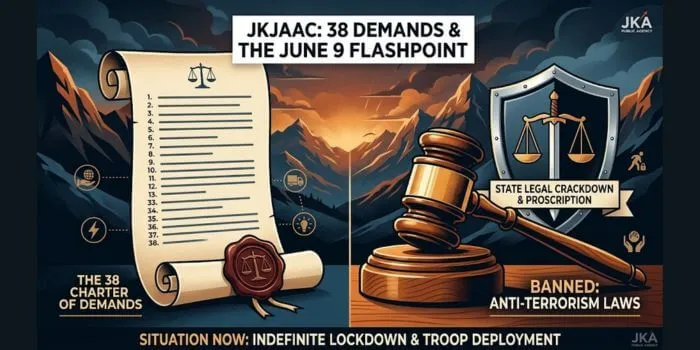
With marathon negotiations failing and the government taking the severe step of banning the organization under anti-terrorism laws, a massive, highly volatile showdown is scheduled for June 9, 2026.
What is the Jammu Kashmir Joint Awami Action Committee (JAAC)?
The JAAC is a broad-based, non-political civil society coalition that emerged natively within AJK between late 2022 and mid-2023. Rather than being a conventional political party, it is a unified front consisting of:
- Local traders’ associations and merchant unions.
- Transport unions and local municipal representatives.
- Lawyers, student organizations, and civic rights activists.
The movement originally consolidated in response to severe local inflation, rocketing utility prices, and a perceived disconnect between the regional government and the daily struggles of ordinary citizens. Over time, it grew from small, localized sit-ins into a region-wide alliance capable of enforcing total paralyzing lockouts across major districts like Muzaffarabad, Mirpur, Rawalakot, and Kotli.
The Core Demands: The 38-Point Charter
The entire driving force behind the JAAC is its comprehensive 38-Point Charter of Demands. While the points canvas a vast array of local infrastructural upgrades—such as building the Shonter Tunnel, roads, and bridges the core friction rests on two main categories:
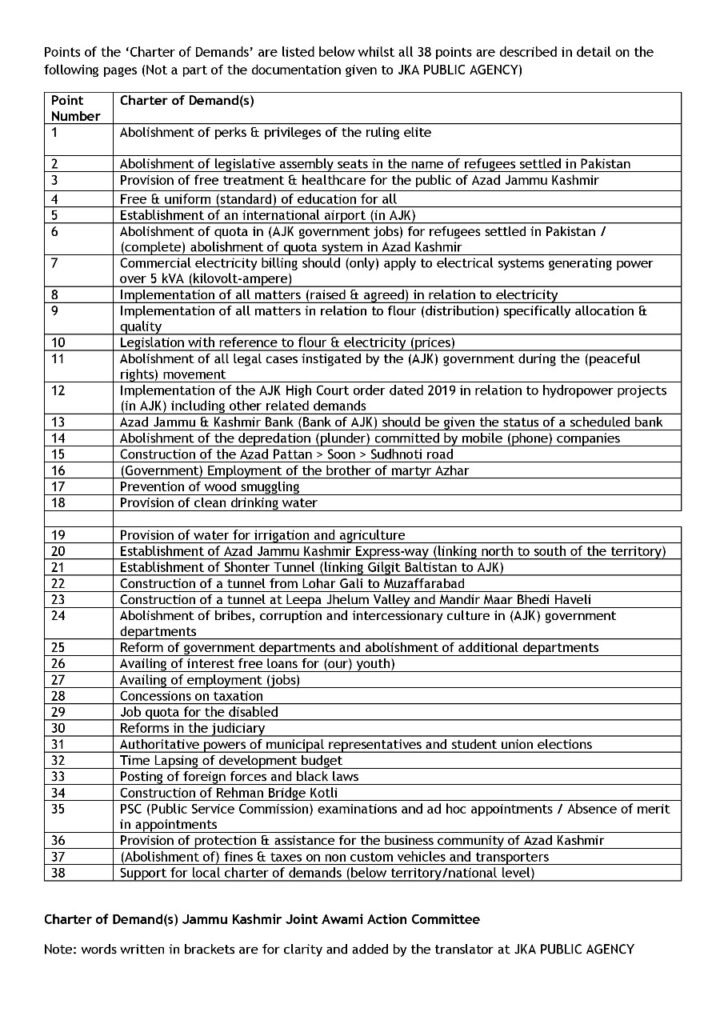
Official 38-Point Charter of Demands
| Point Number | Charter of Demand(s) |
| 1 | Abolishment of perks & privileges of the ruling elite. |
| 2 | Abolishment of legislative assembly seats in the name of refugees settled in Pakistan. |
| 3 | Provision of free treatment & healthcare for the public of Azad Jammu Kashmir. |
| 4 | Free & uniform (standard) of education for all. |
| 5 | Establishment of an international airport (in AJK). |
| 6 | Abolishment of quota in (AJK government jobs) for refugees settled in Pakistan / (complete) abolishment of quota system in Azad Kashmir. |
| 7 | Commercial electricity billing should (only) apply to electrical systems generating power over 5 kVA (kilovolt-ampere). |
| 8 | Implementation of all matters (raised & agreed) in relation to electricity. |
| 9 | Implementation of all matters in relation to flour (distribution) specifically allocation & quality. |
| 10 | Legislation with reference to flour & electricity (prices). |
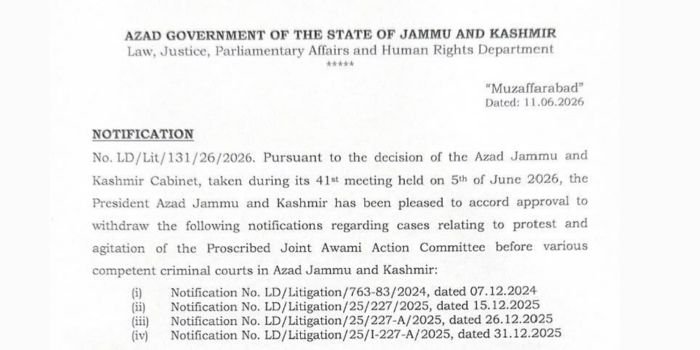
| 11 | Abolishment of all legal cases instigated by the (AJK) government during the (peaceful rights) movement. |
| 12 | Implementation of the AJK High Court order dated 2019 in relation to hydropower projects (in AJK) including other related demands. |
| 13 | Azad Jammu & Kashmir Bank (Bank of AJK) should be given the status of a scheduled bank. |
| 14 | Abolishment of the depredation (plunder) committed by mobile (phone) companies. |
| 15 | Construction of the Azad Pattan > Soon > Sudhnoti road. |
| 16 | (Government) Employment of the brother of martyr Azhar. |
| 17 | Prevention of wood smuggling. |
| 18 | Provision of clean drinking water. |
| 19 | Provision of water for irrigation and agriculture. |
| 20 | Establishment of Azad Jammu Kashmir Express-way (linking north to south of the territory). |
| 21 | Establishment of Shonter Tunnel (linking Gilgit Baltistan to AJK). |
| 22 | Construction of a tunnel from Lohar Gali to Muzaffarabad. |
| 23 | Construction of a tunnel at Leepa Jhelum Valley and Mandir Maar Bhedi Haveli. |
| 24 | Abolishment of bribes, corruption and intercessionary culture in (AJK) government departments. |
| 25 | Reform of government departments and abolishment of additional departments. |
| 26 | Availing of interest free loans for (our) youth. |
| 27 | Availing of employment (jobs). |
| 28 | Concessions on taxation. |
| 29 | Job quota for the disabled. |
| 30 | Reforms in the judiciary. |
| 31 | Authoritative powers of municipal representatives and student union elections. |
| 32 | Time Lapsing of development budget. |
| 33 | Posting of foreign forces and black laws. |
| 34 | Construction of Rehman Bridge Kotli. |
| 35 | PSC (Public Service Commission) examinations and ad hoc appointments / Absence of merit in appointments. |
| 36 | Provision of protection & assistance for the business community of Azad Kashmir. |
| 37 | (Abolishment of) fines & taxes on non custom vehicles and transporters. |
| 38 | Support for local charter of demands (below territory/national level). |
Chronology of Previous Protests and Clashes
The escalation toward the current crisis has been marked by repeated waves of intense mobilization and tragic violence:
- May 2024 Long March: Massive region-wide strikes and a historic Long March toward Muzaffarabad brought life to a total standstill. Clashes during this wave resulted in four deaths, forcing Prime Minister Shehbaz Sharif’s federal government to announce an immediate multibillion-rupee relief package to temporarily slash flour and energy prices.
- September/October 2025 Blockade: Frustrated by delays in the permanent implementation of the agreements, JAAC called a wheel-jam and shutter-down strike. Armed clashes erupted at Neelum Bridge in Muzaffarabad between JAAC activists and rival political workers, resulting in several injuries and the death of a prominent protester named Sudheer. The subsequent funeral and rallies further entrenched public defiance.
The Upcoming June 9, 2026 Protest
The JAAC has called for a definitive, indefinite wheel-jam and shutter-down strike across AJK starting Tuesday, June 9, 2026.
The timing of this upcoming protest has created an absolute gridlock because June 9 is the exact date the AJK Election Commission has set for candidates to begin filing nomination papers for the general elections scheduled for July 27, 2026. JAAC maintains that until the 12 refugee seats are constitutionally amended, the electoral process remains fundamentally flawed.
Last-minute, 9-hour marathon talks held between a federal ministerial team led by Rana Sanaullah and the core leadership of the JAAC (including Shaukat Nawaz Mir) collapsed without a breakthrough, meaning the strike call remains firmly intact.
The Situation Right Now
As of today, the atmosphere in Azad Jammu & Kashmir is highly tense, with authorities preparing for a severe security confrontation:
1. JAAC Declared a Proscribed Terrorist Organization
In a drastic escalation, the AJK Home Department formally issued a notification declaring the Joint Awami Action Committee a proscribed organization under Section 12 of the Anti-Terrorism Act, 2014. The state accuses the civil alliance of inciting anarchy, creating societal insecurity, and deliberately trying to sabotage the upcoming democratic elections. Police have already begun arresting supporters of the banned alliance ahead of the rally.
2. Emergency Travel Advisories Issued
The AJK government has taken the unusual step of issuing an urgent public travel advisory, explicitly telling outsiders to avoid traveling to the region between June 5 and June 20. Tourists, sightseers, and visitors currently staying in scenic spots like Neelum Valley or Rawalakot have been asked to evacuate the territory immediately to avoid being trapped in an unpredictable security situation.
3. Massive Troop Deployment and Shutdowns
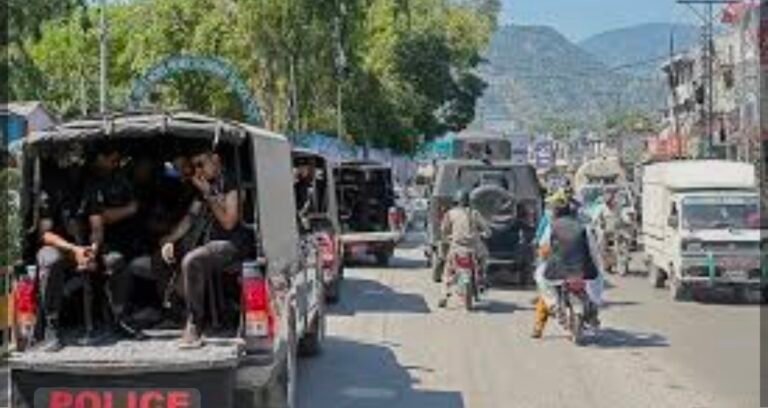
AJK Inspector General of Police, Liaqat Ali Malik, has formally requisitioned over 14,000 additional paramilitary troops from the federal government. Heavy convoys of security personnel have already been filmed entering Muzaffarabad to reinforce regional law enforcement.
Furthermore, the University of AJK has indefinitely postponed all Spring 2026 examinations, and mobile internet/digital communications are widely expected to face severe throttling or complete blockades as June 9 approaches. Critics argue the shutdown will inflict immense harm on local daily-wage laborers, digital freelancers, and the region’s overall economy.
About Author

Latest News!
 News07/31/2026Kashmir Solidarity Gathering: Mushtaq Ahmad Khan Leads Peace Rally at Islamabad’s F-10 Markaz
 News07/29/2026Stand for Azad Kashmir: Islami Jamiat-e-Talaba Stages Massive Protest Outside Islamabad Press Club
 Blog07/23/2026The Indian Legend Regarding the Discovery of Tea: Myth & History
 News07/18/2026AJK Polls: Bilawal Slams ‘Collective Punishment’ of Kashmiris, Vows to Bridge Islamabad-Muzaffarabad Divide