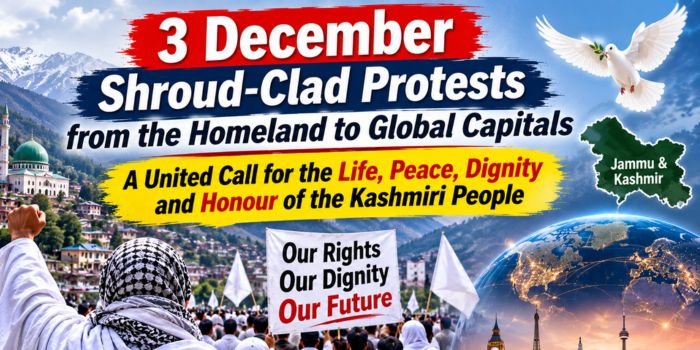
3 December: Shroud-Clad Protests from the Homeland to Global Capitals — A United Call for the Life, Peace, Dignity and Honour of the Kashmiri People
By: Khawaja Kabir Ahmed
3 December could prove to be a significant day in the public rights movement in Pakistan-administered Jammu and Kashmir and in the struggle of Kashmiris living overseas. The Jammu Kashmir Joint Awami Action Committee, in protest against alleged brutality by Pakistani forces, serious human rights violations, the denial of public rights and continued repression, has announced a peaceful march by people wearing burial shrouds from all regions of Pakistan-administered Jammu and Kashmir towards the sit-in protest in Rawalakot on 3 December.
In response to this announcement, Kashmiris living overseas have also pledged their support and announced peaceful demonstrations, wearing burial shrouds, outside Pakistani embassies and consulates on the same day in Europe, the United States, Canada, Australia, New Zealand and other democratic countries.
Thus, an extraordinary scene is expected to unfold on 3 December. People from all regions of Pakistan-administered Jammu and Kashmir will march peacefully towards Rawalakot wearing burial shrouds, while Kashmiris living thousands of miles away will stage similar protests outside Pakistani diplomatic missions. Geographical distances will remain, but the purpose, symbolism and message of these protests will be the same. People in the homeland and Kashmiris abroad will seek to convey their concerns to the world on the same day, with one voice and a shared determination.
This will be more than an ordinary protest. It will represent a political and humanitarian message whose symbolic significance could go far beyond conventional rallies, marches and slogans. Through this action, the Kashmiri people wish to tell the world that their struggle is no longer confined to political demands or economic difficulties. It has become a question of life, security, dignity, honour, fundamental human rights and the right to determine their own future.
A burial shroud is the final garment of human life. In different societies around the world, when people wear burial shrouds during protests, the fundamental message is that they regard their circumstances as a matter of life and death. They are so determined to defend their rights, dignity, freedom and survival that even the fear of death cannot silence their voices. A burial-shroud protest does not signify a desire for death, an invitation to violence or a declaration of armed confrontation against anyone. Rather, it is an attempt by protesters to communicate the gravity of their circumstances to the world through an exceptionally powerful symbol. They wish to demonstrate that when their lives, dignity, fundamental rights and personal security remain under constant threat, they can no longer justify remaining silent.
When men, women, children and young people from all regions of Pakistan-administered Jammu and Kashmir march peacefully towards Rawalakot on 3 December wearing burial shrouds, the sight will send a clear message: the people are not prepared to abandon their demands for fundamental rights. They remain determined to continue their collective, peaceful struggle for the acceptance of their demands, their protection and the preservation of their dignity and honour. Another extraordinary aspect of this protest will be that Kashmiris overseas will also stand outside Pakistani embassies and consulates wearing burial shrouds on the same day. In this way, the burial shroud will become more than a protest garment; it will symbolise shared solidarity and collective responsibility between Kashmiris living in their homeland and those settled abroad.
The presence of white flags during these protests will also carry exceptional significance. In different societies around the world, white is widely recognised as a symbol of peace, non-violence, ceasefire and reconciliation. International humanitarian law also recognises a specific meaning for the white flag in armed conflicts. However, in the context of public demonstrations, its primary message is an expression of peace and peaceful conduct. When protesters wearing burial shrouds march carrying white flags, these two symbols together will convey a powerful message to the world. The burial shroud will highlight the human tragedy and fear of death that protesters say they are facing, while the white flags will make clear that their struggle is not for violence, war or confrontation, but for peace, justice and fundamental human rights.
The protesters wish to tell the world that they will not take to the streets carrying weapons. They will march wearing burial shrouds and carrying white flags. They do not seek war with anyone. They are demanding a safe life, dignity, honour, justice and their fundamental rights in their own homeland. This will be the greatest symbolic strength of the protest: the burial shroud will draw attention to the threats facing human life, while the white flag will declare a commitment to peace and non-violence.
When considering the potential consequences of this protest, one of its most significant implications for Pakistan could be the diplomatic and political pressure it generates. It would be far from reality to dismiss protests in Pakistan-administered Jammu and Kashmir simply as an internal matter of Pakistan. Jammu and Kashmir is a disputed territory, and no part of the former state belongs to any neighbouring country; rather, different parts remain under their respective administrations. When protests taking place in this territory are accompanied by demonstrations in democratic countries around the world, the nature and international significance of the issue change. The announcement of burial-shroud demonstrations outside Pakistani embassies and consulates in the United Kingdom, Belgium, France, Germany, the United States, Canada, Australia and New Zealand, among other countries, indicates that Kashmiris overseas also regard this movement as an issue of human rights, public freedoms and human security.
If local journalists, parliamentarians, human rights activists and civil society representatives can also be encouraged to participate in these demonstrations, it may become increasingly difficult for Pakistan to ignore the situation internationally. This could create opportunities for questions to be raised in the British Parliament, European Parliament, US Congress, Canadian Parliament and other democratic institutions. Calls could be made for the relevant governments to examine the human rights situation in Pakistan-administered Jammu and Kashmir and play a role in securing independent investigations into alleged violations. However, it is important to understand that protests do not automatically result in immediate diplomatic sanctions or changes in government policy. Sustained political engagement, verifiable documentation, media attention and effective diplomatic follow-up are essential to achieving such outcomes.
Reports emerging about events during the public rights movement in Pakistan-administered Jammu and Kashmir are deeply concerning. According to information and various claims being circulated, the number of fatalities is being reported at approximately 150. Serious complaints have also emerged concerning the arrests of women, the inclusion of ordinary citizens, including women and children, on the Fourth Schedule, alleged actions against thousands of people, and restrictions on people’s freedom of movement and their ability to earn a livelihood.
Allegations of attacks on homes, destruction of businesses, subjecting families to economic hardship, drone operations and the use of heavy weaponry further intensify these concerns. Questions have also been raised about the alleged use of weapons of a military nature, including light machine guns (LMGs). If these allegations are substantiated, this is not merely a law-and-order issue; it is an extremely serious matter involving the protection of civilians, fundamental human rights and the limits of state power.
In particular, reports concerning the use of anti-terrorism legislation against women and children demand the attention of international human rights organisations. Any action against an individual must be based on law and evidence and must follow due process and fair legal procedures. Peaceful protest or political dissent cannot, in itself, justify labelling someone a terrorist. Under the universal human rights principles of the United Nations, peaceful assembly, freedom of expression and freedom of association are fundamental rights. Therefore, the 3 December protest should also place a fundamental question before the international community: are the people of Pakistan-administered Jammu and Kashmir free to peacefully raise their voices in pursuit of their rights? A demand for impartial investigations into these allegations, protection for victims and accountability for those responsible should become a central international component of this movement.
The role of Kashmiris living overseas is becoming exceptionally important in this entire situation. Until now, overseas Kashmiris have organised rallies, marches, demonstrations and gatherings outside diplomatic institutions at different times. However, the particular significance of the 3 December call is that, this time, the symbolism, date and central message of the protests will be identical both inside the homeland and abroad. This should not remain merely an emotional expression of solidarity; it must be transformed into a coordinated international public and diplomatic campaign.
During demonstrations outside Pakistani embassies and consulates in every country, a joint written memorandum should be presented, clearly outlining demands concerning the loss of human lives, arrests, the alleged unjust use of the Fourth Schedule, the protection of women and children, the economic rights of civilians and independent investigations. Parliamentarians, human rights organisations, international media and civil society representatives in the respective countries should also be invited to participate. Videos, photographs and credible documentation of the demonstrations should be released through a coordinated international platform so that voices emerging from different parts of the world remain connected and mutually reinforcing.
It is equally essential that all demonstrations remain completely peaceful. There must be no room for provocation, violence, damage to property or hateful behaviour. The greatest moral and political strength of this movement lies in its peaceful character.
The question now is whether 3 December can become a historic turning point. The answer will depend on how effectively and collectively Kashmiris, both within the homeland and overseas, translate this announcement into an organised and meaningful action. If people from all regions of Pakistan-administered Jammu and Kashmir march towards Rawalakot wearing burial shrouds, while Kashmiris across different continents stage similar demonstrations outside Pakistani embassies and consulates on the same day, it will represent an extraordinary political and humanitarian moment.
On one side, people in Rawalakot will be raising their voices for their rights and protection. On the other, in London, Brussels, Paris, Berlin, Washington, New York, Toronto, Ottawa, Sydney and other cities, Kashmiris will be striving to take the same message to international institutions and governments. This will demonstrate to the world that the concerns of the Kashmiri people cannot be confined within geographical boundaries. Kashmiris living overseas stand alongside the people of their homeland and regard the protection of their human, political and democratic rights as a collective responsibility.
For Pakistan, too, this will be an important political message: a public rights movement cannot simply be silenced through administrative measures, arrests or the use of force. When the demands of a movement begin to be heard beyond borders and in different democratic societies, the possibilities of political and diplomatic consequences increase. Nevertheless, the true measure of this protest’s success will not simply be the number of demonstrators or the photographs that go viral on social media. Real success will be measured by how many international media organisations highlight the situation, how many parliamentarians raise questions in their respective legislatures, how many human rights organisations call for investigations, and how many practical steps follow the demonstrations.
On 3 December, the Kashmiri people will take to the streets wearing burial shrouds in their homeland, while Kashmiris overseas will stage similar demonstrations outside Pakistani embassies and consulates. They will carry white flags, their demands will include peace, justice, human rights and public control over their own affairs, and their voices will seek to awaken the conscience of the world. They will tell the world that they do not want war in their homeland. They do not want violence, they do not want to take anyone’s life, nor do they wish to spread hatred against anyone. They simply want their fundamental rights, control over their own resources, the right to decide their political future and protection for their lives.
They will call upon Pakistan, as well as all democratic countries and international institutions, to take serious notice of the human rights situation in Pakistan-administered Jammu and Kashmir, ensure independent investigations into allegations of killings and violence, protect the legal rights of those arrested, and take practical measures to free civilians from fear, repression and insecurity.
The most powerful message of 3 December will be this:
- We are taking to the streets wearing burial shrouds, but our struggle is not for death; it is for life.
- We are taking to the streets wearing burial shrouds, but our struggle is not for war; it is for peace.
- We are taking to the streets wearing burial shrouds, but our struggle is not for violence; it is for justice.
- We are taking to the streets wearing burial shrouds, but our struggle is for the protection of our dignity, honour, respect and fundamental human rights.
- We demand the right to live in our homeland, and we will raise our voices for that same right across the world.
People of the world! Hear our voices. Take notice of our circumstances. Protect our rights. Play your part in preventing human lives from becoming casualties of political interests.
3 December is not merely a date. It has the potential to become an expression of the collective solidarity and peaceful resistance of the Kashmiri people and an effort to awaken the conscience of the international community.
We will march wearing burial shrouds, but our struggle is for life, peace, dignity and honour!
About Author
-
Khawaja Kabir Ahmed is a British/Belgian Kashmiri journalist who has been associated with the field of journalism since his educational days.
He holds a degree in journalism from the UK, is the Director News/Director Public Affairs and Anchorperson of the web TV channel Jammu Kashmir TV.
He writes on various topics in print journalism, focuses on the state of Jammu and Kashmir and is a promoter of fundamental human rights.
Latest News!
 Opinion11/25/20263 December: Shroud-Clad Protests from the Homeland to Global Capitals — A United Call for the Life, Peace, Dignity and Honour of the Kashmiri People
 Opinion11/23/2026What Is the State? The People, the Territory and Sovereignty — or a Powerful Institution?
 Opinion11/21/2026Bloodshed in Pakistan-Administered Jammu and Kashmir: Civilians and Allegedly Its Own Personnel Killed — Why Fear Independent International Investigations?
 Opinion11/18/2026Three and a Half Years of a People’s Movement, Questions Raised a Year Ago, and a People Paying the Price for Their Sacrifices