From Hereditary Power to a Crisis of Leadership: The Historic Responsibility Now Rests on the Shoulders of the Younger Generation!
By: Khawaja Kabir Ahmed
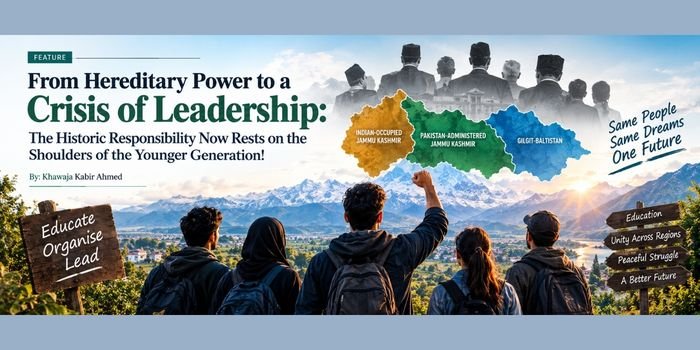
One of the bitter chapters in the history of the State of Jammu Kashmir is that the question of leadership has emerged in much the same form across every part of the state. Whether in Indian-occupied Jammu Kashmir, Pakistan-administered Jammu Kashmir or Gilgit-Baltistan, traditional political leadership has consistently failed to pay attention to the fundamental problems of the people. By persistently ignoring public needs, these leaders have remained preoccupied with the welfare of their own families and the perpetuation of political power through successive generations. This is not a coincidence but an entrenched political pattern that has subjected every region of the divided state to similar deprivation.
The division of the State of Jammu Kashmir may have divided its geography, but it has left its people united in their suffering, deprivation and powerlessness. Those living on either side of the Line of Control share a common history and culture, and, sadly, a common political misfortune as well. Just as a disease can spread through different rooms of the same house, the disease of failed leadership has taken root throughout every part of the state.
In Indian-occupied Jammu Kashmir, power has revolved around a handful of families for decades. One generation has succeeded another in inheriting the same political legacy. Rather than creating opportunities for young people to emerge in politics, political thrones have continued to pass from fathers to sons and daughters. With every election, the public has heard new promises, but the faces and families have largely remained the same.
The situation in Pakistan-administered Jammu Kashmir is no different. Here, too, a handful of families have dominated the legislative assembly and ministerial positions for generations, bringing their sons, daughters and relatives into politics. Political parties have changed, flags and slogans have changed, but the families occupying the corridors of power have remained largely unchanged. For anyone outside this established system, no matter how capable or sincere, the path to political advancement has remained almost entirely closed.
The situation in Gilgit-Baltistan is even more painful. To this day, the region has not been granted constitutional recognition or genuine self-governance. Local politics has remained subordinate to external political parties and influential families. Decisions have continued to be made elsewhere, while local representatives have been reduced to safeguarding those decisions. Those who should have been raising their voices for the rights of their people have instead remained preoccupied with protecting their positions.
One feature has been common to the traditional leadership across all three regions: the problems of ordinary people have never been a genuine priority. Employment, education, healthcare, basic amenities, civil liberties and political rights have remained little more than talking points in political speeches. Their overriding concern has been to ensure that power stays within their own families. To achieve this, they have systematically prepared their next generations, groomed successors and provided them with political training, resources and connections. Today, the same faces and their heirs continue to dominate the political landscape.
When the purpose of leadership becomes the survival of one’s own family, the problems of the public inevitably fall by the wayside. Ordinary citizens have remained entangled in the difficulties of everyday life, while those claiming to represent them have been busy manoeuvring for political power. The result has been a growing distance between the people and their leaders, a steady erosion of trust and an increasing sense of disillusionment with politics.
This disillusionment is dangerous in itself. When people begin to believe that their voices have no influence and that the system exists for the benefit of a privileged few rather than the wider population, society begins to drift towards apathy and disorder. For decades, the people of the State of Jammu Kashmir have endured this condition.
On the other hand, there have been forces that advocated the restoration of the state’s unity, complete independence, self-determination and prosperity. They embraced an ideal rather than personal gain. The sacrifices of leaders such as Maqbool Bhat have become part of history, while countless activists who genuinely cared for the state endured imprisonment, exile and hardship. Their sincerity and sacrifices cannot be called into question.
Yet the bitter truth is that none of these leaders succeeded in developing a successor who could carry their mission forward in a sustained and organised manner. The movement continued to revolve around individual personalities, and whenever a prominent figure disappeared from the scene, a vacuum emerged. The ideology survived, but no sufficiently organised structure was established to take it forward. The training of the younger generation, organisational continuity and the development of collective leadership failed to become firmly established priorities. Instead, much of the movement became caught in a cycle of division after division.
Thus, a peculiar tragedy unfolded. Those who genuinely cared for the state failed to ensure the continuity of leadership. Meanwhile, those who successfully transferred leadership and prepared their descendants for political power often lacked a genuine concern for the people. On one side, there was continuity without sincerity; on the other, sincerity without continuity. This contrast represents one of the greatest tragedies of our political history, leaving generations of people without clear direction.
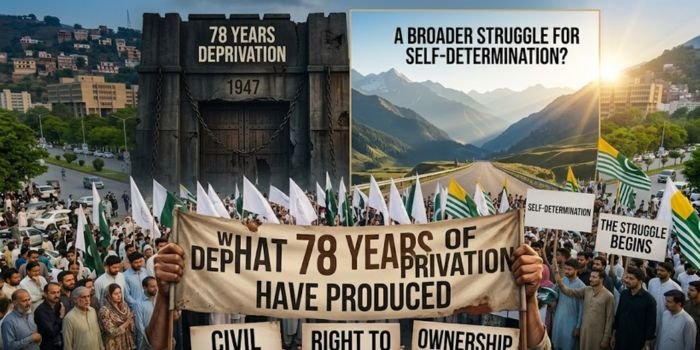
Against this background, the peaceful public rights movement in Pakistan-administered Jammu Kashmir represents a new chapter. This movement is not the product of any family, traditional political party or dominant personality. It has emerged from the people’s own problems and growing political consciousness. Its foundation lies in the basic rights from which the people have been deprived for years.
The Awami Action Committee did not consciously set out with a formal plan to groom successors. Nevertheless, it has awakened such an awareness of rights among the people that leadership is now emerging organically. This may appear to be a simple development, but its significance is profound. Traditionally, leadership was cultivated by selecting a handful of individuals, training them and imposing them from above. In this movement, leadership is rising from the grassroots upwards, emerging from among the people through participation in the struggle alongside them.
Young people and students, who until recently were largely spectators, are now preparing themselves to assume leadership roles. Through protest, dialogue and organisation, they are learning how collective struggle works, how to present a case for their rights and how to earn public trust. This leadership is emerging not from hereditary privilege or patronage but from popular struggle and collective political consciousness. That is its greatest strength.
In this way, the movement is beginning to fill a vacuum that traditional political leadership never attempted to address and that the pro-independence leadership was unable to fill. It offers a response to the weaknesses of both traditions: it combines a genuine concern for the people with the possibility of leadership continuity.
One of the movement’s most significant characteristics is its peaceful nature. In a region where violence and uncertainty have deeply affected people’s lives, demanding public rights peacefully and within the constitutional framework is a sign of considerable political maturity. It gives the movement moral strength and strengthens its case before the international community. Peaceful struggle also makes it possible for more people to participate, including women, older people and young people. Such broad participation provides fertile ground for new leadership to emerge.
If the people across all parts of the state recognise that their problems cannot be solved by relying on a single family or personality, but through collective consciousness and collective leadership, this movement could establish a new political tradition that transcends regional and territorial divisions. To achieve this, the movement must strengthen democratic practices within its own ranks, ensure transparency in decision-making and keep its doors open to emerging leaders.
Most importantly, the movement must not repeat the mistakes of the past. Instead of depending on individual personalities, it must build an institutional structure capable of surviving even when a particular individual leaves the scene. Transferring leadership to future generations is not merely a slogan; it is a condition for survival.
At the same time, communication and solidarity among the different parts of the state must be strengthened. When people in Indian-occupied Jammu Kashmir, Pakistan-administered Jammu Kashmir and Gilgit-Baltistan begin to regard one another’s problems as their own, the walls of division will weaken and a shared political consciousness will begin to emerge.
The people of the State of Jammu Kashmir have endured much. They placed their hopes in the loyalty and commitment of their leaders but were met with indifference. They witnessed the sacrifices of ideological leaders, only to encounter a vacuum after those leaders were gone. Now, for the first time, a movement has emerged in which ordinary people are becoming the architects of their own future.
The lesson of history is clear: leadership that emerges from among the people is the leadership most likely to endure. If this consciousness survives and the younger generation assumes its responsibility with seriousness, the day may not be far off when leadership across every part of the state rests on public trust rather than hereditary political thrones.
Above all, this responsibility rests on the young people of the state, who are its rightful stakeholders, its inheritors and its guardians.
The younger generation lies at the heart of this entire debate about the future. It is therefore essential to address young people directly and draw their attention to the responsibility that history has placed upon their shoulders.
Young people must fully recognise that you are the future of this state. You must step forward, educate yourselves and take leadership into your own hands. Leadership is not a gift passed down through family inheritance or bestowed through someone else’s patronage. It is earned through knowledge, awareness, character and struggle. Traditional leaders prepared their children for political power; you must prepare yourselves to serve the people.
Young people, you are the rightful stakeholders, inheritors and guardians of this land. Its territory, resources, history and future are a trust placed in your hands, and you are the ones who can truly safeguard them. Among the generations that came before you, some paid the price through sacrifice, while others exploited the state for personal gain. Now it is your turn to decide which path you will follow.
To fulfil this responsibility, you must make education and reading your weapons. Study your history and understand your rights for yourselves. Learn the skills of collective struggle and organisation. Develop the ability to tolerate differences of opinion and resolve problems through dialogue. Above all, place the collective cause ahead of personal fame and individual interests.
The day the young inheritors of the state realise that their future lies not in someone else’s hands but in their own will be the day the crisis of leadership begins to come to an end.
About Author

-
Khawaja Kabir Ahmed is a British/Belgian Kashmiri journalist who has been associated with the field of journalism since his educational days.
He holds a degree in journalism from the UK, is the Director News/Director Public Affairs and Anchorperson of the web TV channel Jammu Kashmir TV.
He writes on various topics in print journalism, focuses on the state of Jammu and Kashmir and is a promoter of fundamental human rights.
Latest News!
 Opinion10/21/2026From Hereditary Power to a Crisis of Leadership: The Historic Responsibility Now Rests on the Shoulders of the Younger Generation!
 Opinion10/15/2026Can Any Uniform Grant a Licence to Kill? Can It Erase the Stain of Blood?
 Opinion09/21/2026Yasin Malik’s Case: A New Legal Turn and a Question for the Global Conscience
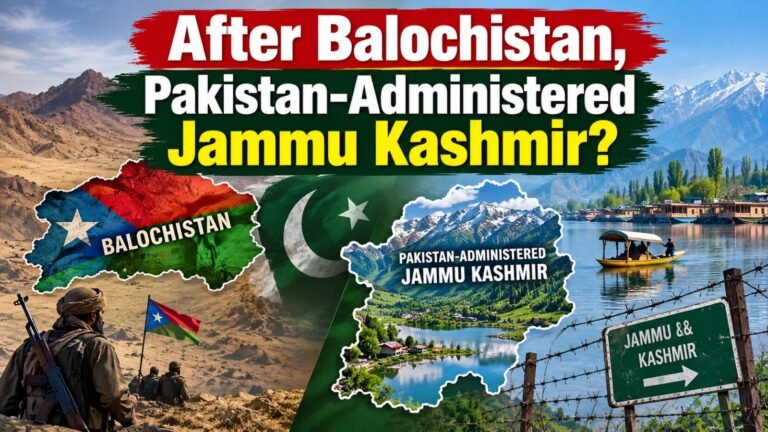
 Opinion09/15/2026After Balochistan, Pakistan-Administered Jammu Kashmir?