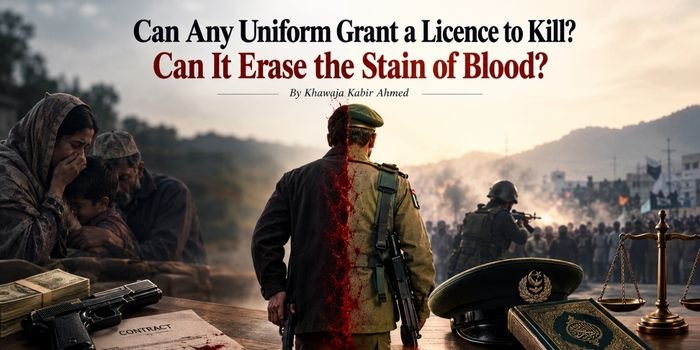
Can Any Uniform Grant a Licence to Kill? Can It Erase the Stain of Blood?
Perhaps the greatest tragedy in human history is not simply that human beings kill one another, but that they find different names for killing to make it appear acceptable. Depending on the circumstances, it may be called a crime, an act of war, the execution of an order, the fulfilment of a duty, or even a means of earning a living.
Consider a contract killer. Someone hires him to kill another person, agrees to pay a sum of money, and provides the means to carry out the murder. The killer takes a life, collects his payment, and walks away. The victim’s family, however, must live with the loss forever.
Now consider a different situation. A person joins government service, receives a salary and a uniform, undergoes weapons training, and is eventually ordered to confront a gathering of protesters demanding their fundamental rights. If that person opens fire on unarmed civilians and someone is killed, a fundamental moral question arises: what difference does it make to the victim whether the person who pulled the trigger was paid a lump sum or received a monthly salary?
The method of payment does not change the value of the life taken. Money cannot bring back a person killed by a contract killer, just as a government salary cannot restore the life of someone killed by a person in uniform.
One person says, “Pay me, and I will kill him.” Another says, “Give me the order, and I will carry it out.” If both actions result in the unlawful killing of an innocent person, neither payment nor obedience automatically makes the act morally or legally defensible.
To the victim, a bullet fired by a person in civilian clothes is no different from one fired by someone in uniform. The wound is the same, the blood is the same, and the loss is irreversible. A mother loses her child, a wife loses her husband, and children may lose their father. The uniform does not lessen their grief.
In Pakistani-administered Jammu Kashmir, civilian deaths and the use of force during the public movement for people’s rights have raised serious questions. The Human Rights Commission of Pakistan’s fact-finding mission has called for independent and impartial investigations into reported deaths and injuries since June 2026, while also noting differing accounts concerning the use of force and the conduct of state and protester groups.
These circumstances demand evidence-based investigations, not assumptions or blanket accusations. The essential questions are straightforward: Who was killed? Why was force used? Who was responsible? Under whose orders was it used? And was that use of force lawful and necessary?
These are not questions directed against the military or any particular institution. They are questions in defence of human life and accountability. A uniform may signify public service and authority, but it cannot place anyone above the law. Equally, responsibility must be established through credible evidence rather than presumed solely from a person’s position or clothing.
A civilised state is not measured by the number of weapons it possesses or the extent of its authority. Its true strength lies in its ability to protect human life, respect fundamental rights, and ensure accountability when those rights are violated. Invoking the rule of law or the authority of the state cannot, by itself, settle the question of whether a particular act of violence was justified.
For Muslims who believe in the Holy Quran, the sanctity of human life carries an especially profound significance. The Quran states that killing one person unjustly is like killing all humanity, while saving one life is like saving all humanity . This teaching reminds us that every human being is more than an individual: each life is connected to a family, a community, a future, and countless hopes and relationships.
When a person is killed, the loss extends far beyond the body that falls. It transforms the lives of everyone who loved that person. No official order, institutional affiliation, or financial arrangement can erase that reality.
Justice, therefore, requires us to look beyond the clothing of the person who used force and examine the act itself. Was a life taken unlawfully? What evidence establishes responsibility? Were the orders lawful? And will those found responsible be held accountable?
History does not ask the victim whether the person who killed them wore civilian clothes or a uniform. The victim was alive, and now they are gone. That is the human reality no official explanation can undo.
Can any particular uniform grant a licence to kill? Can it erase the stain of blood?
No. No uniform makes an unlawful killing acceptable, and no position of authority should shield anyone from accountability. Before judging the clothing of the person who took a life, we must recognise the humanity of the person who lost it.
Blood does not recognise a uniform. And no uniform can erase the stain of blood.
About Author

-
Khawaja Kabir Ahmed is a British/Belgian Kashmiri journalist who has been associated with the field of journalism since his educational days.
He holds a degree in journalism from the UK, is the Director News/Director Public Affairs and Anchorperson of the web TV channel Jammu Kashmir TV.
He writes on various topics in print journalism, focuses on the state of Jammu and Kashmir and is a promoter of fundamental human rights.
Latest News!
 Opinion10/15/2026Can Any Uniform Grant a Licence to Kill? Can It Erase the Stain of Blood?
 Opinion09/21/2026Yasin Malik’s Case: A New Legal Turn and a Question for the Global Conscience
 Opinion09/15/2026After Balochistan, Pakistan-Administered Jammu Kashmir?
- Opinion09/14/2026Sanctions on Israel: A Major and Positive Step —But Why Not the Same for India and Pakistan?