Elections, Constitutional Crisis and the People’s Rights Movement in Pakistan-administered Jammu and Kashmir: An Extraordinary Political Test
The general elections in Pakistan-administered Jammu and Kashmir are taking place at a time when the region is facing two major challenges simultaneously. On the one hand, the five-year constitutional term of the Legislative Assembly is approaching its end, raising constitutional questions regarding the electoral process. On the other hand, the People’s Rights Movement, which has continued for the past three years, has significantly transformed the political landscape.
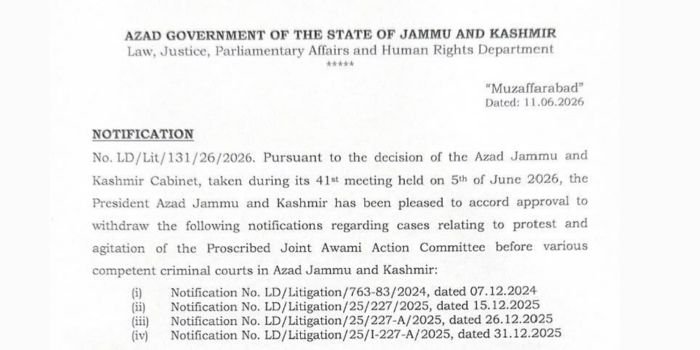
Led by the Jammu Kashmir Joint Awami Action Committee, the movement has challenged the existing system of governance on a wide range of issues, including electricity prices, flour subsidies, taxation, government expenditure, official privileges, administrative reforms and public authority. The loss of lives, arrests and large-scale demonstrations during the movement have highlighted the deep concerns held by a significant section of the population regarding the current system of governance. In such circumstances, the forthcoming elections are not merely a routine constitutional exercise but have become a major political, legal and democratic test.
Following the announcement by the Chief Election Commissioner that the elections for the Pakistan-administered Jammu and Kashmir Legislative Assembly will be conducted in three phases, the most important question is whether the current election schedule is consistent with constitutional requirements.
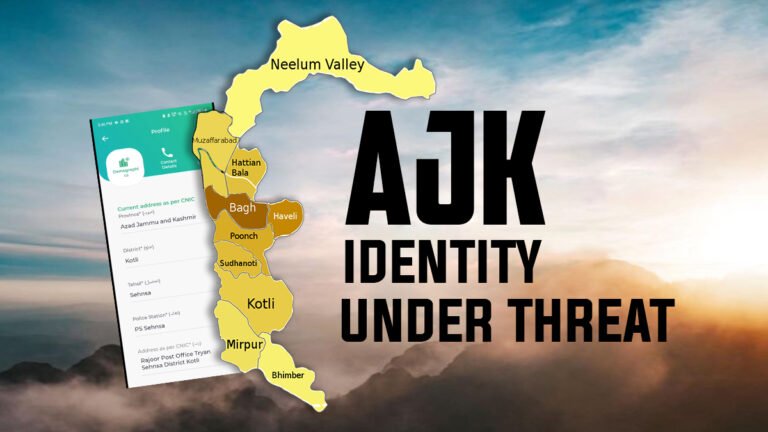
According to the announced schedule, polling will take place in Mirpur Division on 27 July, in Muzaffarabad Division and on the refugee seats on 2 August, and in Poonch Division on 10 August.
Article 22 of the Interim Constitution Act, 1974 provides that the Legislative Assembly shall continue for five years from the date of its first sitting and shall stand dissolved upon the completion of its constitutional term. The same constitutional provision also contains requirements relating to the conduct of elections and the timely declaration of results.
It is true that the Constitution does not explicitly require elections to be held on a single day. Many democratic countries conduct elections in phases for administrative and security reasons. Therefore, the mere fact that polling is scheduled in three phases cannot, by itself, be described as unconstitutional.
However, the constitutional complexity arises if the electoral process continues beyond the expiry of the Assembly’s constitutional term. If the current Assembly completes its term on 3 August while the final phase of polling is scheduled for 10 August, an important constitutional question emerges: what will be the constitutional position during this intervening period?
Can a new Assembly be constituted on the basis of results declared from only some constituencies? Can such an Assembly be regarded as complete when elections in several constituencies have yet to be held? Can the offices of the Prime Minister, the Speaker and matters relating to reserved seats be constitutionally determined before the completion of the entire electoral process?
These are fundamental constitutional questions that require clear legal clarification. A Legislative Assembly is not simply a collection of successful candidates; it derives its constitutional legitimacy from the representation of all constituencies, the allocation of reserved seats and the fulfilment of all constitutional requirements. If elections remain pending in a substantial part of the territory, representation of the people cannot be regarded as complete. For this reason, some constitutional experts argue that, alongside announcing phased elections, the authorities should also have clearly explained the arrangements for the interim period, the declaration of results and the constitutional procedure for constituting the new Assembly.
At the same time, the ongoing People’s Rights Movement has fundamentally influenced politics in Pakistan-administered Jammu and Kashmir. Over the past three years, the movement led by the Jammu Kashmir Joint Awami Action Committee has generated an extensive public debate on civil rights, governance, financial justice and the constitutional distribution of powers.
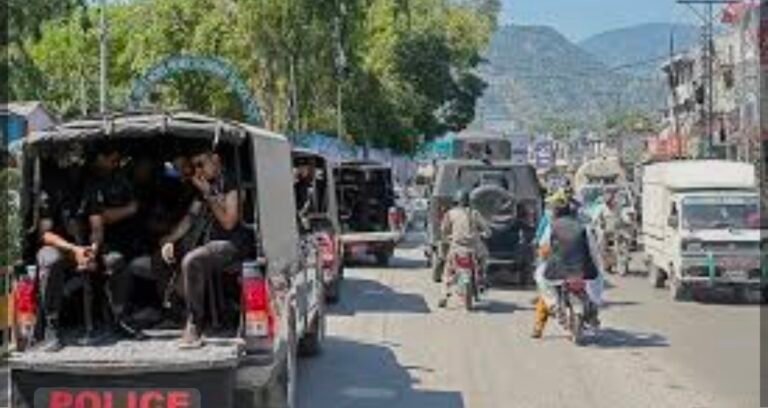
Throughout this period, large public gatherings, sit-ins, shutter-down strikes and protest activities have continued, and remain ongoing. The loss of lives during the movement has further intensified public sentiment. Under such circumstances, the elections raise an important question: can the electoral process alone resolve the prevailing political tensions, or is a broader political dialogue now essential? If hundreds of thousands of people remain mobilised around their demands, with the possibility of a long march towards Muzaffarabad being openly discussed, maintaining a normal electoral environment will undoubtedly present a major challenge.
Successful democratic elections require much more than polling stations, ballot papers and candidates. They also depend upon public confidence, peace, political freedom and the acceptance of the electoral process by the people.
The ongoing peaceful People’s Rights Movement has influenced the elections in several important ways. First, it has affected public confidence. A significant section of society believes that its fundamental concerns and sacrifices have not been adequately reflected within the political system and therefore feels increasingly detached from the electoral process.
Secondly, the political narrative has changed. In the past, elections in Pakistan-administered Jammu and Kashmir largely revolved around political parties, local factions and personalities. Today, however, issues such as public rights, constitutional authority, financial justice, equitable distribution of resources and official privileges have become central political themes. This transformation itself is one of the most significant outcomes of the three-year People’s Rights Movement.
Thirdly, the movement has altered the strategies of political parties. Traditional election promises are no longer sufficient. Voters now seek clear positions from political parties regarding public grievances and the demands emerging from the ongoing movement.
The present situation represents a significant test for the government, the Election Commission and all state institutions. In democratic societies, public protest is not viewed merely as a law-and-order issue but as an expression of public sentiment and concerns regarding governance.
If state institutions choose the path of political dialogue, constitutional clarity and confidence-building, these elections could become a positive step towards stability. However, if public concerns are ignored and the electoral process is reduced solely to a mechanism for transferring power, political instability is likely to continue even after the elections.
The current situation clearly demonstrates the need for a comprehensive review of the electoral and constitutional framework in Pakistan-administered Jammu and Kashmir. The election timetable should be fully aligned with constitutional timelines, a clear legal framework should be established for phased elections, the constitutional procedure for constituting the Assembly should be explicitly defined, and a permanent mechanism for political dialogue with the People’s Rights Movement should be established. Furthermore, the movement’s recognised demands should be implemented in practice to help restore public confidence in the governing institutions.
The present elections in Pakistan-administered Jammu and Kashmir are not simply about forming a new government; they represent a defining moment for the region’s political future. On one side are constitutional questions concerning how and within what timeframe the electoral process should be completed. On the other are public questions regarding the extent to which the people’s rights, sacrifices and demands will be reflected within the political system.
Democracy is not merely about casting votes; it is founded upon public confidence, constitutional transparency and accountable governance.
If these elections are conducted in accordance with constitutional requirements, transparency and public trust, they could contribute to reducing the present political crisis. However, if constitutional ambiguities and public concerns are overlooked, fundamental political questions will remain unresolved regardless of the election results.
The real challenge for Pakistan-administered Jammu and Kashmir is not simply the formation of a new Legislative Assembly, but the creation of a political system in which the people genuinely feel empowered and meaningfully represented.
About Author
-
Khawaja Kabir Ahmed is a British/Belgian Kashmiri journalist who has been associated with the field of journalism since his educational days.
He holds a degree in journalism from the UK, is the Director News/Director Public Affairs and Anchorperson of the web TV channel Jammu Kashmir TV.
He writes on various topics in print journalism, focuses on the state of Jammu and Kashmir and is a promoter of fundamental human rights.
Latest News!
 Opinion10/23/2026The People’s Rights Movement, Overseas Kashmiris and Visits by Political Figures: A Serious Wake-Up Call!
 Opinion10/21/2026From Hereditary Power to a Crisis of Leadership: The Historic Responsibility Now Rests on the Shoulders of the Younger Generation!
 Opinion10/15/2026Can Any Uniform Grant a Licence to Kill? Can It Erase the Stain of Blood?
 Opinion09/21/2026Yasin Malik’s Case: A New Legal Turn and a Question for the Global Conscience