A Mother’s Decision – A Journey Across a Century
From Kalgarh to Britain: The Story of a Forgotten Migration
By Shams Rehman
The history of Kashmiri migration to Britain is usually linked to the 1960s and to the upheavals caused by the construction of the Mangla Dam. Yet the reality is older, deeper and more complicated than this commonly accepted account suggests. Even today, many people assume that migration from Mirpur to Britain began in the 1960s. Historical evidence, however, does not fully support that view.
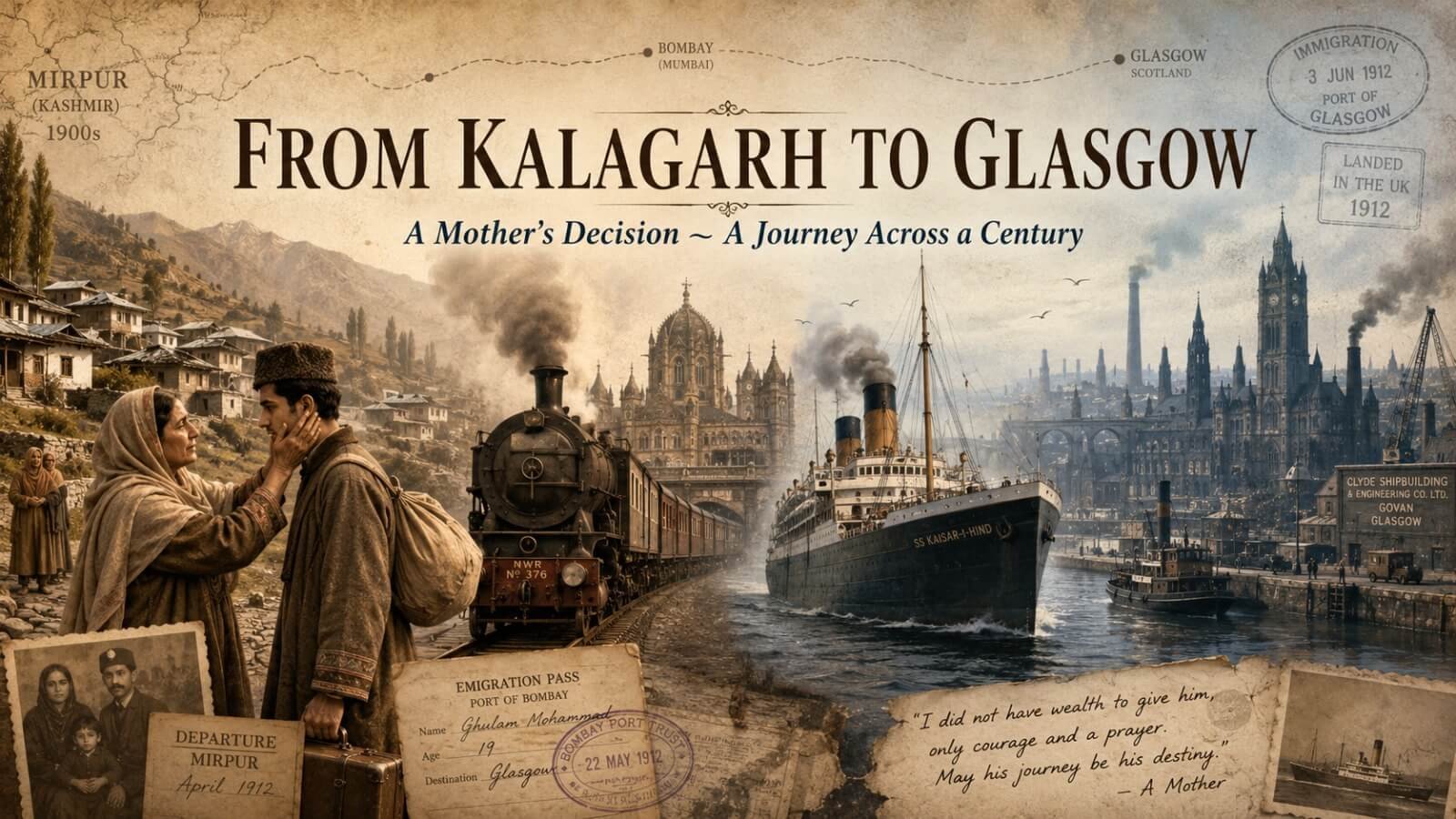
From the Dadyal area of Mirpur, some labourers had already made their way to Britain in the late nineteenth and early twentieth centuries. I first came across this through the research of Professor Roger Ballard at the University of Manchester. But one question remained with me: who was the first person from my own ancestral town of Kalagarh — later renamed Islamgarh — to reach Britain?
Last year, an answer came to me in the form of an oral tradition: Karam Din, known locally as “Karma”, who arrived in Britain in 1918, soon after the First World War.Plague, War and a Mother’s DecisionAfter the First World War, a deadly epidemic spread through different parts of the State of Jammu and Kashmir, including Mirpur, Poonch and Jammu.
Locally, people remembered it as plague, though modern research links it to the global influenza pandemic of 1918, often called the Spanish flu. According to some oral accounts, the disease was brought into the region by soldiers returning from the war.In that epidemic, four of Karam Din’s brothers died.
He was the only surviving son.Faced with the unbearable weight of loss and fear, his mother said to him:“Son, leave this place… perhaps that way you may survive.”That was the moment from which a migration began — not as part of any plan, not as a search for prosperity, but as an act of survival.
From Kalagarh to Bombay:
Searching for FateKaram Din walked to Jhelum. From there, he took the train to Bombay. Once there, he heard that work could be found on ships. Like many others, he stood waiting — somewhere between hope and despair.Then, suddenly, someone placed a hand on his shoulder.“You, come inside.” He was surprised, but he followed.
The man interviewing him looked carefully at his face and said:“You do not recognise me, but I have recognised you.”“Are you not the grandson of Azimullah?”“Yes,” Karam Din replied.“Your grandfather once did us a great kindness. Come to work from tomorrow.
I will tell you the whole story then.”A Forgotten Kindness That Opened a DoorThe next day, Karam Din began working on the ship, in the coal bunker, where the heat was intense and the labour punishing. After some time, the same man, Sarang, took him to the tea room and began to tell his story.“It was about twenty years ago,” he said. “My nephew’s wedding procession had gone to your village, Moora Barri.
There was a custom there that unless someone from the groom’s party lifted the heavy stones, there would be no nikah and no food.“We were poor people. None of us could lift the stones. We were about to be sent back hungry.
Then someone said, ‘Go to Maula.’ Everyone called your grandfather Azimullah by the name Maula.“We went to him. He immediately arranged food for us. Then he called his nephew, Fakir Muhammad. Fakir Muhammad said, ‘First tell me what the task is.’ When he heard that the task was to lift the heavy stones, he said, ‘I will lift the stones first, and eat afterwards.’“He lifted the stones.
The nikah took place. We were fed. And we returned with our honour intact.”Sarang looked at Karam Din and said:“When I saw you standing outside yesterday, I recognised you at once.
And I remembered the kindness of your grandfather.”That was the moment when an old act of generosity quietly wrote a new chapter of history.Ship, Illness and GlasgowWork on the ship was extremely hard: fierce heat, heavy coal and constant physical labour.
As the ship neared Glasgow, Karam Din began showing symptoms of the very disease he had fled — the illness people called plague or influenza. He had left home to escape death, only to be overtaken by its shadow at sea.
He was immediately taken off the ship and admitted to a hospital in Glasgow. After several months of treatment, he recovered and stayed there for some time.During this period, he started a small business and managed to save some money.
The Return Home: An Unbelievable Moment
Nearly a year later, he returned to his village at night.He knocked on the door.“Who is it?”“It is me… Karam Din.”A silence fell inside the house. His grandmother could not believe it. She fainted.The next day, the village was in celebration. Two hundred goats were cooked.A Journey That Became a ChainKaram Din did not return to Britain. But three of his sons — Mamoo Iqbal, Mamoo Azad and Mamoo Muazzam — later went to England.
The first to arrive was Mamoo Iqbal, who reached Britain in 1958.In this way, the journey of one man became, in the next generation, part of a continuing migration.A Forgotten BeginningThis story reminds us that the history of Mirpuri migration did not begin in the 1960s. Its roots go back several decades earlier, into stories that live less in official documents and more in memory, family recollection and oral tradition.
Closing NoteAfter writing this piece, I spoke one day with Professor Zafar Iqbal of Chak Haryam, now living in Oldham. He told me that his maternal grandfather had come to Britain a few years before the First World War.If further details of that journey become available, the next story will be about him.Otherwise, I will share the fascinating account told by Michael Munir of Chak Haryam, now living in Bradford, about Fazal Elahi, known locally as “Chalha”.
About Author

Latest News!
 News07/31/2026Kashmir Solidarity Gathering: Mushtaq Ahmad Khan Leads Peace Rally at Islamabad’s F-10 Markaz
 News07/29/2026Stand for Azad Kashmir: Islami Jamiat-e-Talaba Stages Massive Protest Outside Islamabad Press Club
 Blog07/23/2026The Indian Legend Regarding the Discovery of Tea: Myth & History
 News07/18/2026AJK Polls: Bilawal Slams ‘Collective Punishment’ of Kashmiris, Vows to Bridge Islamabad-Muzaffarabad Divide