The Mobilisation of Armed Groups Against a Peaceful Public Rights Movement and the Role of Pakistani Intelligence Agencies
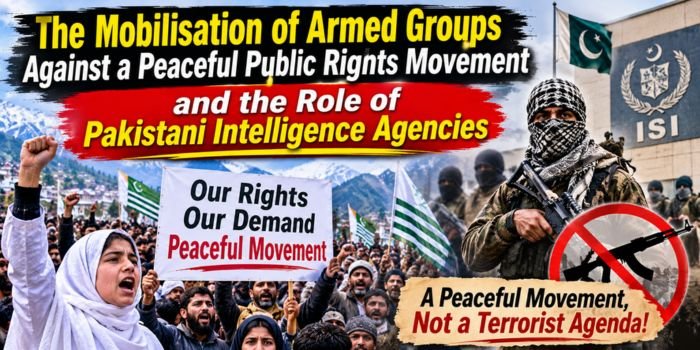
A disturbing series of developments is emerging in Pakistan-administered Jammu and Kashmir, involving attempts to associate the ongoing public rights movement with armed groups, discredit it, and create justification for possible aggression by Pakistani forces. The sequence of events, the sudden activities of armed actors, and their alleged links with state institutions raise serious questions that cannot simply be dismissed as coincidence.
A few days ago, at a conference held in Islamabad, the participation and address of Masood Ilyas, a leader of the proscribed organisation Jaish-e-Mohammed, raised several important questions. In his own speech, Masood Ilyas claimed that he had held meetings with Pakistani government and intelligence officials. He also acknowledged the presence of an armed Jaish-e-Mohammed network and a centre in Rawalakot. According to his statement, Pakistani intelligence officials had allegedly provided him with a list of individuals associated with the ongoing public movement in Rawalakot.
It is important to note that Jaish-e-Mohammed is neither an unknown nor a newly established organisation. The United States designated it as a terrorist organisation on 26 December 2001, while the United Nations listed it under its sanctions regime on 17 October 2001. Pakistan also banned the organisation in 2002. Despite this, a leader associated with the organisation addressing a political gathering in Islamabad and claiming to have met government and intelligence officials exposes a major contradiction between the state’s declared policy and its actual conduct.
Just a few days after this incident, a video message featuring Ghazi Shahzad alongside armed individuals emerged. His conduct over the past three and a half years, the Rawalakot jail break, the death of prisoner Khayyam, his transfer to Afghanistan, and his sudden re-emergence had already raised numerous questions. His latest video alongside armed individuals has made the situation even more serious.
These developments appear to be interconnected. The claims of a proscribed organisation’s leader regarding access to government and intelligence circles in Islamabad, his acknowledgment of an armed network belonging to that organisation in Rawalakot, and the subsequent sudden promotion of local armed figures all raise direct questions about the role of Pakistani intelligence agencies and the alleged patronage of proxy networks operating under their protection. They also point towards the role of Pakistani intelligence agencies in positioning these armed elements against the public rights movement and creating an environment of violence in the region.
This is not a new strategy. Pakistan has a history of creating armed groups for specific objectives, providing them with patronage, and deploying them when required. The admission by Rana Sanaullah Khan in the National Assembly that, “We had prepared them, but now they have turned against us,” is one example of this state policy. The consequences of this approach were previously witnessed in Indian-administered Jammu and Kashmir. Now, the people of Pakistan-administered Jammu and Kashmir are also being forced to face the consequences of such armed networks and their alleged state patronage.
The fundamental truth is that the Jammu Kashmir Joint Awami Action Committee has absolutely no connection with these armed groups, alleged militant organisations, intelligence networks or gun-wielding elements. This is an entirely peaceful movement for fundamental public rights. Its core demands include electricity, flour, education, healthcare, control over natural resources, political freedom and people’s sovereignty. The people of Kashmir have consistently opposed the infiltration of armed groups, proxy politics and attempts to influence their political struggle through the use of weapons.
The Jammu Kashmir Joint Awami Action Committee completely rejects Ghazi Shahzad and all similar armed actors. These elements are not representatives of the public rights movement; rather, they stand in direct contradiction to its fundamental political identity and peaceful struggle. They have no right to use the movement’s name, claim to represent it, or promote any armed narrative against it.
Pakistani intelligence agencies must understand that the people of Pakistan-administered Jammu and Kashmir have now become politically conscious and aware. They cannot be intimidated through armed groups, their movement cannot be held hostage by proxy actors, and their legitimate demands cannot be suppressed through an atmosphere of violence or aggression by Pakistani forces.
The people have risen to demand their fundamental rights, not to advance the agenda of any armed group. This movement belongs neither to Jaish-e-Mohammed, nor to Ghazi Shahzad, nor to any intelligence agency or its proxies. It is the people’s own movement, founded on political awareness, collective strength and peaceful struggle.
Every attempt to mobilise armed actors against this popular movement and manufacture justification for aggression by Pakistani forces must be exposed. Any use of armed force against peaceful civilians must be recognised for what it is: Aggression by Pakistani Forces, not an operation.
About Author
-
Khawaja Kabir Ahmed is a British/Belgian Kashmiri journalist who has been associated with the field of journalism since his educational days.
He holds a degree in journalism from the UK, is the Director News/Director Public Affairs and Anchorperson of the web TV channel Jammu Kashmir TV.
He writes on various topics in print journalism, focuses on the state of Jammu and Kashmir and is a promoter of fundamental human rights.
Latest News!
 Opinion11/28/2026The Mobilisation of Armed Groups Against a Peaceful Public Rights Movement and the Role of Pakistani Intelligence Agencies
 News11/26/2026Any Military Action in Pakistan-Administered Jammu and Kashmir Would Not Be an Operation — It Would Be Open Aggression and Genocide!
 Opinion11/25/20263 December: Shroud-Clad Protests from the Homeland to Global Capitals — A United Call for the Life, Peace, Dignity and Honour of the Kashmiri People
 Opinion11/23/2026What Is the State? The People, the Territory and Sovereignty — or a Powerful Institution?