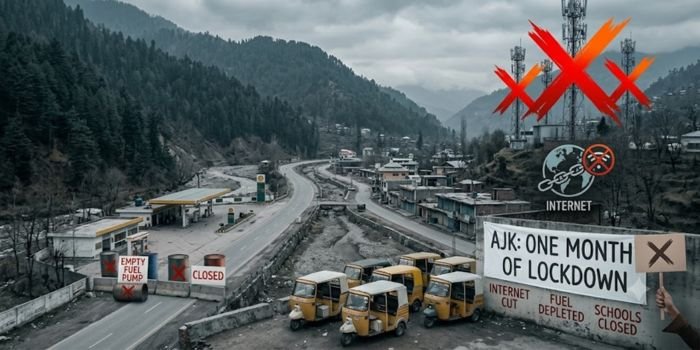
Sanctions on Israel: A Major and Positive Step —But Why Not the Same for India and Pakistan?
Whether Kashmir or Palestine, the people living there are human beings
By: Khawaja Kabir Ahmed
Palestine and Jammu and Kashmir are two longstanding internationally recognised disputes that have remained before global politics, the United Nations and international human rights institutions for decades. The Palestine question reached the United Nations General Assembly in 1947, while the Jammu and Kashmir dispute was taken up by the UN Security Council in 1948. Through Resolution 47, the Security Council called for the restoration of peace and provided for determining the wishes of the people through a plebiscite.
Today, against the backdrop of the destruction in Gaza and the grave human rights situation facing the Palestinian people, international pressure is increasing against Israeli settlements and entities associated with them. The United Kingdom announced restrictions on the import of goods originating from illegal Israeli settlements in the occupied territories, while the European Union imposed targeted sanctions on certain Israeli settlers and related organisations. This is an important and positive step because it demonstrates that practical measures can be taken against individuals and organisations responsible for serious human rights violations.
But history provides an even greater example, and that is South Africa. In response to the apartheid system, the international community did not limit itself to condemnation. It maintained political, diplomatic and economic pressure for years. In 1977, the UN Security Council imposed a mandatory arms embargo against the apartheid government of South Africa. Prior to that, international pressure had also increased in areas such as oil and other sectors. The measures taken against South Africa in the history of the United Nations remain a prominent example of how sanctions and practical pressure can be used when fundamental rights and human equality are systematically violated.
Similarly, in 1966, the UN Security Council imposed economic sanctions against Southern Rhodesia, which were subsequently expanded. Today, targeted sanctions are also being used against individuals and organisations responsible for violations in countries including Myanmar and Russia. In other words, the international community already possesses an established mechanism for imposing sanctions and applying practical pressure.
So the fundamental question is this: if sanctions are possible against Israel over human rights violations; if sanctions were possible against apartheid South Africa; if economic sanctions were possible against Southern Rhodesia; and if individuals and organisations in other countries can face targeted sanctions, why can the same principle not be applied in the case of India and Pakistan?
Should international human rights standards not be applied equally to every region? Can a large economy, geopolitical importance, defence partnerships or political interests be considered more important than human rights? And above all, are Kashmiris not human beings?
India is a major economy and an important strategic partner of several global powers, while Pakistan also holds significant geopolitical and strategic importance in the region. But the question remains: must the people of Kashmir always pay the price for international strategic interests?
If relations with powerful states can push human rights concerns into the background, then it is only natural to question the impartiality of the international human rights system.
There is, however, another fundamental distinction that must be recognised. In the case of Palestine, the issue involves occupation by a major power, whereas different parts of the State of Jammu and Kashmir are currently under the control of three nuclear-armed powers—India, Pakistan and China. This political and historical complexity is undeniable. But that complexity cannot be used as a justification for ignoring the fundamental human, political and democratic rights of the people of Jammu and Kashmir.
In this situation, Kashmiris living abroad must also change their strategy. Their struggle should no longer remain limited to demonstrations and protests. It should be transformed into organised political and legal pressure. Reliable documentation of human rights violations should be prepared, and sustained information should be provided to parliamentarians, human rights organisations, lawyers, journalists and policymakers. Concrete evidence should be presented in support of targeted sanctions against individuals and institutions responsible for serious violations.
The possible use of weapons, surveillance technology and other forms of assistance in ways that could contribute to human rights violations should also be subjected to proper scrutiny.
The Palestinian struggle has demonstrated to the world that international public opinion is not created overnight. Years of advocacy, documentation, journalism, legal efforts, political engagement and public pressure can eventually compel governments to reconsider their policies. The example of South Africa remains one of the clearest historical reminders that international pressure, sustained struggle and popular resistance can together bring about change even within seemingly powerful and entrenched systems.
Kashmiris support the Palestinian people’s demand for justice because injustice is condemnable wherever it occurs. But if human rights are genuinely universal principles, then those same principles must apply to the people of Jammu and Kashmir.
Whether Kashmir or Palestine, the people living there are human beings. Why, then, should the standard of justice be different?
The people of the State of Jammu and Kashmir have a simple question for the international powers:
If sanctions and international pressure are possible for Palestine; if they were possible for South Africa; if they were possible for Southern Rhodesia; and if targeted sanctions are possible against responsible individuals and organisations in other countries, why are they not possible for Jammu and Kashmir?
And if Palestine, why not Jammu and Kashmir?
About Author

-
Khawaja Kabir Ahmed is a British/Belgian Kashmiri journalist who has been associated with the field of journalism since his educational days.
He holds a degree in journalism from the UK, is the Director News/Director Public Affairs and Anchorperson of the web TV channel Jammu Kashmir TV.
He writes on various topics in print journalism, focuses on the state of Jammu and Kashmir and is a promoter of fundamental human rights.
Latest News!
 Opinion09/14/2026Sanctions on Israel: A Major and Positive Step —But Why Not the Same for India and Pakistan?
 Opinion08/20/2026Changing U.S. Policy on Jammu and Kashmir And the Kashmiri People Caught Between Two Nuclear Powers
 Opinion08/15/2026A Dangerous Game for Pakistan:If Jammu and Kashmir’s State Identity Is Attacked, How Far Will the Backlash Go?
 Opinion08/13/2026August 13:What 78 Years of Deprivation Have Produced