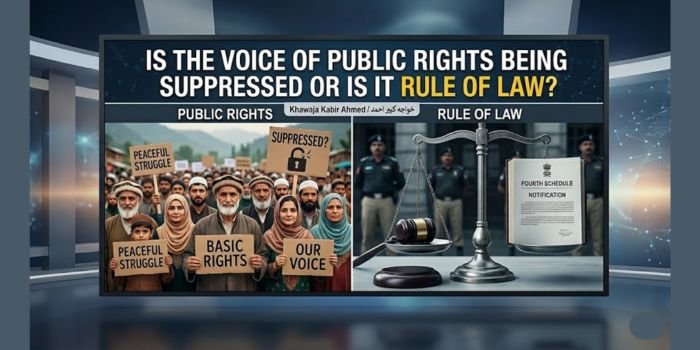
Is the Voice of Public Rights Being Suppressed or Is It Rule of Law?
Khawaja Kabir Ahmed
For more than three years, in Pakistan-administered Jammu and Kashmir, the Jammu Kashmir Joint Awami Action Committee has been running a movement for public rights, which its supporters describe as a completely peaceful, constitutional, and public struggle. During this movement, at various times, negotiations were also held with the Government of Pakistan and the Government of Azad Jammu and Kashmir, and the demands were also accepted in principle. This is why this movement is seen not only as a prominent and effective voice of public rights, but the people of Jammu Kashmir also see the Joint Awami Action Committee as their representative.
In such circumstances, declaring the Joint Awami Action Committee as banned, issuing various notifications against its workers, and including numerous individuals in the Fourth Schedule has created serious concern among the people of the state. A fundamental question being raised on this step is that when the declared objective of this movement was the struggle for public rights, the achievement of the right to ownership and right to governance, supremacy of the constitution, rule of law, and protection of public rights, then why is this movement facing strict legal measures?
In any democratic society, dissent, protest, and public demands are resolved through constitutional and political means rather than state power. If action is taken against any movement, it is necessary that there be a strong legal basis, transparent evidence, and full scope for judicial review. Otherwise, such measures can increase public distrust and political tension.
Supporters of the Joint Awami Action Committee maintain that this movement is not of any particular political party but is a representative movement of the basic economic and civic rights of ordinary citizens, which has organized the people beyond traditional politics. In their view, strict actions against this movement are equivalent to suppressing the public voice.
In this situation, the appropriate path is not further confrontation but a return to the Constitution, law, and negotiations. It should be noted that the government has accepted the Charter of Demands of the Joint Awami Action Committee at different stages; therefore, it should now be fully and honestly implemented so that public trust is restored and a sustainable solution to the problems can be found.
At this time, it is necessary that all notifications issued against the Joint Awami Action Committee be immediately withdrawn, actions related to declaring it banned and the Fourth Schedule be revoked, and all matters be resolved according to the already agreed agreement. The government should implement its accepted Charter of Demands without delay and adopt a meaningful path of negotiations to resolve differences.
Public rights, constitutional supremacy, and rule of law are not contradictions of each other but the foundation of a strong and peaceful society. Therefore, it is necessary that dissent is not seen as hostility but as part of the democratic process, and instead of suppressing the public voice, it should be heard.
Where there is a state, there is politics, and where there are people, there is government. This principle is a reminder that the real foundation of authority is public trust.
The people want implementation of those demands that have already been accepted in the agreements between the Government of Azad Jammu and Kashmir, the Government of Pakistan, and the Jammu Kashmir Joint Awami Action Committee. Therefore, it is necessary that these agreements be implemented seriously so that the trust deficit does not deepen further.
It is also a general public perception that strict administrative measures, restrictions, and arrests may not resolve problems but can make them more complicated. Therefore, it is necessary to move forward through dialogue instead of force.
The solution to the problems of peaceful political and public movements always lies in dialogue and constitutional paths. Therefore, supporters of the Awami Action Committee emphasize that they were peaceful, are peaceful, and will remain peaceful, and will continue their peaceful struggle for their legitimate and already accepted demands.
About Author

-
Khawaja Kabir Ahmed is a British/Belgian Kashmiri journalist who has been associated with the field of journalism since his educational days.
He holds a degree in journalism from the UK, is the Director News/Director Public Affairs and Anchorperson of the web TV channel Jammu Kashmir TV.
He writes on various topics in print journalism, focuses on the state of Jammu and Kashmir and is a promoter of fundamental human rights.
Latest News!
 Opinion09/21/2026Yasin Malik’s Case: A New Legal Turn and a Question for the Global Conscience
 Opinion09/15/2026After Balochistan, Pakistan-Administered Jammu Kashmir?
- Opinion09/14/2026Sanctions on Israel: A Major and Positive Step —But Why Not the Same for India and Pakistan?
 Opinion08/20/2026Changing U.S. Policy on Jammu and Kashmir And the Kashmiri People Caught Between Two Nuclear Powers