The 12 Refugee Seats in AJK: Identity, Representation, and a Growing Constitutional Debate
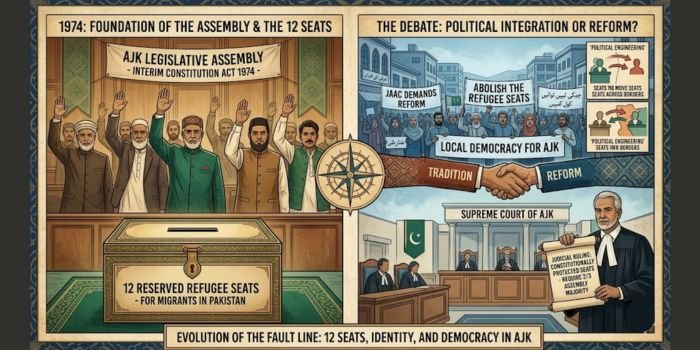
Azad Jammu and Kashmir (AJK) is currently witnessing an intense constitutional and political debate over one of its most distinctive electoral arrangements: the 12 legislative assembly seats reserved for Jammu and Kashmir refugees residing in Pakistan.
What was originally established to ensure the political inclusion of displaced Kashmiris has, over time, become a highly contested issue. Today, these seats lie at the center of discussions about democratic representation, political influence, and the future direction of AJK’s governance.
Historical Background: Why Were the Refugee Seats Created?
The roots of the refugee seats can be traced back to the events of 1947, when the partition of the subcontinent led to the displacement of large numbers of Kashmiris who migrated to different parts of Pakistan. As these communities remained emotionally and politically connected to their homeland, a mechanism was developed to preserve their representation in AJK’s political system.
The first formal step came through the Azad Jammu and Kashmir Refugees Registration and Representation Act of 1960. Under this arrangement, registered refugees living across Pakistan were granted the right to elect 12 representatives to the Azad Jammu and Kashmir State Council.
This system gained constitutional protection in 1974, when the AJK Interim Constitution Act introduced a modern parliamentary framework and established the Legislative Assembly. The refugee seats were incorporated into the new constitutional structure, ensuring that displaced Kashmiris continued to have a voice in AJK’s political affairs.
How the System Works
The AJK Legislative Assembly consists of 53 seats, including 45 general seats elected from within Azad Kashmir and 12 seats reserved for refugees living in Pakistan.
Unlike other constituencies, these refugee seats are not elected by residents of AJK. Instead, they are chosen by registered refugees from Jammu and Kashmir and their descendants who live in different regions of Pakistan.
The 12 seats are divided into two categories:
- Six seats for refugees originating from Jammu and surrounding areas, many of whom are concentrated in Punjab cities such as Sialkot, Lahore, and Gujranwala.
- Six seats for refugees from the Kashmir Valley, whose populations are spread across cities including Islamabad, Rawalpindi, and Karachi.
During AJK elections, polling stations are established across Pakistan, allowing eligible refugee voters to cast their ballots for these constituencies.
The Controversy: Two Opposing Viewpoints
The debate surrounding the refugee seats reflects a broader disagreement about representation and political authority in AJK.
Calls for Reform or Abolition
Critics argue that the current system has become a tool for political manipulation. Since the refugee constituencies are located outside AJK, major Pakistani political parties often play a significant role in determining their outcomes.
Opponents claim that a party may fail to secure strong support among voters inside Azad Kashmir but still gain enough refugee seats to influence government formation. In their view, this weakens the democratic voice of people living within AJK and allows external political forces to shape local governance.
Many activists and regional rights groups believe that the arrangement no longer serves its original purpose and requires serious constitutional reform.
The Case for Retaining the Seats
Supporters of the system see the issue very differently. For them, the refugee seats represent more than just electoral constituencies—they symbolize the enduring connection between displaced Kashmiris and their homeland.
Those defending the arrangement argue that refugee families endured immense hardship during migration and should not be deprived of their political rights. They maintain that removing these seats would weaken the historical and political bond between these communities and AJK, while also undermining the broader narrative of the Kashmir dispute.
From this perspective, the refugee quota remains an important constitutional commitment that reflects both history and identity.
The Role of the Judiciary
As political tensions intensified and demands for reform grew louder, questions emerged about whether the government could alter or abolish the refugee seats through executive action.
The AJK Supreme Court addressed this issue in a significant advisory opinion. The court held that the 12 refugee seats are protected under Article 22 of the AJK Interim Constitution and cannot be removed or modified by the Prime Minister or the cabinet through administrative decisions.
According to the court, any change to the refugee quota must come through a formal constitutional amendment. Such an amendment would require the support of a two-thirds majority in the AJK Legislative Assembly. Until that process takes place, the refugee seats remain a constitutionally protected part of the region’s political system.
Conclusion
The debate over AJK’s 12 refugee seats is about far more than electoral numbers. It touches on questions of identity, historical justice, democratic representation, and political power. For some, the seats are a vital symbol of the rights and sacrifices of displaced Kashmiris. For others, they have become an obstacle to genuine democratic representation within Azad Kashmir.
As discussions continue, the issue remains one of the most sensitive and consequential constitutional questions facing AJK today. Any future change will require not only legal consensus but also a careful balance between historical obligations and contemporary democratic expectations.
About Author

Latest News!
 News07/31/2026Kashmir Solidarity Gathering: Mushtaq Ahmad Khan Leads Peace Rally at Islamabad’s F-10 Markaz
 News07/29/2026Stand for Azad Kashmir: Islami Jamiat-e-Talaba Stages Massive Protest Outside Islamabad Press Club
 Blog07/23/2026The Indian Legend Regarding the Discovery of Tea: Myth & History
 News07/18/2026AJK Polls: Bilawal Slams ‘Collective Punishment’ of Kashmiris, Vows to Bridge Islamabad-Muzaffarabad Divide