American Wars and Global Politics: A Continuous Tale of Military Interventions Over Two Centuries
Research and Written by: Khawaja Kabir Ahmed
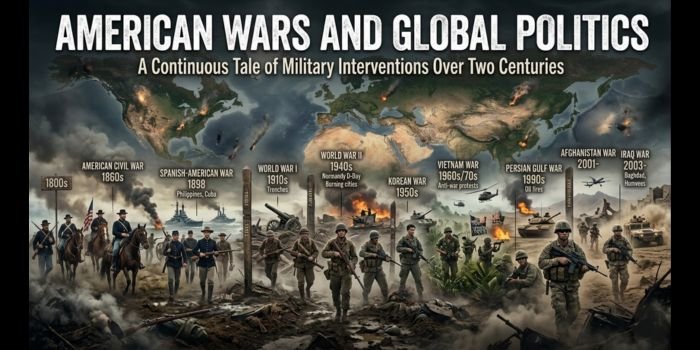
Throughout human history, power, interests, and war have always been interconnected. Over the past two centuries, the United States has played a unique role in global wars and politics, conducting military interventions across different regions of the world, which, according to the U.S., were aimed at its geopolitical, economic, and security interests. Founded at the end of the 18th century, the country initially fought wars to ensure its survival and protect its borders, but over time, its military presence began to be felt worldwide.
According to the U.S. Congressional Research Service, from 1798 to 2026, the United States conducted over 400 military interventions across nearly every region of the world. These include major wars, limited military actions, air and naval strikes, drone operations, and attempts to change governments. In every era, specific political and economic objectives drove these interventions.
During the American Revolution (1775–1783), the U.S. fought for independence from Britain and emerged as a new state on the world map. Even after independence, tensions with Britain continued, leading to the War of 1812. Although the war ended without a clear victor, it strengthened the American national identity.
In the 19th century, the U.S. adopted the ideology of Manifest Destiny to expand its territory. This led to the Mexican-American War (1846–1848), resulting in the annexation of California, Nevada, Utah, Arizona, and New Mexico. Casualties were approximately 40,000. The Spanish-American War (1898) shifted U.S. foreign policy and brought the Philippines, Guam, and Puerto Rico under American control. However, the Philippine independence movement led to a new conflict, the Philippine-American War (1899–1902), which claimed over 200,000 civilian lives.
By the early 20th century, the U.S. had become a global power. In World War I (1917–1918), America initially remained neutral but later joined the Allies, playing a key role in ending the war. World War II (1941–1945) began after Japan’s attack on Pearl Harbor, and in its final phase, the U.S. dropped atomic bombs on Hiroshima and Nagasaki, killing around 200,000 people.
After World War II, the world divided into two major military blocs: one led by the U.S. and its allies, and the other by the Soviet Union and its supporters. During this period, U.S. military interventions increased rapidly. In the Korean War (1950–1953), the U.S. supported South Korea while North Korea was aided by China and the Soviet Union. Casualties were around 300,000. The Vietnam War (1955–1975) became one of the bloodiest conflicts of the Cold War. The U.S. supported South Vietnam against communist North Vietnam, resulting in approximately 2 million Vietnamese civilian deaths and 58,000 American soldiers killed.
During this period, several limited interventions also occurred, including Lebanon (1958), Cuba (1961), the Dominican Republic (1965), Cambodia and Laos (1970s), Grenada (1983), and Panama (1989), where President Manuel Noriega was removed from power.
In 1991, during the Gulf War, Iraq invaded Kuwait. The U.S. led a global coalition to expel Iraqi forces, resulting in over 100,000 casualties. In Somalia (1992–1994), humanitarian operations faced severe combat, and in the Balkans/Kosovo (1999), NATO conducted air strikes.
Following the September 11, 2001 attacks, the U.S. declared a global war on terror and invaded Afghanistan. This conflict lasted 20 years, causing thousands of civilian deaths and displacing millions. In 2003, the U.S. invaded Iraq, claiming the presence of weapons of mass destruction—a claim later proven false. This war caused over 200,000 deaths.
In the 21st century, U.S. military strategy saw the rise of drone warfare, with operations in Pakistan, Yemen, and Somalia. In 2011, military action was taken against Libya’s Gaddafi regime, and from 2014 onward, operations continued in Syria against ISIS.
On February 28, 2026, the U.S. and Israel conducted Operation Lion’s Roar, launching air and missile strikes on Iran. The stated goal was to limit Iran’s nuclear and ballistic missile programs and regional influence. Iran responded with missile and drone attacks, affecting the Strait of Hormuz and global trade. Preliminary reports indicate casualties of over 1,200 in Iran, 11 in Israel, and 8 in the U.S., though these numbers may change.
Historically, U.S. military interventions have resulted in millions of deaths and affected tens of millions. According to the U.S., the primary objectives of these wars included national security, maintaining regional power balance, controlling energy and trade routes, promoting democratic values, and combating terrorism. However, a critical global question remains: is military intervention the primary way to safeguard the interests of global powers?
This two-century-long history is not merely a list of wars but a continuous story of global power evolution and geopolitical strategy. The 2026 conflict with Iran added a new and sensitive chapter to this narrative.
Note: All data in this article are based on available research and reports from institutions such as:
Congressional Research Service – Instances of Use of United States Armed Forces Abroad
Brown University – Costs of War Project
SIPRI Military Conflict Database
Uppsala Conflict Data Program (UCDP)
Encyclopaedia Britannica – History of U.S. Military Interventions
Council on Foreign Relations – U.S. Military Interventions Timeline
About Author

Latest News!
 News10/18/2026Jammu Kashmir Liberation League Opposes Military Intervention in Political Dispute
 Opinion10/17/2026Pakistan’s $100 Billion Export Dream: The Missing Link Is Policy Delivery
 News07/31/2026Kashmir Solidarity Gathering: Mushtaq Ahmad Khan Leads Peace Rally at Islamabad’s F-10 Markaz
 News07/29/2026Stand for Azad Kashmir: Islami Jamiat-e-Talaba Stages Massive Protest Outside Islamabad Press Club