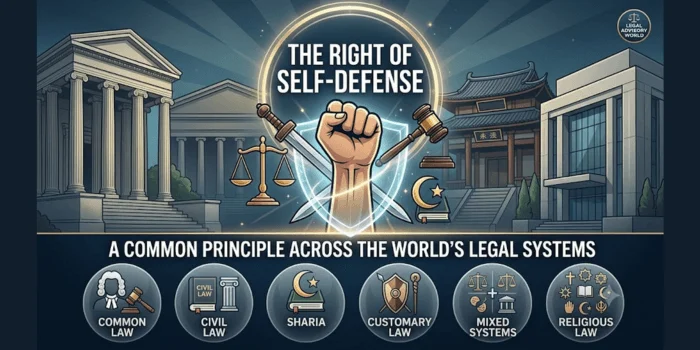
The Right of Self-Defense: A Common Principle Across the World’s Legal Systems
Research and written by: Khawaja Kabir Ahmed
Political, social, and legal systems vary widely across the world, yet there is one principle on which almost all civilizations and states agree: every individual has the right to protect their life, property, and dignity. This principle is commonly known as the Right of Self-Defense, and it is a fundamental and indispensable component of modern legal systems.
A look at Western legal frameworks shows that both constitutional and criminal laws in the United States clearly recognize this right. In many U.S. states, legal doctrines such as the Stand Your Ground law and the Castle Doctrine allow individuals to use force to defend themselves when they reasonably believe they face an imminent threat to their lives, particularly within their homes and, in certain circumstances, in public places. However, the exercise of this right is always subject to the principles of necessity and proportionality.
In the United Kingdom, the right of self-defense is firmly established under Common Law. The law provides that a person may use reasonable force if they honestly and reasonably believe they are facing an immediate threat. British courts carefully assess whether the force used was proportionate to the circumstances, applying the standard of what a reasonable person would have considered necessary rather than relying on emotions or hindsight.
Germany’s criminal law also provides strong protection for the right of self-defense. Under the German Criminal Code, an individual who is subjected to an unlawful attack may take whatever action is immediately necessary to repel that attack. Likewise, French law recognizes the principle of legitimate defense, while maintaining that the use of excessive force beyond what is necessary remains punishable under the law.
In Muslim-majority countries, including Pakistan and several other South Asian states, the same principle is also recognized. Under the Pakistan Penal Code, every individual has the legal right to defend their own life and property, or that of another person, when confronted with an immediate and unlawful threat. Here too, the fundamental legal requirement is that the defensive response must not exceed what is reasonably necessary.
From the perspective of international law and human rights, the broader legal framework also reflects this principle. The United Nations Charter and established international legal norms recognize that the primary responsibility for protecting individuals rests with the state. However, when such protection is not immediately available in the face of an imminent threat, individuals retain a limited right to defend themselves until the danger has passed.
An important distinction must be emphasized: no civilized legal system in the world treats self-defense as a license to kill. Rather, it is a qualified legal right accompanied by clear responsibilities. The most important of these is the principle of proportionality, meaning that the defensive response must be no greater than what is reasonably required to neutralize the threat.
The conclusion is clear. Whether in the United States, the United Kingdom, Germany, France, or the countries of South Asia, legal systems consistently uphold one fundamental principle: every individual has the right to protect themselves. The differences lie not in the recognition of this right, but in the legal limits, procedures, and safeguards that each country has established in accordance with its own legal traditions and social context.
It can therefore be said that the right of self-defense is a universal legal principle rooted in both human nature and the rule of law. It reflects one of the most fundamental concepts of justice: the inherent right of every person to preserve life, protect dignity, and ensure their own survival within the boundaries established by law.
About Author

-
Khawaja Kabir Ahmed is a British/Belgian Kashmiri journalist who has been associated with the field of journalism since his educational days.
He holds a degree in journalism from the UK, is the Director News/Director Public Affairs and Anchorperson of the web TV channel Jammu Kashmir TV.
He writes on various topics in print journalism, focuses on the state of Jammu and Kashmir and is a promoter of fundamental human rights.
Latest News!
 Opinion09/21/2026Yasin Malik’s Case: A New Legal Turn and a Question for the Global Conscience
 Opinion09/15/2026After Balochistan, Pakistan-Administered Jammu Kashmir?
- Opinion09/14/2026Sanctions on Israel: A Major and Positive Step —But Why Not the Same for India and Pakistan?
 Opinion08/20/2026Changing U.S. Policy on Jammu and Kashmir And the Kashmiri People Caught Between Two Nuclear Powers