How Pakistan’s ‘Open Merit’ Policy Is Erasing Kashmiri Identity
Written By Waheeda Jammu Kashmiri
Introduction
From a Kashmiri perspective, it has become impossible to ignore what is unfolding under Pakistani administration in Jammu and Kashmir (AJK). We are not citizens of Pakistan — even Pakistan’s own constitution recognizes this. Yet, each year brings new measures that pull our homeland closer to quiet assimilation.
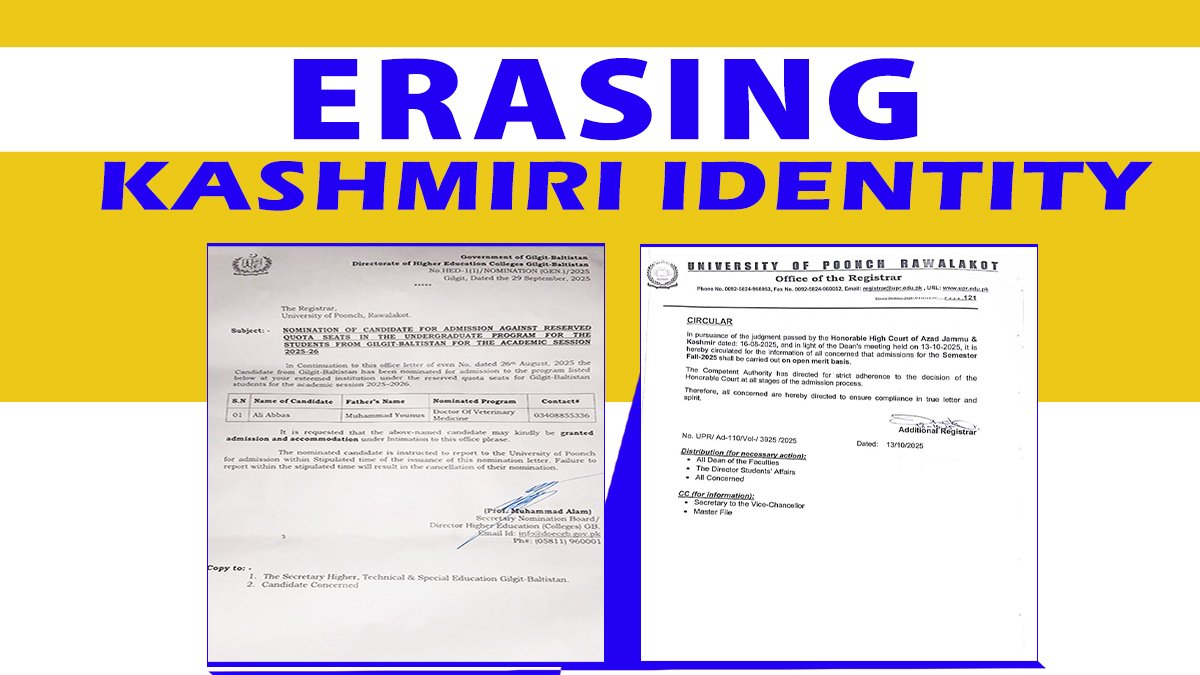
What once began as “administrative alignment” has evolved into something far more deliberate. From the printing of “Province of Pakistan” on official bank cheques to the establishment of Punjab Police check posts within AJK territory, Pakistan is tightening its grip through bureaucratic and institutional control. The most recent and damaging step comes from the education sector, where the University of Poonch has implemented an “All Pakistan Open Merit” admissions policy — sidelining Kashmiri students from their own universities.
The Court Decision That Sparked the Controversy
In August 2025, the High Court of Pakistani-administered Jammu and Kashmir issued a landmark ruling abolishing all quota systems in public-sector jobs and educational institutions. Justice Sardar Ejaz Khan, in his judgment dated 16 August 2025, declared that recruitment and admissions must be based on “open merit,” citing the Interim Constitution of AJK (1974) as the basis for equality among “state subjects.”
However, this ruling left a crucial ambiguity unresolved: Did “open merit” apply only to state subjects of Jammu and Kashmir — or to all citizens of Pakistan?
This lack of clarity opened the door for sweeping changes. The University of Poonch, taking advantage of the vague language, issued a circular allowing admissions from across Pakistan. The result? Local and Gilgit-Baltistan students were effectively displaced from their rightful seats in their own educational institutions.
Impact on Kashmiri and Gilgit-Baltistan Students
The consequences of this decision were immediate and severe. For decades, students from Gilgit-Baltistan (GB) had reserved seats in AJK universities under official nomination schemes. This year, however, they were turned away despite carrying verified nomination letters.
Previously Reserved Seats for GB Students:
- University of Poonch – 96 seats
- MUST (Mirpur University of Science & Technology) – 96 seats
- University of Kashmir, Muzaffarabad – 140 seats
- University of Kotli – 216 seats
- University of Bhimber – 6 seats
In total, 540 seats were allocated annually for GB students. Yet in 2025, they were denied admission under the new “All Pakistan Open Merit” policy.
Many had traveled hundreds of miles, spending family savings on travel and accommodation, only to be told their admission no longer qualified. Meanwhile, students from Lahore, Karachi, and Islamabad successfully enrolled — filling seats once meant for Kashmiri and GB students.
This marks a turning point: a silent educational annexation, executed through a legal technicality.
Legal Ambiguity or Political Design?
On paper, the “open merit” decision appears to promote equality. But in practice, it blurs the political and legal distinctions between AJK and Pakistan.
By failing to specify that merit should apply only among state subjects, the court’s ruling effectively opens AJK universities to all Pakistani nationals — eroding the last institutional safeguard protecting the unique identity and rights of Kashmiris.
Even if “open merit” were limited to AJK state subjects, students from Gilgit-Baltistan would still be excluded, since the State Subject Rule was abolished in GB decades ago. This creates a legal vacuum that undermines both regions’ autonomy.
The result is not accidental confusion; it is part of a broader pattern of administrative absorption — a gradual integration into Pakistan’s federal systems, in defiance of the region’s special political status and international commitments on the Kashmir dispute.
A Pattern of Systematic Integration
The education policy shift is not an isolated development. It follows a series of administrative moves designed to align AJK with Pakistan’s federal framework:
- The establishment of Punjab Police check posts inside AJK.
- The absorption of postal and telecommunication services under federal ministries.
- The labeling of AJK institutions as “provincial” in official documentation.
Each step, though small in isolation, collectively forms a pattern of systematic integration — a silent annexation without formal declaration.
This method avoids the international scrutiny that would follow open occupation. Instead, it proceeds quietly, through bureaucratic circulars, legal reinterpretations, and institutional reforms that make AJK and GB indistinguishable from Pakistan’s provinces.
Why This Matters: Identity and Autonomy at Risk
This is not merely a question of educational access. It is a matter of identity, self-determination, and legal status.
The erosion of the State Subject Rule — the historical principle distinguishing Kashmiris from other populations — is equivalent to erasing the foundation of AJK’s semi-autonomous character.
If these policies continue, the next generation of Kashmiris may find themselves citizens of a country that never legally recognized them, and students in universities that no longer prioritize their rights in their own homeland.
About Author

-
I am a Computer Science student originally from Mirpur, in Pakistan-administered Kashmir, and currently based in London. Alongside my academic pursuits, I am deeply committed to writing, with a particular focus on local and political issues affecting my homeland. As a contributor to KiNewsHD, I strive to amplify underrepresented perspectives and foster greater awareness through thoughtful, informed commentary.
I am a co-founder of JFJK and previously served as President of its UK zone, where I advocated for the rights and voices of the Kashmiri people, including the aspiration for an independent Jammu and Kashmir. In addition to my advocacy work, I am the founder of K2 Creative Agency, reflecting my interest in creative expression and digital engagement.
As a feminist, I am guided by a strong belief in equality and social justice. I use my platform to engage with issues that matter, drawing inspiration from Shaheed Maqbool Butt, whose legacy continues to shape my perspectives and commitment to activism.
Latest News!
 News06/24/2026The Blood of Our Martyrs Cries Out: Pakistan’s Brutal Crackdown on JAAC Protests in Azad Kashmir
 News05/29/2026AJK Identity Under Threat
 News05/22/2026Hamza Burhan Killed in Muzaffarabad: Kashmiris Trapped Between Indian Propaganda and Pakistani Hypocrisy
 Blog05/20/2026Troop Withdrawal in Jammu and Kashmir: Debate and Justification